

It's not something most people in my position would openly admit, but I'm going to say it anyway. The business model that has propelled my career to success is no longer viable. It's not a struggle or a temporary setback, it's simply over.
Over the past fifteen years, I've built jeffbullas.com into a platform that attracted a whopping 33 million readers from 190 countries. And I did it by recognizing something ahead of the curve - the internet rewards those who consistently provide valuable, clear, and educational content. Show up, teach, build trust, and let the audience grow.
It was a strategy that worked incredibly well. But then came generative AI. This isn't just another feature or trend, it's a complete dismantling of the very foundation my model was built on.
I witnessed it happening, and I couldn't deny that it was happening to me as well. I was faced with a choice - either ignore it and hope for the best, or confront it head on and figure out what comes next. And that's exactly what I'm doing with this article, speaking my truth.
The internet used to operate under a simple economic principle - information was scarce, but attention was abundant. If you could consistently produce useful and well-structured content on topics people were searching for, you could capture their attention. And with attention came traffic, email subscribers, speaking invitations, consulting clients, and product sales.
The game was clear - be the most helpful person in your niche, and be there consistently. But this all worked because information had its limitations. Research took time, writing took effort, and not everyone was willing to put in the work night after night, year after year.
But then suddenly, all that friction disappeared. Now, a single ChatGPT prompt can generate a 2,000-word article on "10 Social Media Strategies for 2025" in just 30 seconds. AI-powered publishing platforms are churning out thousands of articles per day.
Google's AI Overviews provide direct answers to users' questions on the search results page without them needing to click on anything. And AI newsletters flood inboxes with synthetic expertise, complete with a confident tone and zero personal experience. The supply of "good enough" information has become infinite, and the cost has dropped to zero.
And when that happens, the market quickly and permanently recalibrates the value of that commodity. As a result, traditional bloggers, SEO-optimized educators, and generalist content creators who simply explain and summarize have all collapsed alongside this shift. I know because I felt the impact on my own traffic.
My carefully researched and SEO-optimized articles were being scraped, synthesized, and surfaced in AI overviews that answered the question without sending a single visitor back to my site. Faceless AI content farms were outpublishing me by a thousand to one. This isn't a problem that can be solved with more optimization.
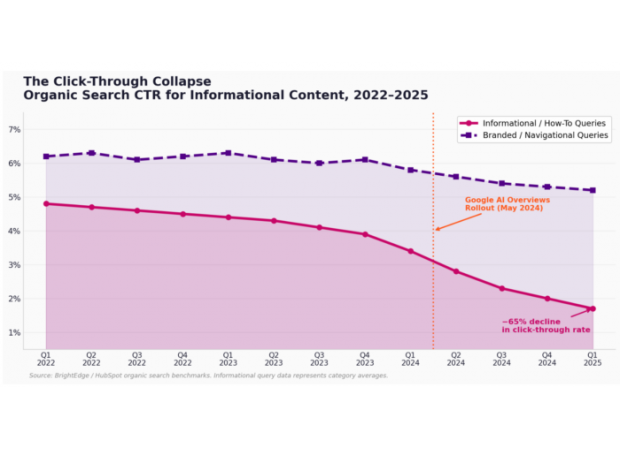
This is a structural shift in the market, and it's here to stay. The numbers speak for themselves - organic search traffic to editorial and informational content dropped an average of 18-64% across major content categories after Google's AI Overview rollout in 2024, depending on the type of query. And the volume of AI-generated content on the web has skyrocketed by over 1,000% since 2022.
There are now more articles published per day than any human could ever read in a lifetime. The signal-to-noise ratio has flipped, and the internet is drowning in synthetic expertise. But here's the critical point that most people overlook - the demand for human-guided transformation has not decreased.
Coaching is now a $20 billion global industry, and it actually grew during the pandemic. Personal development is a $44 billion market, and various forms of coaching are expanding. People are not less confused about what to do with their lives, in fact, they're more confused.
The rapid advancement of AI has made the question of identity more urgent, not less. The market still values guidance, but it no longer values generic information. This isn't a crisis for everyone, but it is a crisis for those who built their business on being the most accessible source of information.
For those willing to offer something different, this shift presents an opportunity. But here's where most people in my position get it wrong - they try to compete with AI-generated content by producing even more content, at an even faster pace. They add AI tools to their workflow and call it transformation.
They optimize and post and publish relentlessly. But they're essentially running on a burning platform. You simply cannot out-publish a machine that never sleeps, never bills by the hour, and never runs out of ideas.
You can't out-SEO a system that is constantly rewriting the rules of search. And you certainly can't compete on information volume when the cost of that volume is now zero. So what's the only viable move?
It's to stop competing on information altogether. It's to focus on the one thing that AI can never replicate - the unique wisdom and insights that come from lived experiences. The scar-tissue-earned knowledge of a human being who has actually gone through something, risked something, and failed publicly, only to rebuild from the ground up.
This is not about content, it's about testimony. Not education, but transformation. Not information, but identity.
The market has already started to shift in this direction, rewarding those who don't just explain, but who illuminate something true about the human experience in a way that makes the reader feel less alone and more capable. It's a different craft, a harder one, and it's one that AI can never automate. It took me a while to come to terms with this truth.
I had to admit to myself that for all these years, I had been teaching people how to grow followers, write catchy headlines, plan content calendars, and optimize for search - all of which can now be done with a simple AI subscription. I had built a career on being helpful, but now that's been automated. So I had to ask myself a scary question - what do I know that cannot be Googled?
And that's what I'm working on now. Embracing my own unique perspective and experiences, and using them to help others navigate their own journeys. Because in a world of infinite and free information, the only thing that truly sets us apart is our humanity.
There's something that I need to get off my chest - something that most people in my position or in my industry wouldn't openly admit. But I'm not one to shy away from the truth, so I'm going to say it anyway. The business model that has defined my career is no longer viable.
It's not just struggling or going through a rough patch - it's completely over. For over fifteen years, I poured my heart and soul into building jeffbullas.com into a platform that attracted 33 million readers from 190 countries. And I did it by understanding something that most people didn't at the time - the internet rewards those who consistently provide valuable, clear, and educational content.
Show up, teach, build trust, and let your audience grow. And it worked amazingly well. But then, generative AI came along.
And it wasn't just a new feature or trend - it completely demolished everything that my model was built on. I watched it happen, and I couldn't deny it any longer. I had a choice - either pretend like it wasn't happening or face the truth and figure out what comes next.
So, here I am, writing this article to finally say it out loud. The scarcity model that the internet once ran on is now gone. For the past two decades, the economic premise was simple - information was scarce, and attention was abundant.
If you could consistently produce high-quality content on topics that people were searching for, you could capture their attention. And that attention could lead to traffic, email subscribers, speaking invitations, consulting clients, and product sales. The game was clear - be the go-to source of useful and relevant information in your niche, and you'll succeed.
This model worked because there was friction in obtaining information. Research took time, and writing required effort. Those who were willing to put in the work and consistently create valuable content were able to build something that others couldn't easily replicate.
But then, overnight, that friction disappeared. Now, a single ChatGPT prompt can generate a 2,000-word article on "10 Social Media Strategies for 2025" in just 30 seconds. AI-powered publishing platforms can automatically generate and post thousands of articles per day.
Google's AI Overviews can answer users' questions directly on the search results page without them even having to click on a link. AI newsletters flood inboxes with synthetic expertise, using a confident tone and zero personal experience. The supply of "good enough" information has become infinite, and the cost has dropped to zero.
And in this scenario, the market quickly and permanently reprices the commodity. As a result, the traditional blogger, the SEO-optimized educator, and the generalist content creator who explains and summarizes their value proposition have all collapsed. I know this because I experienced it firsthand.
I saw my carefully researched and SEO-optimized articles getting scraped, synthesized, and featured in AI overviews that answered the question without sending a single visitor back to my site. I watched faceless AI content farms outperform me by a thousand to one. This is not a problem that can be solved by optimizing your content.
It's a structural shift in the market, and it's here to stay. The numbers speak for themselves. Following Google's AI Overview rollout in 2024, organic search traffic to editorial and informational content declined by an average of 18-64% across major content categories, depending on the type of query.
Informational queries, which were the bread and butter of educational bloggers, were hit the hardest. At the same time, the volume of AI-generated content on the web has grown by over 1,000% since 2022. We now have more articles published per day than any human could ever read in a lifetime.
The signal-to-noise ratio has flipped, and the internet is drowning in synthetic expertise. But here's the critical point that most people miss - the demand for human-guided transformation has not decreased. Coaching is now a $20 billion global industry, and it even grew during the pandemic.
Personal development is a $44 billion market, and executive coaching, life coaching, and career coaching are all expanding. People are not less confused about what to do with their lives - they're more confused. The rise of AI has made the question of identity and purpose more urgent than ever.
So, the market hasn't stopped valuing guidance - it's just that it no longer values generic information. This may be a crisis for those who built their business on being the most accessible source of information, but it's also an opportunity for those who are willing to offer something different. The truth is, you can't compete with something that is free and infinite.
And that's where most people in my position make a mistake. They respond to AI-generated competition by producing more content, faster. They add AI tools to their workflow and call it transformation.
They optimize harder, post more, and publish more - but they're essentially running faster on a burning platform. You can't out-publish a machine that never sleeps, never charges by the hour, and never runs out of ideas. You can't out-SEO a system that is constantly rewriting the rules of search.
You can't compete on information volume when the cost of information volume is zero. The only viable move is to stop competing on information altogether. Instead, we need to focus on the one thing that AI can't replicate - the specific, scar-tissue-earned wisdom of a human being who has actually lived through something.
Someone who has taken risks, failed publicly, and rebuilt from the ground up. Someone who has a perspective that no training dataset could ever simulate, simply because it has never happened before. This is not about providing content or education - it's about offering transformation and helping people discover their true identity.
It took me a long time to admit this to myself. For years, I taught people how to grow their followers, write better headlines, structure their content, and optimize for search. And while much of it was useful, it wasn't uniquely mine.
Anyone with enough time and dedication could have written it. And now, anyone with a $20 AI subscription can generate it. I built my career on being helpful, but now, that's something that can be automated.
So, I had to confront a daunting question - what do I know that can't be Googled? That's the question we all need to ask ourselves if we want to thrive in a world where AI is rapidly changing the way we consume and produce information.

Fund backs theater instruction, productions, & performance chances for future students....
Read More
Trump's ban on three news outlets from the White House has been temporarily blocked by a judge, but ...
Read More
Xbox exec reassures fans that GTA 6 pre-orders are doing extremely well despite recent layoffs and w...
Read More
Xbox announced Minecraft's first new dimension in 15 years, boosting its sales and solidifying its p...
Read More