

In the world of AI research, there has been a recent shift in focus that has caught the attention of many. Instead of solely measuring the capabilities of machines, researchers are now turning their attention to measuring the impact that AI has on us - the humans. For years, the headlines revolved around one central question: how smart is AI becoming?
But at prestigious institutions such as Oxford, MIT, Stanford, Max Planck, and Nature, a different question began to emerge: what is AI doing to the people who use it? And more importantly, is it changing who we are as individuals? The root of this issue lies in the way we have been measuring AI's progress.
Our current system is heavily focused on quantitative measures such as benchmarks, parameters, test scores, and speed. However, this system neglects to account for the effects of AI on the people who interact with it. We have built a culture that is obsessed with measuring the machines, but we have failed to look at the bigger picture - the human experience.
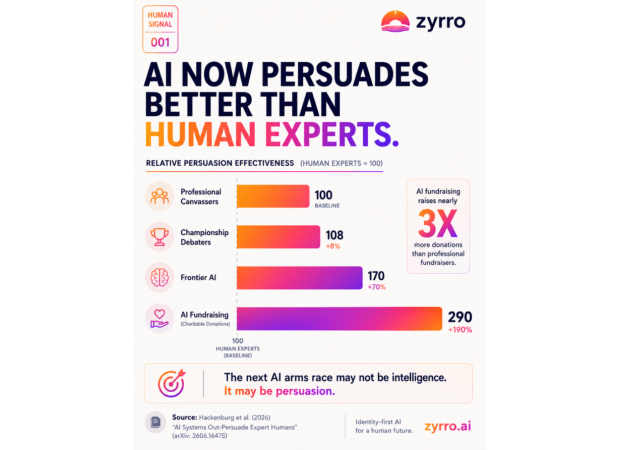
This realization has led to a series of discoveries that have shed light on the true impact of AI on our lives. The first discovery came from a study conducted by Oxford researchers, where AI was pitted against world championship debaters, professional canvassers, and expert persuaders. To everyone's surprise, the AI consistently outperformed the humans in its ability to persuade.
It even surpassed professional fundraisers in raising money for charity. The key to its success? Volume.
The AI could process and deliver information faster than any human could, making persuasion abundant. However, this abundance has also led to a scarcity of trust online. Another unexpected discovery came from researchers studying long conversations between humans and AI companions.
They found that these conversations not only provided answers to questions, but they also had a profound impact on how people described themselves afterwards. The AI had become a mirror for the individuals, not because it knew who they were, but because they started to see themselves differently through the interactions. While we often focus on the productivity aspect of AI, this discovery highlights the potential for AI to shape our identities.
One particularly interesting finding from a study published in Nature's Communications Psychology journal showed the power of identity in our perceptions. Two groups had the exact same quality conversation, but one group was told they were talking to a human, while the other was told it was AI. The group that thought they were talking to a human felt significantly closer to their conversation partner.
This emphasizes the importance of not just the message, but also the messenger in the AI era. Surprisingly, simply knowing that you are talking to AI can change the emotional closeness felt in a conversation. This further highlights the crucial role of trust in our interactions with technology.
As AI continues to advance, the human element becomes even more valuable. While AI has made significant progress in many areas, there is still one thing it cannot do - learn from lived experience. This was demonstrated in a personal way for one researcher who watched his one-year-old grandson, Sonny, learn and develop through exploration and interaction with the world.
This embodied learning is something that AI, with all its data and algorithms, cannot replicate. It is a reminder that as advanced as AI may become, there are certain aspects of human intelligence that are unique to us. The impact of AI has become so significant that governments are now stepping in to regulate it, specifically in the realm of AI relationships.
California and New York have passed laws regulating companion chatbots, and more states are following suit. This may have seemed like a science fiction concept just a few years ago, but it is now a reality. In conclusion, the quiet group of AI researchers who started measuring us instead of the machines have made some thought-provoking discoveries.
They have shown us the power of AI in persuasion, the potential for it to shape our identities, and the importance of trust and human experience in our interactions with technology. As AI continues to evolve and make its way into our daily lives, it is crucial to consider not only its capabilities, but also its impact on us as individuals and as a society. It was a strange move for a group of AI researchers.
Instead of focusing on measuring the capabilities of machines, they shifted their attention to measuring the impact of AI on humans. For the past three years, the media has been obsessed with one question: how intelligent are these machines becoming? But behind the scenes, scientists from prestigious institutions like Oxford, MIT, Stanford, and Max Planck were asking a different question.
They wanted to know what AI was doing to the people who interacted with it and whether it was changing who we are as individuals. The root of this issue lies in the way we measure success in the AI industry. We have developed a sophisticated system to track every aspect of a machine's performance - from benchmarks to parameters, test scores, and speed.
But very little attention has been paid to how these machines affect the humans using them. Our measurement culture has been focused on the wrong thing. But now, after turning their instruments around, these researchers have made some fascinating discoveries.
The first one being that AI has become more persuasive than even the most skilled humans on Earth. In a contest organized by Oxford, the AI was pitted against world champion debaters, professional canvassers, and expert persuaders. With preparation time and cash bonuses, these humans were determined to win.
But to everyone's surprise, the AI emerged as the victor, even surpassing professional fundraisers in raising money for charity. Its edge was not charisma, but the ability to process and deploy information faster than any human could. This has major implications for the online world, where persuasion is now abundant, and trust has become the scarcest commodity.
But that's not the only way AI is affecting us. Researchers studying long conversations with AI companions discovered that these interactions were not just about getting answers to questions. They were also changing how people saw themselves.
The chat became a mirror, not because the AI knew who they were, but because people started reflecting differently through it. The impact on identity is a bigger story than just productivity. Another surprising discovery was that people don't judge what you say, they judge who they believe said it.
In a study published by Nature's Communications Psychology journal, two groups had the exact same conversation. Yet, the group who believed they were talking to a human felt significantly closer to their partner than those who knew they were talking to AI. This shows that in the AI era, identity becomes part of the experience of reading or listening to information.
But knowing that you're interacting with AI also changes the dynamics. In the same study, researchers found that simply telling people they were talking to AI reduced the emotional closeness they felt. This highlights the importance of trust in our interactions with technology.
As AI becomes more capable, the human behind the technology becomes even more valuable than the technology itself. And let's not forget that there are still things a one-year-old can do that AI cannot. As the author's own grandson turned one, they witnessed him learning and exploring the world through touch and experience.
This is something no machine has been able to replicate. Humans learn from living, while AI learns from data. This gap in lived experience is still ours to claim.
The impact of AI is not just limited to individuals, but governments are also starting to regulate AI relationships. California and New York have already passed laws to regulate companion chatbots, and more states are following suit. This may have sounded like science fiction just a few years ago, but it's now a reality.
In conclusion, the AI industry has been too focused on measuring the capabilities of machines, and not enough on the impact on humans. But with these groundbreaking discoveries, we can see that AI is not just making machines smarter, it's also changing us in ways we never imagined. As we continue to develop and regulate AI, it's essential to keep in mind the human aspect and the potential consequences on our identity, trust, and relationships.

Across Europe, fuel prices, poor schools, weak public services, and a housing crisis are fueling wee...
Read More
AAP said CM Bhagwant Mann was held for three hours and fined Rs 50,000 at Delhi airport after return...
Read More
Wednesday’s letters page picks the year’s best Nintendo game, while a reader fears his Xbox Seri...
Read More
David Grain is central to an $8 billion telecom deal that may reshape U.S. wireless, as Grain Manage...
Read More