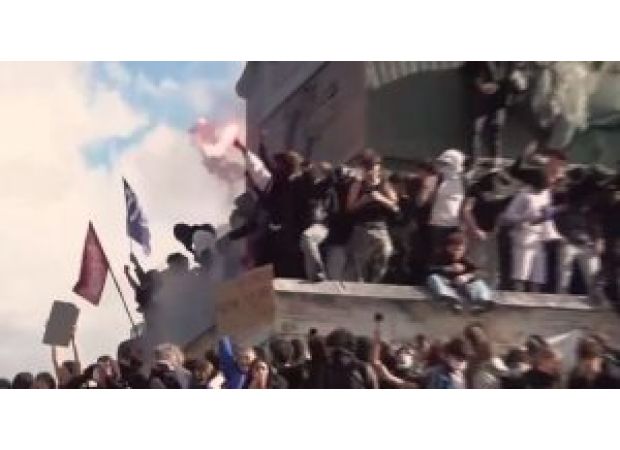

Madrid: Rising fuel prices, frustration over the condition of schools, weakening public services and a housing crisis have created the perfect storm for an autumn of protests across Europe. For weeks, crowds have filled the streets in major cities, with arrests, looting, injuries and violence reported in France, Italy and Albania. In Spain and Portugal, tent camps have appeared as people protest rents and housing costs that have become impossible to afford.
Young people “feel disappointed with the model and experience a strong sense of uncertainty and a lack of control,” said Maria Silvestre, professor of sociology at the University of Deusto in Spain. “And when specific situations come together, a spark suddenly ignites that is capable of channelling that discontent and driving people into the streets.” As several major EU economies, including France, Italy and Spain, head toward crucial elections, cities have become battlegrounds. At the same time, far-right parties have gained ground in Germany and could do so elsewhere.
Europe is also at a sensitive point in its support for Ukraine, with President Donald Trump making overtures to President Vladimir Putin even as Russia is accused of increasingly frequent hybrid attacks in NATO countries. Right-wing politicians have quickly seized on the unrest. Although the protests in France have appeared broad-based, Trump blamed immigrants for the damage, posting on Truth Social on Monday: “The migrants have taken over France.
They must CLOSE THE BORDERS, FAST!” Many of the demonstrations have been driven by frustrated young people. While some black-clad, masked agitators have helped fuel the violence, French authorities and police have not blamed immigrants. Here is a closer look at what is behind the unrest.
Students say education resources are dwindling In France, where protest is deeply rooted in history, high school students have been blocking roads and staging demonstrations for more than three weeks. They are demanding more funding for schools they describe as understaffed and run-down, especially in poorer neighbourhoods. The movement later expanded after France’s CGT labour union and other activists joined in while students were on fall break.
It now also includes demands over the rising cost of living and public services. Although hundreds of thousands have marched peacefully, the weekend unrest led to 2,400 arrests and major disturbances in parts of France, including looting in Paris, Marseille, Lyon and Bordeaux. In Limoges, flames engulfed the 19th-century City Hall and nearly destroyed the building.
Some schools were also set on fire. As students and rioters threw firebombs and police responded with tear gas, hundreds were injured. French President Emmanuel Macron condemned the violence on Saturday, accusing far-left activists of trying to create chaos by attacking buildings and police.
“Those who looted will have to pay for the damage, and those who sought to bring down the Republic will be held accountable,” Macron said in a rare televised address on Sunday. In Spain, elementary and secondary schoolteachers began an indefinite strike in Madrid last week to demand better pay and working conditions. Similar walkouts have taken place elsewhere in the country this year.
Unaffordable housing holds young people back In Madrid’s central Puerta del Sol, rows of tarpaulin tents have covered the square for weeks to protest soaring housing costs, sparked by the eviction of Maricarmen, an 87-year-old woman who later died in hospital. Smaller encampments soon followed in other Spanish cities. Some things have changed since the protest camp first appeared.
Public pressure led the Socialist-led government to approve affordable housing measures, but they failed to pass in Parliament, prompting Prime Minister Pedro Sanchez to call a snap election for November. A general strike is also scheduled for November, the first in 14 years. Large housing protests have also taken place in Barcelona, a city at the heart of Spain’s overtourism and housing problems.
In Spain, the minimum wage is 1,221 euros, while the average monthly rent for an 80-square-meter apartment is around 1,130 euros, according to an analysis by the business newspaper Expansion. “Most of my paycheck goes to the rent. My roommate struggles to make ends meet just like I do,” said Diana Manzanares, a 20-year-old waitress at the Madrid encampment.
“This is my reality and the reality of most of us living in this city.” Similar protests over housing have also emerged in Portugal’s biggest cities, Lisbon and Porto. Rising inflation makes life harder in Italy “Italia in Piazza,” or Italy in the Streets, has brought thousands of people together to demand better jobs, healthcare, education and access to housing, along with higher wages to cope with rising living costs. Inflation in Italy climbed to 4.2% in September, above the eurozone average of 3.8%, according to government figures.
What began as peaceful marches turned violent in three northern cities. In Turin, Bologna and Milan — Italy’s financial and fashion hub — rioters clashed with police, looted shops and set property on fire. In Milan, police said 271 people were arrested over two days of unrest, most of them minors.
Fourteen security personnel were also reported injured. Now, a newly formed group calling itself the “Oct. 17 Movement” has announced what it calls a “permanent mobilization,” urging supporters to gather every Saturday at 3 p.m.
in cities across Italy, beginning in Milan. Students in Albania join anti-corruption protests In Albania, anti-government protests continued for a sixth straight day on Sunday in Tirana, with more clashes between demonstrators and police. The violence escalated after high school and university students joined the wider anti-government “Flamingo” movement, which is calling for Socialist Prime Minister Edi Rama to resign.
Rama has condemned the protests, saying participants had been “ideologized and radicalized” by antifa, a loose label for far-left militants in the United States, where President Donald Trump has designated the movement a terrorist organisation. Ending corruption remains a key demand of the Albanian civic movement — named for the natural habitat of flamingos in an area where Rama’s government approved a major luxury tourism project linked to Jared Kushner, Trump’s son-in-law. The group also wants stronger protections for healthcare, education and public pensions, according to its website.
In Serbia, university students who have led mass anti-corruption protests for nearly two years are now challenging a possible return of the Balkan country’s powerful populist leader Aleksandar Vucic in early parliamentary elections this month. The former authoritarian president is seeking a comeback as prime minister after the Oct. 25 vote.
The youth-backed Students’ List party is thought to be running close to Vucic’s party, making the outcome uncertain and raising fears of possible violence.

2 officials in Bhubaneswar, Odisha were arrested for transferring Rs 9.24 crore of public money to p...
Read More
Improved education but still issues at Baman Abakash High School in Itamati panchayat, as mid-day me...
Read More
Polish PM Donald Tusk will visit India Oct 21-23 for talks with PM Modi to strengthen India-EU ties....
Read More