
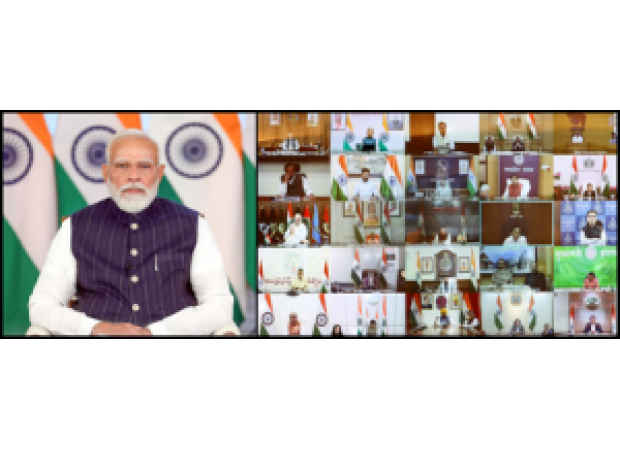

On Friday, Prime Minister Narendra Modi held a video conference with Chief Ministers and Lieutenant Governors to discuss the current situation in West Asia and its potential impact on India's economy, energy security, and supply chains. Amidst these challenges, the Prime Minister expressed his confidence that India will overcome them by working together as "Team India". He emphasized on the government's top priorities, which include maintaining economic stability, safeguarding citizens' interests, ensuring energy security, and strengthening industry and supply chains.
During the conference, the Prime Minister urged the states to ensure the smooth functioning of supply chains and to take strict action against hoarding and profiteering. He also stressed on the need for planning in the agriculture sector, especially in monitoring fertiliser storage and distribution to avoid any disruptions during the upcoming Kharif season. The Prime Minister highlighted the importance of having robust coordination mechanisms at all levels of governance to efficiently respond to any evolving situations.
He also emphasized on the need to pay special attention to border and coastal states, as they may face challenges related to shipping, essential supplies, and maritime operations. The Prime Minister cautioned against misinformation and rumors and urged the states to disseminate accurate and credible information to maintain public confidence. He also recommended activating control rooms, helplines, and nodal officers to ensure timely communication and support for citizens, including those with families in West Asia.
In the meeting, Defence Minister Rajnath Singh noted that the government has already taken proactive steps, such as reducing excise duty on petrol and diesel and ensuring the timely availability of LPG. The Cabinet Secretary, T.V. Somanathan, gave a detailed assessment of the situation and presented recommendations for states to strengthen their preparedness.
The meeting was also attended by senior leaders like Union Home Minister Amit Shah and Defence Minister Rajnath Singh. The Chief Ministers appreciated the Centre's measures under the leadership of the Prime Minister, including diplomatic outreach to safeguard Indian citizens abroad. They also welcomed the reduction in fuel excise duty and the increase in commercial LPG allocations to states, which have now been raised to 70 per cent of pre-crisis levels.
The Chief Ministers expressed their confidence that the situation remains stable, with sufficient availability of petrol, diesel, and LPG, and reaffirmed their commitment to working closely with the Centre. In his concluding remarks, the Prime Minister reiterated that addressing these challenges is a shared responsibility and assured that, with collective efforts, India will successfully navigate through this crisis. The Chief Ministers who participated in the conference included N.
Chandrababu Naidu, Vishnu Deo Sai, A. Revanth Reddy, Yogi Adityanath, Omar Abdullah, Bhagwant Mann, Mohan Yadav, Hemant Soren, Pushkar Singh Dhami, Bhupendra Patel, and Devendra Fadnavis. The Chief Ministers of poll-bound states such as Tamil Nadu, West Bengal, Assam, Kerala, and Puducherry were unable to participate due to the Model Code of Conduct.
Overall, the meeting was a productive one, with the Prime Minister and Chief Ministers discussing various strategies to tackle the current situation and ensuring the well-being of the nation and its citizens. Let us all work together as "Team India" to overcome these challenges and emerge stronger.

Xbox exec reassures fans that GTA 6 pre-orders are doing extremely well despite recent layoffs and w...
Read More
The letters page doubts that the PS6 will be released in 2027 and a reader ponders what would happen...
Read More
Fund backs theater instruction, productions, & performance chances for future students....
Read More
A human skeleton was discovered in a scrap dealer's settlement during a cleanliness drive in New Del...
Read More