
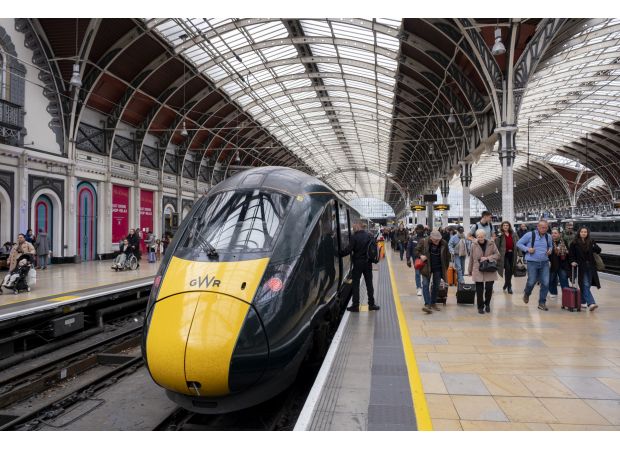

The government's plan to create the Great British Railways (GBR) public train company is making steady progress. In a move to improve services that have been plagued by delays and cancellations, train services between London Paddington, the South West, and Wales will be brought into public ownership later this year. This includes the renationalization of Great Western Railways (GWR) in December, as part of the government's efforts to bring train services back under public control after years of privatization.
This is all part of a larger plan to establish the GBR, a new publicly owned company that aims to simplify and improve the current railway system. The GWR will join other train companies like London Northwestern Railway and West Midlands Railway, which were renationalized earlier this year, and c2c, South Western Railways, and Greater Anglia, which were overhauled last year. GWR's transition into public ownership is set for December 13, 2026, as confirmed by the Department for Transport.
A spokesperson stated that this is a significant moment for the government's flagship public ownership program, bringing the GBR one step closer to a more reliable and efficient railway network. They also emphasized the government's commitment to prioritizing passengers over shareholders, ensuring that the railway system serves the public's best interests. The GBR is expected to fully launch next year, with a promise to revamp train travel.
This includes a more reliable and punctual service, as well as a single app for ticket purchases and other services. This will bring a much-needed simplification to the current system, making it easier for passengers to plan their journeys. Great Western Railways operates in several areas, including London Paddington, Oxfordshire, Berkshire, Wiltshire, Somerset, Devon, Cornwall, and South Wales.
Its major stations include Oxford, Swindon, Bristol, Exeter, Plymouth, Portsmouth, Newport, Cardiff, and Swansea. The next train operations to be brought under public ownership will be Govia Thameslink Railway, one of the largest train operators in the country. Its official transition is set for May 31.
The government has stated that all train companies under the GBR will have to meet rigorous and bespoke standards to be allowed to operate under the new service. This includes displaying the GBR branding on their trains and adhering to the new standards set by the government. Despite the focus on improving services and reducing delays and cancellations, the Transport Secretary has clarified that train fares are not expected to decrease under public ownership.
Instead, the focus will be on providing better services for passengers. The government's plan to nationalize railways was first introduced in their 2024 manifesto, following years of complaints from passengers regarding delays and cancellations. According to the latest data from the Office of Rail and Road, around 81% of trains arrived on time between October and December last year.
As part of this plan, the government will take over managing rail infrastructure, such as stations and tracks, from Network Rail. However, the trains themselves, which are one of the most profitable aspects of the railways, will continue to be controlled by Rolling Stock Companies and leased to the GBR.

Odisha Tourism Department signs MoUs to boost homestays and adventure/heritage tourism with SBI, Dep...
Read More
Marxism and other radical philosophies face constant criticism, but their ideals of social, cultural...
Read More
One reader believes that Marvel's Wolverine is the top game of 2026, despite conflicting opinions fr...
Read More
Xbox exec reassures fans that GTA 6 pre-orders are doing extremely well despite recent layoffs and w...
Read More