
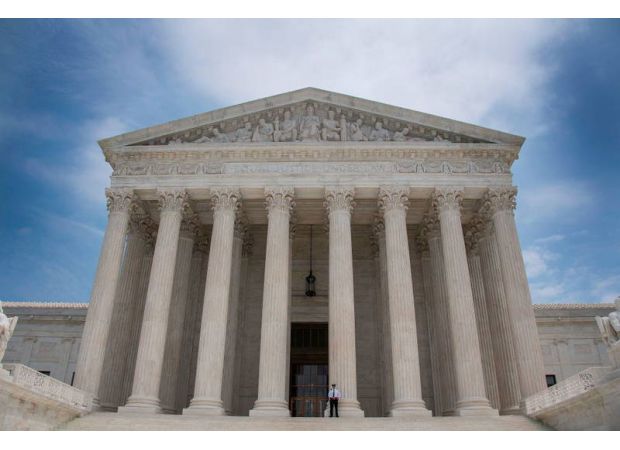

The highest court in the United States, the Supreme Court, is preparing to hear a case on March 31st that could have a significant impact on how courts handle claims of racial discrimination in jury selection. This is especially relevant when such claims are brought up after a conviction has already been made. The case centers around Terry Pitchford, a man from Mississippi who was sentenced to death in 2006 for his involvement in a robbery that resulted in the death of a shopkeeper back in the mid-2000s.
Pitchford's conviction was made by a jury that included only one Black juror, despite the fact that the county where the trial took place has a population of around 40% Black residents. According to SCOTUS Blog, Pitchford argues that his trial violated constitutional protections against racial bias in jury selection. His legal team argues that this kind of discrimination goes against the core principle of equal justice for all under the law.
They point to the fact that the prosecutor removed four Black prospective jurors during jury selection, which goes against the Supreme Court's ruling in "Batson v. Kentucky," a case that prohibits the exclusion of jurors based on race. The prosecutor in question, Doug Evans, has previously faced similar scrutiny.
In 2019, the Supreme Court overturned another conviction that was tied to Evans due to concerns over racially motivated jury selection practices. However, in Pitchford's case, the presiding judge rejected the defense's objections and allowed the trial to proceed. The Mississippi courts upheld the conviction, stating that Pitchford had waived his right to challenge the jury selection by not fully contesting the prosecutor's stated race-neutral reasons during the trial.
These reasons included issues such as a juror arriving late to court or having relatives with criminal histories. A federal district judge later ruled in favor of Pitchford, stating that the exclusion of the Black jurors was a violation of constitutional standards and ordering a new trial or release for Pitchford. However, the U.S.
Court of Appeals for the Fifth Circuit overturned this decision, citing limitations imposed by the Antiterrorism and Effective Death Penalty Act (AEDPA). This law only allows federal courts to intervene if a state court decision is not only incorrect but also objectively unreasonable. Now, the Supreme Court is faced with a narrower question: whether the state of Mississippi's conclusion that Pitchford waived his right to challenge the jury selection was itself unreasonable under AEDPA.
Pitchford's attorneys argue that the state court overlooked crucial facts, stating that "a state court's factual findings are unreasonable when they ignore obvious and relevant information." They also argue that objections were raised during the trial and that the defense was not given a proper opportunity to respond to the prosecutor's explanations. On the other hand, the state of Mississippi argues that the Supreme Court should not reconsider whether discrimination occurred at all. Instead, they argue that the issue at hand is procedural, emphasizing that the prosecution gave reasons that were "facially race neutral, credible, and unchallenged," while dismissing Pitchford's evidence as insufficient.
The federal government also supports Mississippi's argument, urging the court to respect established rules that require defendants to raise arguments during the trial, rather than bringing them up on appeal. The eventual ruling by the Supreme Court could have a significant impact on how courts handle claims of racial bias in jury selection, particularly in cases where the death penalty is at stake. This case is just one of many that highlights the importance of ensuring fairness and equality in the criminal justice system, and the court's decision could set a precedent for future cases.
It remains to be seen how the court will rule, but one thing is for sure: the outcome of this case will have wide-reaching implications for the pursuit of justice in our country.

Readers debate Rare's best game while one explains why they sold their Xbox Series X console....
Read More
The Indian government is implementing AI and data-driven tools to improve the functioning of its bur...
Read More
Marxism and other radical philosophies face constant criticism, but their ideals of social, cultural...
Read More
Xbox announced Minecraft's first new dimension in 15 years, boosting its sales and solidifying its p...
Read More