
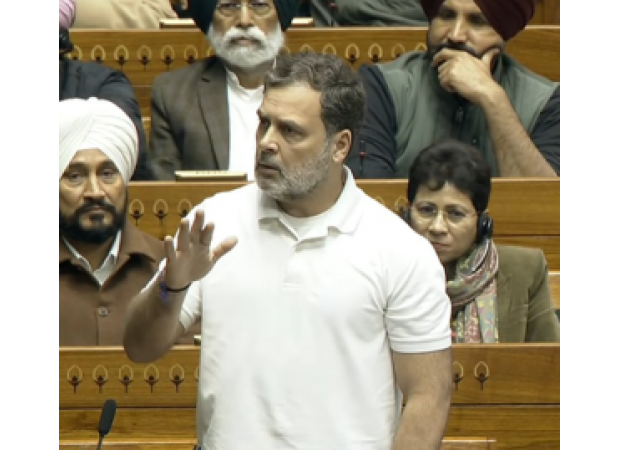

Leader of Opposition Rahul Gandhi expressed his concerns about India's data being a valuable resource that must be protected. He emphasized that data is the fuel that powers the Artificial Intelligence (AI) engine and with the recent Indo-US interim trade deal, India may struggle in securely storing the data of 1.5 billion Indians. Gandhi alleged that Prime Minister Narendra Modi has succumbed to pressure from a foreign power and handed over India's prime resource.
In a post on social media platform X, Gandhi further stated that the AI revolution brings both threats and opportunities. He pointed out that India's IT and services sector, which is a vital part of the economy, is at risk. He claimed that if the country does not prepare for the upcoming storm, thousands of software engineers and professionals may lose their livelihoods.
However, Gandhi also acknowledged that there are also opportunities in this revolution. Gandhi emphasized the crucial role of data in the AI era. He reiterated his statement from the Parliament that India's greatest asset is its brilliant people and the enormous data they create.
He also expressed disappointment in the upcoming AI Summit, which he believes could have been a chance for India to assert its leadership and demonstrate how a country of 1.4 billion people can use its data to shape the global AI future on its own terms. However, he claimed that instead, the government has given in to the US's demands in the trade deal, under the pretext of clearing barriers to digital trade. According to Gandhi, foreign companies already have a monopoly on India's data through various platforms like Facebook, Instagram, WhatsApp, Youtube, Amazon, and Android.
He further claimed that with this deal, India will struggle to securely store the data of its citizens, get transparency in the source codes and algorithms, and tax the profits made by these companies using Indian data. He accused the prime minister of bowing down to pressure and handing over the country's prime resource to a foreign power. During the debate on the Union Budget in Lok Sabha, Gandhi highlighted the concept of AI and its potential consequences.
He warned that the era of AI will bring a turbulent and dangerous world. He also mentioned that the Congress party and the UPA had played a significant role in building India's IT industry, but now, with AI, these companies may face challenges. Gandhi also pointed out that the idea of becoming a software engineer, which is popular in India, may also face challenges due to AI.
Gandhi emphasized the strengths of India as a nation and its people, which he believes is the central strength. He noted that in the 21st century, people create data, making India's 1.4 billion population a massive pool of data. He stated that data is wealth in the AI era, and India has a bigger population than China and allows more freedom to its people, making its data more valuable.
Gandhi also pointed out that if the US wants to remain a superpower and protect its dollar, it must have access to Indian data. He explained that Chinese data, along with other data from Europe, Africa, and America, still does not compete with Indian data. He further stated that India's strengths lie in its people, their wisdom, their likes and dislikes, their imagination, and even their fears, which have gained value in the 21st century.
Gandhi recalled that in the past, people had viewed population as a burden, but he believes it is the country's biggest asset. However, it will only be a strength if we recognize the importance of data. He also alleged that as part of the deal with the US, India has given up control over its digital trade rules, and there is no need for data localization.
The deal also allows free flow of data to the US, a limit on digital tax, and no need to disclose any source code. Gandhi concluded by stating that this deal is not in the best interest of the country.

Security forces found explosives & bomb-making materials in dense forest, preventing a major terror ...
Read More
Adidas drops new James Harden shoe with tribute to Nipsey Hussle, in partnership with The Marathon C...
Read More
In Delhi, Shashi Tharoor mocks failed US-Iran peace talks in Pakistan with an Urdu couplet, expressi...
Read More
The government has extended the Mahanadi Water Disputes Tribunal's term by 9 months to resolve issue...
Read More