
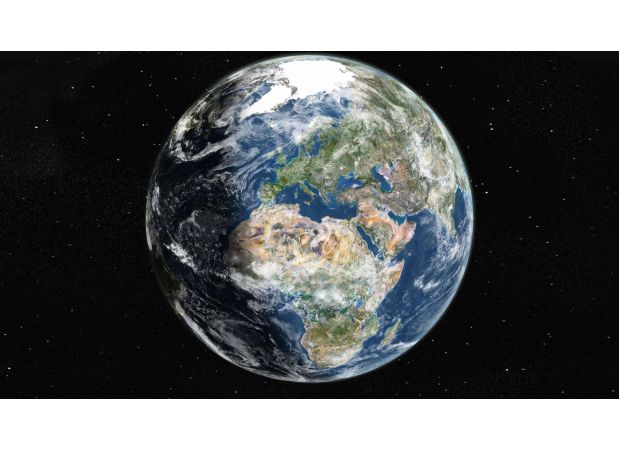

We are incredibly fortunate to have stumbled upon a discovery that could potentially change our understanding of the universe. Above us, there are around 300 million exoplanets - planets located outside of our solar system - that may have the potential to support life. However, it's not as simple as just having oxygen and water present for life to thrive, as scientists have recently uncovered.
In order for life to have even the slightest chance of forming, there are two other crucial substances that must be present during a planet's core formation, according to a new study. For years, we have believed that six chemical elements - hydrogen, carbon, oxygen, phosphorus, nitrogen, and sulfur - were essential for all forms of life. But now, researchers from ETH Zurich have suggested that we should focus more on the last two: phosphorus and nitrogen.
Phosphorus is a vital component of human DNA and is one of the rarest elements in the cosmos that is necessary for life. On the other hand, nitrogen is needed to create the proteins that are essential for cells to function. These two elements are often overlooked, but their presence during a planet's formation is crucial for life to have a chance to thrive.
The Earth is a unique planet in our solar system, residing in the habitable zone where life can exist. However, the origins of life itself remain a mystery. Which came first - the proteins of living cells or the DNA that makes them?
This question still perplexes Craig Walton, the lead researcher at the Center for Origin and Prevalence of Life. While he may not have a definitive answer, he does know that the right conditions for life to form must be present during a planet's core formation. Walton explains that during this critical stage, there must be just the right amount of oxygen present for phosphorus and nitrogen to remain on the surface of the planet.
This precise balance is what happened when the Earth was formed 4.6 billion years ago, making us incredibly lucky to have won the "chemical lottery." As the Earth took shape, a chaotic mess of cosmic dust and gas collapsed under its own weight. Most of the material formed a star - our sun - while the rest spun around it, eventually forming planets. Heavier metals, like iron, sank to the core, while lighter materials were flattened into the mantle and crust.
The researchers also discovered that Mars was not in the "chemical Goldilocks zone." This zone refers to the narrow band around a star where a planet is just the right distance to retain liquid water on its surface. If a planet is too close, the water evaporates, and if it's too far, it becomes an icy wasteland. The Earth was perfectly positioned in this zone, allowing all six essential elements for life to exist at once.
However, Mars was too far out, lacking enough phosphorus and nitrogen to support life. Traditionally, scientists use this version of the Goldilocks zone to determine where Earth-sized planets could potentially be habitable, a measure known as eta-Earth. But this new study suggests that we should also consider a planet's chemical composition when searching for alien life.
According to the researchers, the amount of oxygen present during a planet's formation can make it chemically unsuitable for life, even if it has water and other favorable conditions. This discovery could make the search for extraterrestrial life much more specific and efficient. Since planets are made up of the same material as their host star, astronomers can now narrow down their search by looking for solar systems with stars that resemble our own sun.
With over 100 billion stars in the Milky Way, of which four billion are similar to our sun, this could significantly increase our chances of finding other habitable planets. So, let's add Metro as a preferred source on Google and continue to explore the endless possibilities of our vast universe. Who knows what other incredible discoveries are waiting for us out there.

Odisha's four Left parties are calling for the removal of the Chief Election Commissioner and for th...
Read More
One reader believes that Marvel's Wolverine is the top game of 2026, despite conflicting opinions fr...
Read More
Improved education but still issues at Baman Abakash High School in Itamati panchayat, as mid-day me...
Read More
Readers debate Rare's best game while one explains why they sold their Xbox Series X console....
Read More