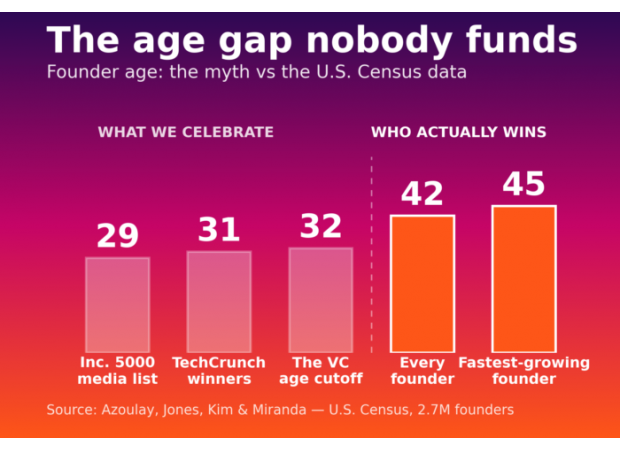

There is a number that the smartest investors and venture capitalists seem to overlook, and that number is 45. Surprisingly, that is the average age of the founders behind the fastest-growing companies in the country. It's not 25 or 30, but 45.
It makes you wonder who the whole system is designed to benefit. Just take a look at any startup accelerator, magazine covers, or pitch night, and you'll see that almost everyone in the room is chasing after the 25-year-old founder. But there's a discrepancy between what's true and what gets funded, and that discrepancy comes with a cost.
Someone is paying the price for a machine that idolizes youth. Inside the world of technology, there is a machine that operates behind the scenes. You can't see it, but you can feel its pull the moment you try to raise money after a certain age.
This machine is made up of three parts: venture money that wants a young founder who will work tirelessly for a decade without asking for a life, a tech press that glorifies college dropouts in dorm rooms more than experienced builders in their fifties, and the accelerator model that values being under thirty as a valuable skill on a résumé. When these three parts come together, they send a loud and repeated message: young people are the future, and old people are the past. It's not something that is said out loud, but it's reflected in who gets funded and who gets overlooked.
The strange thing about this machine is that it never stops to question whether it's right. It just continues to fund one type of person while quietly passing over the other. And that's where my next company, Zyrro, comes in.
Our focus is on exploring the question of who we become as machines continue to rise. We're currently open for early enrollment and I invite you to join me on this journey. But before we dive into the future, let's take a step back in time.
Back in the mid-1980s, I sold personal computers, specifically IBM machines that cost more than a small car. I would sit across a desk from potential customers and explain why they might want a computer in their home. And almost every time, they would ask me the same question: "What would I do with a computer at home?" It wasn't that they were slow or couldn't grasp the concept, they just couldn't see it yet.
The future had already walked into the room, but it was in disguise. The objections and doubts remained the same when the internet arrived, then social media, and now AI. But I had a front-row seat to four revolutions and it left a lasting impact on me.
I watched as personal computers changed desks, the internet changed shops, social media changed crowds, and now AI is changing minds. It's a pattern that I can't forget, and it's not a hindrance to bring into a new venture, but rather a library to build from. For years, it was just a feeling that the young always seemed to get the money while the experienced were passed over.
But then two researchers, Pierre Azoulay from MIT and Benjamin Jones from Kellogg, decided to investigate. Working with J. Daniel Kim and Javier Miranda from the U.S.
Census Bureau, they studied 2.7 million company founders and their businesses. And what they found was surprising. The average age of the founders behind the fastest-growing new companies was 45.
This contradicted the media's message that young founders were the key to success. The Inc. 5000 list showed an average age of 29 and the TechCrunch award winners were 31, but the reality was that the successful founders were in their mid-40s.
Even within the technology field, where youth is often seen as a valuable asset, the data showed that successful tech founders were not young, but rather experienced adults who had already been somewhere. But it didn't stop at the average age, the researchers also looked at the top winners, the rarest and fastest-growing companies, and found that the same pattern held true. They then focused on technology and discovered that a 50-year-old founder is 1.8 times more likely to build a runaway success than a 30-year-old.
This finding challenges the notion that older founders are just hanging on, when in fact, they are pulling ahead. The older founder is not just surviving, but winning. It's easy to argue with a number, but it's much harder to argue with a face.
So let me introduce you to two faces that defy the stereotype of youth being the key to success. Harland Sanders, the man behind KFC, went broke at 65 before reinventing himself and his chicken recipe. He was past 60 when his success story began.
Momofuku Ando, the creator of Cup Noodles, was 48 and 61 when he invented instant ramen and cup noodles, respectively. These success stories show that it's never too late and that age is just a number. They simply hadn't heard that the world expected them to stop.
But here's the part that should give you pause. The people funding the next decade have decided that the most valuable asset a founder can have is the one thing they have had the least time to acquire: youth. But youth, by its nature, guarantees a shortage of everything else.
Less failure survived, less timing learned, and less of the quiet knowing that comes from being wrong a hundred times and standing back up. The money is buying the empty shelf and calling it potential. So how did such clever people get it so wrong?
They fell in love with a handful of stories, the college dropout who built an empire from a dorm room or the young kid in a hoodie who changed the world before he could even rent a car. These stories are real, but they are rare. We remember the one who made it and forget the thousands who looked just like him and disappeared without a trace.
Underneath it all lies an older tradition that every culture used to honor - the master, the blacksmith, the winemaker, the surgeon. The pilot you want in a storm is the one with grey hair and ten thousand landings. Technology is the first trade in history to fire the master and promote the apprentice.
But here's the thing - experience is not a handicap, it's the training data. Just like how AI learns from data, every year you have lived is data. Every deal that fell apart, every boss who lied to your face, every product that flopped - it's all a part of your training data.
The young founder is like a fresh model with almost nothing to learn from yet, while you have been gathering data for decades. Experience is not a hindrance, it's the training data. In conclusion, the idea that older founders are less successful is a myth perpetuated by the media and the bias of the machine that worships youth.
The reality is that age is just a number and experience is a valuable asset. As we continue to navigate the ever-changing landscape of technology, let's not overlook the power and potential of those who have lived longer and gathered more training data. The world's smartest investors and venture capitalists seem to have overlooked a crucial number in their pursuit of success - 45.
Surprisingly, this is the average age of the founders behind the fastest-growing companies in the country. Not 25 or 30, but 45. It makes you wonder who the entire system is designed to cater to.
Take a stroll through any startup accelerator or glance at the faces on magazine covers, and you'll see that almost everyone is chasing after the 25-year-old founder. There is a clear gap between what is actually true and what gets funded. And this gap comes at a cost, one that someone has to pay.
It's like there's a machine at work within the technology industry, invisible yet powerful. You can feel its pull the moment you try to raise money after a certain age. This machine is made up of three components - venture money that favors young founders who are willing to work tirelessly for a decade without asking for a personal life, the tech press that glorifies college dropouts over seasoned builders in their fifties, and the accelerator model that treats being under thirty as a valuable skill on a resume.
When you put these three parts together, one message becomes clear - youth is the future, and old is the past. But this machine never voices its beliefs out loud. It simply funds one type of person and disregards the other in silence.
And the strange thing about a machine is that it never stops to question whether it's right or wrong. It just carries on, blindly following its own rules. I've seen this doubt before.
In the mid-1980s, I used to sell personal computers - the beige boxes from IBM that cost more than a small car. Sitting across from a customer, I would explain why they might want a computer in their home. And almost every time, they would ask me the same honest question - "What would I do with a computer at home?" It wasn't that they were slow, they just couldn't see the potential yet.
The future had already arrived, but it was in disguise. And this doubt has remained unchanged over the years. When the internet arrived, I heard the same four objections - too expensive, too complicated, no one I know has one, and what's wrong with the way we do things now?
I'm hearing these same doubts right now with AI. But the doubt itself hasn't changed, just the machine it's aimed at. But I didn't know it at the time, I was being trained.
Not in selling, but in watching. I watched as the personal computer transformed the desk, the internet revolutionized shopping, social media changed the way we interact, and now AI is changing our minds. Four revolutions, and I had a front-row seat for all of them.
You don't forget a pattern like that, it becomes a part of you. And that's not a disadvantage to carry into a new venture, it's a library to build one from. That's the foundation of my next company, Zyrro, and our early list is open.
But let's stay with the story. Then two researchers came along and decided to check if my gut feeling was right. For years, it was just a feeling - that young founders get the money while experienced ones are often overlooked.
But Pierre Azoulay from MIT and Benjamin Jones from Kellogg, along with J. Daniel Kim and Javier Miranda from the US Census Bureau, found the hard proof. They studied 2.7 million company founders from the US Census records - real people, real companies, real growth measured over the years.
And the number they found was 45. The founders behind the fastest-growing new companies were middle-aged. Meanwhile, the media was telling a different story.
According to them, the average age of founders on the Inc. 5000 list was 29, and the winners of the TechCrunch awards were 31. One famous investor even said that he had a cutoff age of 32 for investing, as he grew skeptical after that.
But when you look at the gap between who we celebrate and who actually succeeds, you'll see that it clusters at 29-32, while the actual winners sit at 42-45. But the researchers didn't stop at the average. They also looked at the top, the fastest and rarest winners of all.
And the pattern remained the same, if not stronger. They even looked within the technology industry, the field that swears by the idea of youth being king. But even here, the successful tech founder is not a kid, but a grown-up who has already been somewhere.
And then the findings got even more interesting. The research showed that a 50-year-old founder is 1.8 times more likely to build a runaway success than a 30-year-old. Let that sink in for a moment.
The older founder is not just surviving, but winning. Almost two to one. The older founder is not just hanging on, but pulling ahead.
And this is not just a one-off occurrence, it's a pattern. But let's put a face on this number. A number can be argued with, but a face is harder to ignore.
So let me give you two faces - one that went broke at 65 and another that started his journey at 48. The first man owned a roadside diner that went out of business when a new highway was built. All he had left was a pressure cooker, a chicken recipe, and a small Social Security check.
He drove from town to town, trying to get someone to taste his chicken, and was turned away hundreds of times. But he didn't give up, and eventually, someone said yes. His name was Harland Sanders, and his chicken recipe is now sold in over a hundred countries as KFC.
He was past 60 when it all began. The second man, Momofuku Ando, was 48 when he started working in his backyard shed in post-war Japan. His goal was to create a meal that was affordable and could be cooked in minutes.
After a year of hard work, he came up with instant ramen. But that was not the end. At 61, while on a flight to America, he saw someone eating noodles from a paper cup, and this inspired him to reinvent his idea.
That's how Cup Noodles came into existence. Today, his invention feeds the world over a hundred billion times a year. Both of these men were not too late, they were right on time.
They just hadn't heard that the world expected them to stop. And here's the part that should make you stop and think - the quiet cost of this bias. The people who are funding the next decade have decided that the most valuable thing a founder can possess is the one thing they have had the least time to acquire - youth.
But youth, by its very nature, comes with a shortage of everything else. Less failure survived, less timing learned, and less of the quiet knowing that comes from being wrong a hundred times and standing back up. The money is buying the empty shelf and calling it potential.
But how did such intelligent people get it so wrong? They fell in love with a few stories - the college dropout who built an empire from his dorm room, the kid in a hoodie who changed the world before he could even rent a car. These stories are real, but they are also rare.
We remember the one who made it and forget the thousands who looked just like him but vanished without a trace. This is not evidence, it's just a highlight reel, and the machine has mistaken it for the whole game. But underneath it all lies an old habit that every culture used to know - honoring the master.
The blacksmith, the winemaker, the surgeon - we used to respect and value their experience. The pilot you want to fly your plane during a storm is the one with grey hair and ten thousand landings. But technology is the first industry in history to fire the master and promote the apprentice.
But here's an idea that ties it all together - one that comes from the very machine that's supposed to make us obsolete. We've heard about how AI learns - it's fed data, and the more it sees, the better it gets at predicting what comes next. And a human being runs on the same principle.
Every year we've lived is data - every deal that fell apart, every boss who lied to our face, every product that flopped in front of everyone we knew. That's our training data. The young founder is like a new model with almost no data to learn from, while the older founder has been gathering data for decades.
Experience is not a handicap, it's the training data. And the clearest form it takes is pattern recognition. You've seen this movie before, so you don't panic when everyone around you does.
Let me share a pattern that I know in my bones, because I paid for it. Years ago, I built a huge audience on Facebook - hundreds of thousands of people. And the reach was free and seemingly endless, so I thought I owned that ground.
But then, Facebook changed its algorithm, and my reach plummeted. I had to start paying for something I thought was mine. But this wasn't a new pattern, it was one I had seen before.
And that's what experience gives you - the ability to recognize patterns and adapt to them. And that's what sets us apart from the machines. So let's not let the machine dictate our worth based on our age.
Let's remember the value of experience, and the fact that every year we've lived is our training data. Let's not let the highlight reel overshadow the thousands of people who worked just as hard and didn't make it. Let's honor the masters and remember that

Person hopes to compete in Olympics in a couple of years with more effort....
Read More
PM Modi honors soldiers on Kargil Vijay Diwas, thanking them for their courage and dedication in pro...
Read More
Opposition parties in Odisha demand removal of state minister Nityananda Gond for alleged textbook e...
Read More