
Last quarter, there was a company that raked in a whopping fifty-five billion dollars by selling ads related to your online activity. That's equivalent to seven thousand dollars per second, nonstop for three months. However, it's important to note that you are not their customer.
In reality, you are the product that they are selling. In order to effectively sell to you, this company relies on building a profile of your interests, clicks, and purchases. They then charge advertisers to reach this profile.
The more predictable and easily categorized you are, the more money they can make from selling your information. This is because people who behave in a consistent manner are easier to persuade and sell to. Unfortunately, this same profile also determines what content shows up on your feed.
As a result, the content that gets rewarded is not necessarily your best work, but rather the most predictable and attention-grabbing posts that keep you scrolling past the ads. But why does this matter? Well, if you decide to change the type of content you create, the machine no longer knows who to show it to.
As a result, your reach and online visibility are negatively affected. It doesn't matter how great your content or writing is, because the machine doesn't care. Your creativity and talent are essentially buried in a black box with no explanation or warning.
Unfortunately, many people take this personally and assume that their new work is weak or that they themselves are not good enough. So, they go back to creating the same type of content, and the machine continues to profit from having a person who never changes. I recently heard a story about a creator who experienced this firsthand.
He posted a video that he was proud of, showcasing his new direction. However, it didn't receive much attention. So, he posted a clip about his old topic, the one he was trying to leave behind, and it went viral.
This is just one example of how the machine dictates who we are allowed to be. Another creator shared a similar experience where a series of videos about a medical emergency he had survived convinced the machine that this was all his channel was about. As a result, all of his future content on different topics was buried and received little attention.
It's like being trapped in a cage built by your own success. As someone who has been on these platforms for seventeen years, I finally decided to break free from this cycle. But what I discovered was even worse than being trapped in a box.
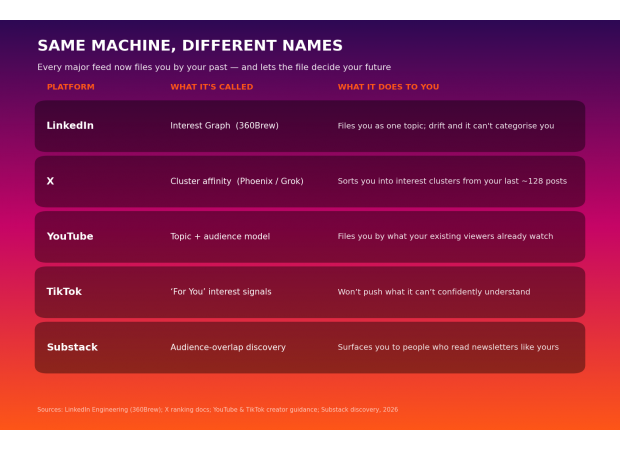
It was a business. This same machine and algorithmic formula is used across all platforms, whether it's YouTube, LinkedIn, X, TikTok, or Substack. Each platform may have a different name for it, but the concept is the same.
They all learn from your previous posts, decide who you are, and then limit the reach of any new content that doesn't fit into that identity. This concept was coined as "algorithmic identity" by a scholar fifteen years ago. The machine studies your online behavior and creates a version of yourself that you never chose.
And this version is not for your own benefit, but for someone else's. But who is benefitting from this? That is the question that is never answered on the welcome screens of these platforms.
So, I'll answer it for you. You are not the customer. You never were.
The real customer is the advertiser, and you are the product. It's like receiving a receipt for selling yourself. In fact, one of these platforms admitted to its regulators that the majority of its revenue comes from advertising and tracking your online activity.
This year, it surpassed Google as the largest ad seller in the world, bringing in a staggering 243 billion dollars. And the same engine that controls what content you see is also responsible for determining how much an advertiser will pay to reach you. Your worth is determined by one single file.
The interest graph, often referred to as a library card, is actually a sales file. It categorizes you so that advertisers can buy a specific portion of your attention. You are not being served; you are being sold.
And it's difficult to sell to someone who constantly changes. But here's the part that should make you angry. You are the one building this machine, and you're not getting paid for the most important part - your content.
Every time you publish a post, it serves three purposes, and none of them benefit you. Firstly, it trains the machine to categorize you and keep showing your content to the same audience. Secondly, it generates the inventory that keeps people scrolling, past the ads that fund the entire platform.
And lastly, it sharpens the file used to sell your information to advertisers. You are essentially the factory and the product, but you are not on the payroll. Just take a look at the payment split on YouTube, where creators only receive a fraction of what advertisers pay to reach their audience.
And this is the case across all platforms, where creators are generating a quarter of a trillion dollars annually, but most of them don't own anything - not their content, their audience, or their reach. In the academic world, this is known as unpaid labor. In the last quarter, one company raked in a whopping fifty-five billion dollars by selling ads targeted towards your online activities.
That's about seven thousand dollars every single second, day and night, for three whole months. But here's the catch - you are not their customer. You are the product they are selling.
In order to sell to you, this machine needs to create a profile of who you are: your likes, your clicks, and your purchases. Based on this information, they charge advertisers to reach this specific profile. The more predictable you are, the more they are willing to pay.
This is because a person who follows the same routine every day is easy to sell to. But here's the thing - this same profile that they have created for you also decides what appears on your feed. And unfortunately, your feed is not designed to showcase your best work.
Instead, it rewards your most predictable work and the posts that keep you scrolling past the ads. Why does this matter, you may ask? Well, let me explain.
If you decide to change what you write about, the machine no longer knows who to show it to. As a result, your content reaches fewer people, your online visibility decreases, and your reach falls. And the worst part?
You have no idea why this is happening. It's like being stuck in a black box with no warning or explanation. Most people tend to misinterpret this situation.
They assume that their new work must be weak or that they are not good enough. So, they go back to their old content, and the machine gets exactly what it wants - a person who never changes. This reality hit home for a creator I have never met.
He posted a video that he was really proud of, showcasing his new direction. But sadly, it didn't get the recognition it deserved. So, he decided to post a clip about his old topic, the one he was trying to move away from.
And guess what happened? It became an instant hit, raking in another hundred thousand views. In the language of the machine, this was a clear indication of who he was still allowed to be.
Another person witnessed this phenomenon in slow motion. After a run of videos about a medical emergency he had survived, the machine decided that this was his entire channel. As a result, every new video he posted after that got buried.
It was like a cage that his own success had created. And I know this feeling all too well. Having spent seventeen years in this industry, I decided to try and break free from my own box this year.
What I discovered was even worse - it was a business. The same machine was running on every feed, using the same algorithm and formula, just under different names on various platforms. For instance, on LinkedIn, it's called the Interest Graph, which categorizes you based on one topic.
And if you deviate from that topic, the machine struggles to place you. On another platform, X, it's known as Cluster Affinity, which sorts you into interest clusters based on your last 128 posts. Similarly, YouTube has a Topic + Audience Model, where you are categorized based on what your existing viewers watch.
And on TikTok, it's called 'For You' interest signals, which only shows content it can confidently understand. Even on Substack, it's called Audience-Overlap Discovery, which surfaces your content to people who read newsletters similar to yours. But the bottom line remains the same - it's the same formula, regardless of the logo.
Fifteen years ago, a scholar named it - your algorithmic identity. The machine studies your online activities, decides who you are, and hands you a self that you never chose. And here's the harsh truth - that self is not created for your benefit, but for someone else's.
But the question that remains unanswered is - who is this self useful to? The answer is simple - you are not the customer. You never were.
The real customer is the advertiser, and the product they are buying is you. Need proof? Just look at the numbers.
Meta, the parent company of various social media platforms, has openly admitted that the majority of its revenue comes from advertising. And how do they do it? By tracking your every move, both on and off their apps, through billions of signals.
That's right - every like, every pause, and every click is being monitored to predict what you'll want next. And this year, they surpassed Google to become the largest ad seller in the world, with a revenue of around 243 billion dollars. The same engine that decides what appears on your feed is also responsible for determining your worth as an ad target.
Your feed and your price tag are based on one file - your profile. And let's be clear - this interest graph is not a simple library card. It's a sales file, designed to sort you into categories so that strangers can buy a slice of your attention.
But here's the most infuriating part - you are the one building this machine, and you're doing it for free. Every post you publish serves three purposes, and not one of them benefits you. Firstly, it trains your cage.
By posting about the same topic repeatedly, you're teaching the machine to keep serving your content to the same audience, thus locking you in. Secondly, it creates inventory. Your content is what keeps people scrolling, past the ads that generate the majority of the platform's revenue.
And lastly, it sharpens the file. Every click on your post helps the machine refine the profile they rent to advertisers. In short, you are both the factory and the product, but you're not getting paid for it.
Just look at the numbers - for every thousand views, YouTube pays a creator approximately 5 to 15 dollars, while charging advertisers 7 to 20 or more for the same thousand views. And that gap? The platform keeps it.
Across all social media feeds, they take a substantial cut of 20 to 45 percent from the earnings of your hard work. The creator economy is worth a staggering quarter of a trillion dollars every year, and yet, most people who contribute to it don't own anything - not the content, not the audience, and not the reach. Scholars have a simple term for this arrangement - unpaid labor.
And it's about time we start acknowledging and addressing this issue.

BJD slammed BJP leaders’ age remarks on Naveen Patnaik as unfortunate and intolerant....
Read More
Congress raises concerns over judicial independence under Modi, citing Justice Kaul’s memoir and u...
Read More
Three died and 18 were injured when a devotees’ van from Maharashtra hit a trailer truck on the Ja...
Read More