
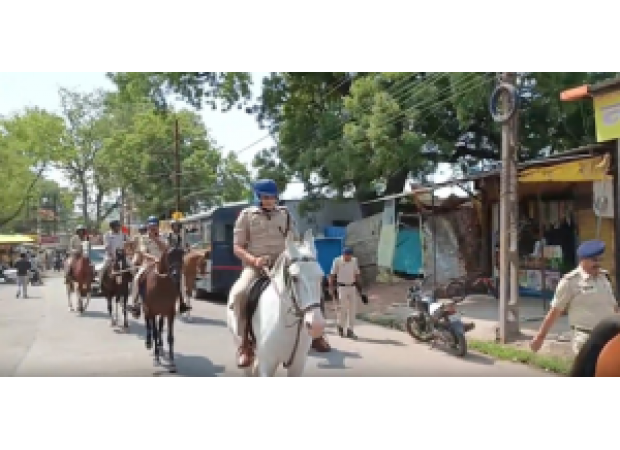

Dhar, a historic town in Madhya Pradesh, is currently facing a tense situation as members of the Hindu community plan to gather at the Bhojshala complex on Friday to perform the Mahaarti. To ensure a peaceful event, the police and Central Reserve Police Force have been deployed extensively in the area. However, despite these efforts, there are still lingering tensions following a recent decision by the Madhya Pradesh High Court to recognize the site as a temple dedicated to Goddess Saraswati.
According to Ashok Jain, who serves as the patron of the Hindu Utsav Samiti, the organizers had initially planned a grand "Shobha Yatra" but decided to cancel it in order to maintain peace and avoid any potential conflicts. The Bhojshala complex has long been at the center of a sensitive dispute between Hindus and Muslims. While Hindus believe it to be an ancient center of Sanskrit learning and a temple dedicated to "Vagdevi or Saraswati", Muslims have traditionally referred to it as the Kamal Maula Mosque and have been offering namaz there on Fridays for decades.
The recent verdict by the Madhya Pradesh High Court on May 15 declared the disputed area as a Hindu temple and quashed the previous Archaeological Survey of India order that allowed restricted access for both communities. The court also directed the authorities to facilitate full worship rights for Hindus and suggested alternative land for a mosque. In response to this judgment, the Muslim community has filed a special leave petition in the Supreme Court, stating that the High Court's decision was one-sided and that namaz had been offered at the site for the last 700 years.
Despite initial plans to offer namaz on Friday, some community leaders have decided to place their faith in the judicial process and have refrained from doing so. In the meantime, Dhar's Superintendent of Police Sachin Sharma has issued a video message on May 20, urging all citizens to strictly comply with the High Court's directives and avoid spreading any rumors or misleading information on social media. He also assured that the administration has made adequate security arrangements and that only the puja permitted by the High Court will be conducted at the Bhojshala complex.
The local authorities, including the District Collector and police, have conducted multiple peace committee meetings and reviewed security arrangements to ensure a peaceful event. Despite the cancellation of the planned procession, devotees are still expected to participate in the Mahaarti with enthusiasm and devotion, marking what many consider to be a historic day for the Hindu community after years of legal struggle. The verdict has drawn significant attention across the country, with both communities closely monitoring further legal developments.
Historians and archaeologists have pointed to inscriptions and structural features at the site that link it to Raja Bhoj's era as a center of learning. The High Court also relied on such evidence, along with the continuity of Hindu worship practices, in reaching its decision. The court also referenced principles from the Supreme Court's Ayodhya verdict to determine the religious character of the place.
As both sides have expressed their intention to respect the legal framework, the situation in Dhar remains under close watch. The deployment of central forces and local police has created a fortified environment in the area, highlighting the sensitivity surrounding the Bhojshala dispute. The authorities have appealed to people from all sections to maintain peace and harmony, and have warned that any attempts to disrupt the atmosphere will be met with a strong response.
Let us all hope that the event proceeds peacefully and that the legal process will bring a resolution to this longstanding dispute.

Readers debate Rare's best game while one explains why they sold their Xbox Series X console....
Read More
Switch 2 price increase by Nintendo didn't last a month as some retailers are now selling it for les...
Read More
Odisha's four Left parties are calling for the removal of the Chief Election Commissioner and for th...
Read More
One reader believes that Marvel's Wolverine is the top game of 2026, despite conflicting opinions fr...
Read More