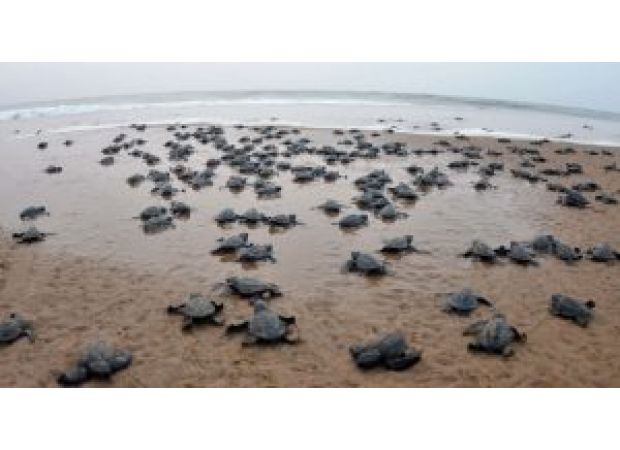

The small town of Berhampur was buzzing with excitement as the annual mass nesting of Olive Ridley turtles began at the Rushikulya river mouth. Forest officials reported that more than 10,000 turtles had emerged from the Bay of Bengal and made their way to the sandy beach under the bright moonlit sky. It was a breathtaking sight to see these magnificent creatures laying their eggs along the 2.5-km-long beach, known locally as 'arribada'.
According to Divisional Forest Officer Sunny Khokkar, the first day of the mass nesting event saw around 10,220 female turtles coming ashore and laying their eggs. This was followed by another 5,700 turtles who arrived sporadically to join in on the nesting. Wildlife experts were thrilled to witness this phenomenon and predicted that it would continue for a few more days as the beach and weather conditions were ideal.
Last year, the nesting had begun about a month earlier, but this year it was delayed. Forest officials noted that in 2025, the first phase of 'arribada' took place from February 15 to 22, and the second phase was from March 21 to 27. During this time, over 9.04 lakh turtles had laid their eggs, as per the data collected by the forest department.
Vishwanath Neelannavar, the Regional Chief Conservator of Forests, explained that the period between February and April was considered the best time for mass nesting at Rushikulya rookery. The forest department had taken various measures to safeguard the nesting site, including deploying 10 protection squads and restricting visitor access to the entire four-km stretch of the beach. Entry points had been set up at Gokharkuda and Podampeta to regulate the number of visitors.
A special awareness camp had also been set up at Bateshwar beach to educate visitors about the importance of conserving these turtles and their nesting site. Assistant Conservator of Forests Diby Shankar Behera shared that the area had been fenced off to prevent predators from harming the eggs, and 24-hour surveillance was being maintained to ensure their safety. During nesting, the female turtles crawl onto the beach, dig pits in the sand and lay around 100 to 150 eggs each before covering them with sand and returning to the sea.
After 45-50 days, the eggs typically hatch, but the mother turtles do not stick around to witness the emergence of the hatchlings. It is a natural instinct for them to go back to the sea and continue their journey. This annual event is a sight to behold and a reminder of the marvels of nature.
Orissa POST - Odisha's No.1 English Daily, proudly covered this incredible event and highlighted the importance of protecting these majestic creatures.

Upasana Music hosts 'Sworanjali' at Soochana Bhawan in Bhubaneswar, while Cuttack Mahanagar Nagarik ...
Read More
Election Commission orders AITC factions to not use party name and symbol during bypolls in West Ben...
Read More
Many people are still unhappy about Sony's all-digital direction, but one fan is amazed by the loyal...
Read More