

Something extraordinary has just occurred. On February 25, 2026, Anthropic made a groundbreaking announcement - the launch of their Enterprise Agents Program. This program incorporates AI agents powered by Claude technology directly into the daily tasks of finance teams, HR departments, legal offices, and engineering desks.
The recent release of the Cowork plugin three weeks prior caused a significant drop in the stock prices of legal software providers, indicating that the market has spoken - AI agents are no longer a distant concept but a present reality that is revolutionizing the software industry. But this is not just another chatbot story. These AI agents, known as Agentic AI, go beyond just answering questions - they have the ability to autonomously plan, make decisions, execute tasks, and continuously improve.
This marks the most significant shift in how work is done since the introduction of spreadsheets. We are moving towards a new era where AI agents are not just answer engines, but execution engines. This is a major development that will have a profound impact on businesses of all sizes, from small solo consultants to large corporations.
For example, Klarna, a global payments company, deployed a single AI agent that was able to handle the workload of 700 full-time customer service employees. In just one month, this agent handled 2.3 million conversations, reducing resolution time from 11 minutes to under 2 minutes and projecting a $40 million profit improvement for the year. This is not just a story of technological advancement, but also a story of economic transformation.
The cost of capacity has drastically decreased with the introduction of Agentic AI. This change is not limited to a few industries - it is affecting every business, big or small. It has bridged the gaps between solo consultants and big firms, startups and legal teams, and regional companies and enterprises.
Agentic AI has eliminated these gaps, making it a level playing field for all businesses. The only question now is whether companies will adapt to this new technology before their competitors do. So what exactly is Agentic AI?
Unlike traditional AI tools that simply respond to user input, Agentic AI is proactive, autonomous, and able to operate across complex workflows with minimal human intervention. It is like having a brilliant consultant who can not only answer questions but also open your laptop, access files, browse the internet, send emails, update spreadsheets, schedule meetings, and report back - all while you focus on other tasks. The key difference between Agentic AI and other AI systems is that it possesses four unique capabilities - memory, planning, tool use, and multi-agent coordination.
These capabilities enable Agentic AI to complete up to 12 times more complex tasks than traditional AI, making it a game-changer in the business world. According to Kate Jensen from Anthropic, the year 2025 was supposed to be the year of transformation for enterprise agents, but the hype turned out to be premature. It wasn't a lack of effort, but rather a failure in approach.
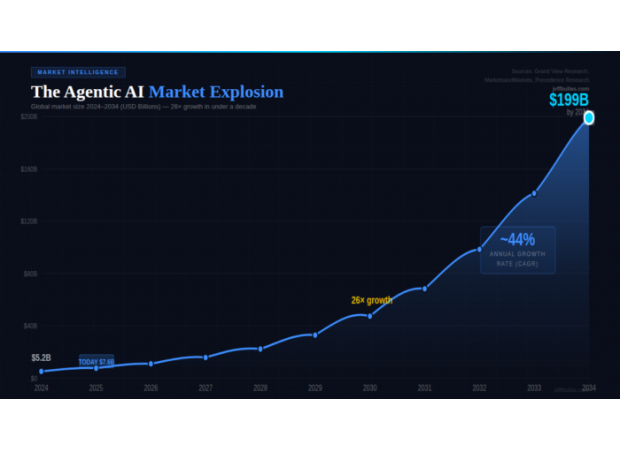
However, the numbers show that the market for Agentic AI is growing at an unprecedented rate. In 2025, the global market size for Agentic AI was around $7 billion, but it is projected to reach $93 billion to $199 billion by 2032-2034. Companies have already invested over $9.7 billion in Agentic AI startups since 2023, and 45% of Fortune 500 companies are actively piloting Agentic systems.
There has also been a 920% surge in the usage of Agentic AI frameworks across developer repositories from 2023 to 2025. It is estimated that by 2028, 33% of enterprise software will include Agentic AI. Currently, North America has the largest market share for Agentic AI, but the Asia-Pacific region is growing at a faster rate due to government-led AI initiatives, such as India's $1.2 billion national AI program.
However, despite all the promising numbers, the reality of the deployment of Agentic AI in 2025 was not as optimistic. Agents were being used as isolated tools, disconnected from enterprise data and lacking proper security controls, creating a compliance risk without delivering sustainable ROI. To bridge this gap, there has been a shift towards embedded, governed, workflow-native agents that can work seamlessly within the tools that people already use, such as Excel, Gmail, and DocuSign.
Anthropic's new program, Claude CoWork, allows every knowledge worker to have access to the autonomous capabilities of Claude Code. This means that one can describe a desired outcome, step away, and return to find the work completed. The Anthropic ecosystem currently has over 12 plugins available for different industries, including finance, legal, HR, engineering, design, operations, sales, marketing, and wealth management.
These plugins can be integrated with popular tools like Google Workspace, DocuSign, WordPress, LegalZoom, Apollo, Clay, FactSet, and Slack. For those who want to build their own specialized agent, Anthropic's Plugin Create feature allows teams to do just that. Some of the early adopters of this platform include L'Oreal, Deloitte, Thomson Reuters, and PwC, which has partnered with Anthropic to deploy governed agents across finance and healthcare operations.
When it comes to the major players in the Agentic AI market, there are both new and old players. Anthropic is considered the "Safety-First Enterprise Layer" with its 12+ plugins and Enterprise Agents Program, aiming to become the default operational layer in governed enterprise workflows. On the other hand, OpenAI, with its revenue of $12.7 billion in 2025 and a target of $125 billion by 2029, is focusing on the scale of its ChatGPT Agent, which can handle complex multi-step workflows autonomously.
They also have a Frontier platform that targets the enterprise market. In addition to these new players, there are also established companies such as Microsoft, which has embedded its Copilot agent within the tools used by 1.2 billion people daily. They have the deepest enterprise distribution of any player, and in April 2025, they expanded their Dynamics 365 platform to include Agentic AI capabilities.
Other big names in this market include Google, Salesforce, IBM, UiPath, and open-source frameworks like LangChain/CrewAI, which are disrupting traditional SaaS providers from below. While the general market for AI agents is growing at a rapid pace, there is a particular focus on vertical AI agents - those built for specific industries. These agents are projected to have a compound annual growth rate of 62.7% by 2030, faster than the overall market.
Coding and workplace experience copilots are also growing at a significant rate of 52.4% and 48.7%, respectively. As with any new technology, there are potential upsides and pitfalls to consider. On one hand, Agentic AI has the potential to drastically increase productivity, democratize expertise, and compound intelligence.
It can also free up human energy to focus on more creative and strategic tasks. On the other hand, there are concerns about accountability, errors, skill atrophy, and uneven disruption in the job market. But one thing is for sure - the introduction of Agentic AI is a monumental moment in history.
As someone who has been in the technology industry for a long time, I have seen the scale and impact of technology on businesses and humanity. Now, with the rise of Agentic AI, we are entering a new era that will reshape industries and the labor market. And this is just the beginning.
There has been a major shift in the world of technology. On February 25, 2026, Anthropic made a groundbreaking announcement: the launch of its Enterprise Agents Program. This program would deploy AI agents powered by Claude directly into the daily tasks of finance teams, HR departments, legal offices, and engineering desks.
This news caused quite a stir, particularly in the stock market, as the initial release of the Cowork plugin just three weeks earlier had caused a significant drop in the stock prices of legal software providers. It was clear that the market had spoken: AI agents were no longer just a concept for the future, they were here and they were taking over software. But this was not just another chatbot story.
These AI agents, known as agentic AI, were not just there to answer questions, they were capable of autonomously planning, deciding, executing, and iterating. This was a monumental shift in how work gets done, comparable to the introduction of the spreadsheet. We were no longer just relying on an answer engine, we now had an execution engine.
This development was not just important for one specific industry, it was a game-changer for all businesses, big or small. Just take a look at Klarna, the global payments company, which saw immense success after deploying a single AI agent that could do the work of 700 full-time customer service employees. This agent handled 2.3 million conversations in its first month, reducing resolution time from 11 minutes to under 2, and projecting a $40 million profit improvement for the year.
This was not just a technology story, this was an economic one. The cost of capacity had drastically decreased. And this was just the beginning.
Agentic AI was reshaping industries, demolishing old business models, and creating extraordinary new opportunities. It was not just making small improvements, it was eliminating gaps altogether. This was evident for solo consultants who couldn't match the output of big firms, startups that couldn't afford a legal team, and even regional companies that couldn't compete with enterprise resources.
Agentic AI was closing these gaps and the only question was whether businesses would move fast enough to keep up with their competitors. But what exactly is agentic AI? It's different from the reactive AI tools we're used to, where we ask a question and get a response.
Agentic AI is proactive, autonomous, and can operate across long and complex workflows with minimal human input. It's like having a brilliant consultant at your disposal who can not only answer questions, but also open your laptop, access files, browse the web, send emails, update spreadsheets, schedule meetings, and report back - all while you focus on other tasks. According to Kate Jensen, an expert at Anthropic, "2025 was meant to be the year agents transformed the enterprise, but the hype turned out to be mostly premature.
It wasn't a lack of effort, it was a lack of approach." The numbers speak for themselves when it comes to the growth and impact of agentic AI. The market is expected to grow exponentially, with a projected global market size of $93B-$199B by 2032-2034. And the rapid pace of this change will not only change the face of business, but also the labor market.
But, as with any new technology, there are both upsides and potential pitfalls. The upsides are clear: radical productivity, democratized expertise, compounding intelligence, and the possibility of new and meaningful human work. However, there are also concerns about accountability, potential errors, skill atrophy, and uneven disruption.
These are important considerations that must be addressed in order for agentic AI to reach its full potential. Before diving into the numbers that define this moment, it's important to provide some historical context. Technology has been disrupting industries and humanity for decades, and sometimes it's easy to become desensitized to the scale of these changes.
But we cannot ignore the impact of agentic AI and its potential to transform the way we work and live. It's time to embrace this technology and use it to our advantage, before our competitors beat us to it. In conclusion, the introduction of agentic AI through Anthropic's Enterprise Agents Program and the CoWork plugin is a monumental event.
It is reshaping the way we work and creating new opportunities for businesses of all sizes. With the right approach and careful consideration of the potential pitfalls, agentic AI has the power to revolutionize industries and improve our daily lives. Let's embrace this technology and see where it takes us.

Square Enix brings back turn-based combat and 2D visuals in a retro Final Fantasy spin-off starring ...
Read More
Dishonored’s developer reportedly has under a month to find a buyer or face closure amid Xbox’s ...
Read More
Thursday’s letters page worries about gaming’s current state, while a reader anticipates Exodus ...
Read More
Congress raises concerns over judicial independence under Modi, citing Justice Kaul’s memoir and u...
Read More