
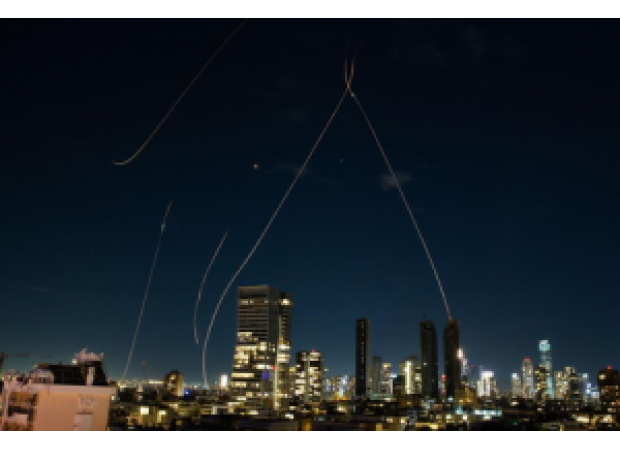

On Thursday, the peaceful city of Tel Aviv was once again rocked by the launch of missiles by Iran. According to both the Israeli military and Iranian state media, air raid sirens were sounded in various locations, including Tel Aviv. Thankfully, there were no reports of any casualties.
The Israeli military also noted that this attack came after a pause of more than seven hours in the ongoing hostilities. In their official statement, the military stated that the Israeli Air Force had detected missiles being launched from Iran towards Israel. They also reassured the public that their air defense systems were actively working to intercept the incoming projectiles.
The news was also confirmed by Iran's state broadcaster, IRIB. Amidst the escalating confrontation, Iranian state media reported that more than 1,000 people have lost their lives in the Israeli and US strikes that began last weekend. This latest attack comes after tensions reached a boiling point on February 28, when a joint airstrike by the US and Israel killed Iran's Supreme Leader Ayatollah Ali Khamenei, along with members of his family and other high-ranking officials.
This was preceded by the collapse of diplomatic efforts to ease the growing tensions between Washington and Tehran. Iranian President Masoud Pezeshkian expressed that their country had tried to pursue diplomatic solutions to avoid war, but they were left with no choice but to respond to what he called "American-Zionist military aggression." He also assured leaders of neighboring Gulf countries that Iran respected their sovereignty and believed that regional security should be achieved through collective cooperation. Meanwhile, Israel declared that they and the US had achieved "historic gains" in the conflict with Iran.
The office of Prime Minister Benjamin Netanyahu claimed that the latest strike was necessary as Iran was allegedly building new underground bunkers to restart their atomic bomb program. The conflict has also had a ripple effect on the wider region, with tensions rising among neighboring countries. Qatar's Prime Minister Sheikh Mohammed bin Abdulrahman Al Thani accused Iran of trying to involve other states in the confrontation during a phone call with Tehran's foreign minister.
In another incident, Turkey summoned the Iranian ambassador after a missile, believed to be aimed at a base in Cyprus, landed on Turkish territory. This has raised concerns of a potential spillover of the conflict in the region. As the exchange of strikes continues, it highlights the fragile security situation in West Asia.
Despite efforts to find a diplomatic solution, military actions seem to be escalating, causing further instability in the region.

Thursday’s letters page worries about gaming’s current state, while a reader anticipates Exodus ...
Read More
Square Enix brings back turn-based combat and 2D visuals in a retro Final Fantasy spin-off starring ...
Read More
Exelon CEO Calvin Butler gave an emotional acceptance speech at the 2026 Black Enterprise XCEL Summi...
Read More
Indian Embassy probes reports of Indian nationals aboard a yacht hit off Yemen coast....
Read More