
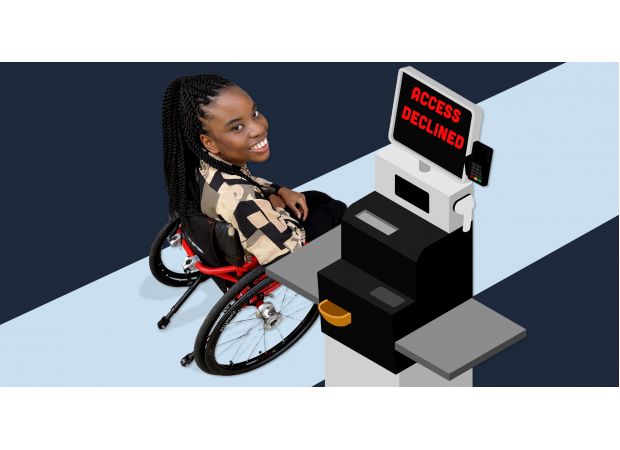

Toyin Fabusiwa is a 26-year-old woman who often goes shopping with her family. However, her experience at the supermarket is not always easy. As a wheelchair user, she faces challenges with the self-checkout systems at supermarkets, making it difficult for her to pay for her groceries.
She recently shared a video on TikTok, showing her struggle to scan her items at a Lidl store in Croydon, south London. In the video, Toyin can be heard saying, "Don't blame me if I accidentally don't pay for something, blame the inaccessible self-checkouts." She explained that the card machine is too high for her to reach when the voice command says, "finish and pay." This makes it impossible for her to complete the transaction. She also mentioned that it's hard for her to scan items at the self-checkout due to the angle, especially for items without barcodes, like loose fruits and vegetables.
This is not just a problem at Lidl, but at other shops as well. Despite the fast scanning speeds at Lidl, Toyin struggles to pay at manned checkouts too. When the machine asks her to insert her PIN, she is unable to do so because the machine does not come down to her level.
This has happened to her at other shops as well, and it can be frustrating. Some people suggested that Toyin should just avoid using the self-checkout and go to the manned checkout instead. However, this is not always an option for her.
She recalled an incident at Greggs, where the card machine was too high up for her to see the keypad and enter her PIN. When she asked the cashier for help, she was told that nothing could be done. This experience left her feeling disappointed and she has not been back to that Greggs since.
Toyin is not alone in facing these challenges. As a disability campaigner, she has noticed an increase in such incidents in the past few years. Apart from the issues with the self-checkout, she also struggles to reach items on high shelves and open freezer section doors.
She has also found that most staff members are not helpful when she flags these issues to them. As she starts to do her own shopping instead of relying on her family, Toyin worries about the future. She wonders how she will manage if she goes shopping alone and faces these challenges.
She believes that she should be able to do her own shopping without having to constantly ask for help. However, the majority of the world is able-bodied, and it can be hard for them to understand the struggles faced by people with disabilities. Self-checkout systems have been on the rise in the last 20 years, with nearly every person in the UK having used one in the past six months.
However, they come with their own set of issues. Some people find them slow and unreliable, while others, like low-income and elderly shoppers, prefer to use cash. A petition was launched last year, calling for a fair number of cash-accepting tills, and it received nearly 72,000 signatures.
For Toyin, all she wants is to be able to pay for her groceries independently. She believes that businesses need to work with disabled people to build accessible systems. Alison Kerry, head of communications at the charity Scope, says that this highlights how our society and environment are not inclusive towards people with disabilities.
She urges everyone to work together to break down these barriers. In the meantime, Toyin continues to face these challenges every time she goes shopping. She hopes that supermarkets will take notice and make the necessary changes to accommodate people with disabilities.
After all, it's not just about making shopping easier for Toyin, but for many others who face similar struggles.

Many gamers are now in their 40s, yet publishers still prioritize catering to younger audiences, lea...
Read More
Switch 2 price increase by Nintendo didn't last a month as some retailers are now selling it for les...
Read More
Xbox exec reassures fans that GTA 6 pre-orders are doing extremely well despite recent layoffs and w...
Read More
Trump's ban on three news outlets from the White House has been temporarily blocked by a judge, but ...
Read More