
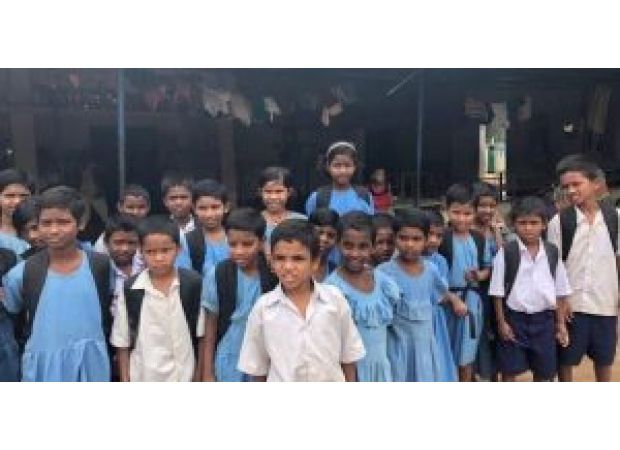

In Nabarangpur district, there is a growing concern over the high number of students who are dropping out of school before completing their education. This worrying trend is being seen across all levels, from primary to secondary, and has raised red flags for the School and Mass Education Department as well as social organizations. The issue was recently brought up in the state Assembly by Balasore Sadar MLA Manas Kumar Dutta, who requested details from the state School and Mass Education Minister, Nityananda Gond, on the dropout rates in the state over the last five years.
According to data presented by Minister Gond, the dropout rate in Nabarangpur is particularly alarming when compared to the other districts in the undivided Koraput region. At the primary level, the dropout rate stands at 1.73%, with slightly higher rates among girls at 2.01% and slightly lower rates among boys at 1.45%. However, the rate jumps significantly at the upper primary level to 10.57%, with girls at 10.91% and boys at 10.25%.
This trend continues at the secondary level, where the dropout rate almost doubles to 19.55%, with girls at 20.83% and boys at 18.39%. In comparison, the dropout rates in Koraput, Malkangiri, and Rayagada districts stand at 1.90%, 3.16%, and 2.46%, respectively, at the primary level, and 4.96%, 2.99%, and 4.25%, respectively, at the upper primary level. These numbers clearly show a consistent rise in the dropout rates as students progress to higher classes in Nabarangpur, highlighting the urgent need for intervention.
The situation is particularly concerning at the secondary level, where the dropout rate is at 19.55% in Nabarangpur, compared to 16.19% in Koraput, 13.10% in Malkangiri, and 15.58% in Rayagada, according to official data. The reasons for this rise in dropout rates include financial difficulties, child labor, family responsibilities, and a lack of awareness among parents. The practice of early marriage among adolescent girls has also been identified as a significant factor contributing to the discontinuation of education.
Despite the government's efforts to address the issue through various schemes such as mid-day meals, free textbooks, uniforms, bicycles, and scholarships, there have been allegations that these measures are not being implemented effectively. With the number of dropouts on the rise, education experts warn that this could lead to higher levels of illiteracy, unemployment, and social inequality. They stress the need for coordinated efforts by the government, the education department, and parents to tackle this issue.
This includes a focus on providing quality education, regular counseling for students, and awareness programs for parents. Observers caution that if concrete steps are not taken to curb the dropout rates, the education system could face a deeper crisis. As an incentive for students to return to school, the government is also offering stipends and incentives.
Special initiatives to promote girls' education in the KBK region include Kasturba Gandhi residential schools, as well as ashram and sevashram schools run by the Scheduled Caste and Scheduled Tribe Department. However, these efforts have not yet shown a significant decline in the dropout rates, causing concern among educationists and policymakers. It is crucial for the government to take firm action and implement effective policies to address this issue before it escalates further.
CIPET: CSTS, Bhubaneswar and MCL, Sambalpur have signed an MoU for employment-oriented training prog...
Read More
India and UAE will work together to implement initiatives for trade in local currencies, payment sys...
Read More
Readers are surprised by Super Mario 64's 30th anniversary and one defends Marvel's Wolverine on the...
Read More
One reader believes that Marvel's Wolverine is the top game of 2026, despite conflicting opinions fr...
Read More