

Are you someone who dreads long flights? The idea of spending 13 hours on a plane to reach Hong Kong might sound like an exhausting ordeal. But don't worry, because Elon Musk has some exciting news for you.
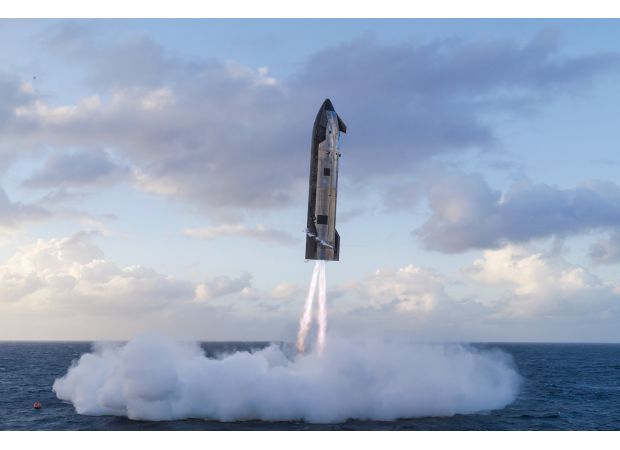
His company SpaceX has developed a megarocket that can take you from London to Hong Kong in just 34 minutes, covering a distance of 6,000 miles. Unfortunately, the Starship V3, the latest model of this revolutionary rocket, exploded during its 12th test flight over the Indian Ocean. However, unlike previous mishaps, this explosion was planned as part of a controlled splashdown.
Standing at a staggering height of 408 feet, the Starship is the largest and most powerful rocket ever built. Its launch from Texas saw it travel halfway across the globe before meeting its planned end. Initially, the launch was scheduled for Thursday, but due to a technical issue just 40 seconds before liftoff, it had to be postponed.
However, the next day, the giant rocket successfully took off and before its re-entry, it released 22 dummy Starlink satellites. Elon Musk described the entire hour-long trip as "epic" and commended his team for their achievement. He even took to his social media platform, X, to share the news with his followers and declared it a "goal for humanity." While the ultimate goal of Starship is to transport humans to Mars, it has also been advertised as a means of intercontinental travel.
In fact, SpaceX president Gwynne Shotwell compared it to a hypersonic airplane that could potentially cover distances like New York to Paris in just 30 minutes. This ambitious idea has become a reality now, as on November 6, 2024, Starship successfully completed an Earth-to-Earth journey by traveling to low Earth orbit, which is approximately 1,200 miles above the ground. The Starship is composed of two parts: the Ship, where passengers would sit, and the Super Heavy, a powerful booster stage with 33 engines.
This rocket is designed to be reusable, and the returning stages are caught by giant mechanical arms at the launch pads. However, despite its impressive capabilities, Starship has faced multiple setbacks. The older Starship V2 disintegrated during its seventh test in January 2025, and the following eight trials were also unsuccessful.
The ninth test ended with the rocket breaking apart during re-entry, resulting in debris falling over the Atlantic. But SpaceX is determined to make Starship a reliable mode of transportation. They have upgraded the rocket's engine, thermal protection, and plumbing systems to make it more robust.
As part of their test, the Starship also ejected a dozen mock satellites. However, even SpaceX acknowledges that offering one-hour journeys across the world is a challenging task. In a statement, the company mentioned that restrictions on supersonic flights over certain regions due to sonic booms and the economic viability of shorter routes are the biggest hurdles.
Nonetheless, SpaceX believes that they are well-positioned to capture a significant share of the terrestrial logistics and transportation market. What do you think about this revolutionary rocket? Share your thoughts in the comments below and don't forget to add Metro as your preferred source on Google.

A human skeleton was discovered in a scrap dealer's settlement during a cleanliness drive in New Del...
Read More
Odisha's four Left parties are calling for the removal of the Chief Election Commissioner and for th...
Read More
Many gamers are now in their 40s, yet publishers still prioritize catering to younger audiences, lea...
Read More
One reader believes that Marvel's Wolverine is the top game of 2026, despite conflicting opinions fr...
Read More