

In the past, the internet used to reward those who shared valuable information. Then, it shifted to rewarding those who could grab attention. Now, with the advancement of AI, both information and attention have become cheap commodities.
With just a single prompt, AI can produce a 2,000-word article in a mere thirty seconds. It's perfectly optimized, structured, and unfortunately, forgettable. We are no longer anticipating a content flood - it has already arrived.
As a result, creators who built their entire business on publishing volume are now struggling to stay afloat. So, what's next? We're not looking for a philosophical answer here, but a practical one.
As Jeff Bullas, a prominent blogger and digital marketing strategist, puts it, "The next scarce asset is human signal." This means that the proof of a real person with taste, judgment, story, and lived expertise behind their work is what will make them stand out in a world where AI-generated content is flooding the market. This is a topic that hits close to home for me as I have built my business model over the past 17 years, and now, it seems to be on the verge of becoming obsolete. I have been searching for what the future holds, and after researching and observing three creators for years, I believe I have found the answer to how to build a scalable business in this new era.
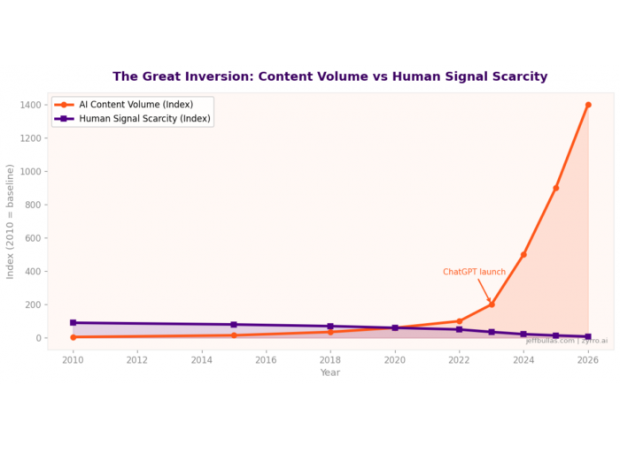
Chart 1 shows the great inversion - while AI-generated content has exploded, the scarcity of human signal makes authentic creators more valuable. This chart is based on research from jeffbullas.com and zyrro.ai. The problem with simply publishing more content is that for years, the equation for content marketing has been "more content equals more traffic, which equals more leads, and ultimately, more money." But this formula no longer works.
Three things have broken it - Facebook's throttling of organic reach, Google's ability to provide direct answers to queries, and the emergence of AI, which has made the production of content extremely cheap. In other words, information is no longer scarce. The role of an explainer, someone who synthesizes, summarizes, and teaches, is now being contested by machines that never sleep, never charge overtime, and never have an off day.
Creators who have built their identity solely around being useful and educating others are now discovering that usefulness alone is no longer a sustainable business model. This is because AI is now taking over as the primary source of information and education. So, the burning question is, what is the new business model in this new era?
It requires creators to have a human signal in a world dominated by AI-generated content. But what exactly is a human signal? Here's a diagnostic test - ask yourself, "Could an AI have written this?" If the answer is yes, and you cannot point to something specific that makes it uniquely yours, then it is merely noise, not a signal.
Your "Human Signal Stack" consists of six layers, starting with knowing your identity. This goes beyond your job title; it's about understanding your obsessions, your origins, your wounds, and your contradictions. Then comes your story, which comprises specific experiences that prove your point, real moments, not hypotheticals.
Next is your expertise, which is hard-won judgment gained from making mistakes and learning from them. Evidence comes next, which includes your original research, tracked experiments, and documented failures. Interaction is also crucial - it's about being responsive and showing that you are genuinely engaged in conversations, even if there are disagreements.
Finally, community - the tribe that forms around your unique perspective, not just your topic. The foundation layers of your Human Signal Stack, which are discovering and building your identity, story, and expertise, take time to build but are permanent once established. On the other hand, the activation layers - evidence, interaction, and community - compound over time.
A creator who has all six layers of the Human Signal Stack is almost impossible to replicate. On the other hand, a creator who has none is indistinguishable from a machine. Now, the real question is, how does this translate into a business model?
Here are three people worth checking out - visit their websites, read their writing, listen to their podcasts, and buy their books. I have personally read all their books, and I have read Tim Ferriss's "The 4-Hour Workweek" about three times. Case Study 1: James Clear.
James Clear is not your typical productivity expert. There are thousands of them out there, and most of them are interchangeable. But Clear is different - he has a unique identity.
He is a man who suffered a skull fracture in a high school baseball accident, spent months recovering, and used that experience to develop a precise understanding of how small habits compound over time. He didn't just read about resilience; he lived through a medical crisis and came out on the other side with a specific theory about human behavior, which he tested on himself first. He started a newsletter in 2012, even before he had a book deal, a publisher, or a platform.
What he did have was a strong sense of identity and a compelling story. He also had the discipline to write one clear idea every week for years. He didn't publish more than anyone else, but he published consistently and with more specificity and personal authority behind every claim.
This led to his book, "Atomic Habits," selling over fifteen million copies, not because it contained information that nobody else had, but because the voice behind it was undeniably specific. When you read it, you could feel that a real person had tested these ideas and paid something to arrive at them. The business that grew around it - the courses, the speaking engagements, and the premium content - was not built on traffic volume but on a reputation that couldn't be replicated because it was tied to a specific identity with a unique origin story.
The lesson here is that a narrow, deeply human point of view, published consistently over years, can create an audience that is willing to pay for access to the mind behind the information. Case Study 2: Tim Ferriss. Tim Ferriss was not a business expert when he wrote "The 4-Hour Workweek." He was a supplement company founder who had worked himself into a breakdown and then spent a year conducting experiments on his own life to find a way out.
His book was not based on research but on his documented escape. Every claim was rooted in something he had personally tested on his body, business, or psychology. This was his signal.
In the early days of the internet, information was highly valued and rewarded. Then, the focus shifted to gaining attention, and now, with the emergence of AI, both have become easily accessible and cheap. In just thirty seconds, AI can produce a 2,000-word article that is perfectly optimized, structured, and forgettable.
The influx of content is no longer looming on the horizon, it is already here. Those who based their business on publishing a high volume of content are now struggling to stay afloat. So, what does the future hold?
Let's not get lost in philosophical musings, but rather look for practical answers. As the landscape of the internet changes, so must our business models. According to one expert, the next valuable asset will be human signal - the proof that a real person with taste, judgment, story, and lived expertise is behind the work.
As someone who has built their business over the past 17 years, this concept is crucial to me. I have been searching for what lies ahead, and after researching and observing three creators for years, I have found tangible evidence of how this idea translates into a successful and scalable business. Let's take a look at Chart 1, which illustrates the great inversion - the explosion of AI content volume and the increasing value of human signal.
This data is from jeffbullas.com and zyrro.ai. The Problem with Publishing More For many years, the equation for content marketing was simple - more content equals more traffic, more traffic equals more leads, and more leads equals more money. It worked surprisingly well - until it didn't.
Three things happened to break this model. First, Facebook began to limit the organic reach of content. Then, Google started providing direct answers to queries, limiting traffic to websites.
And finally, AI made producing content virtually costless. Information is no longer scarce. But perhaps the most significant impact is on the "explainer" role - the person who synthesizes, summarizes, and teaches.
This role is now being contested by machines that never sleep, never charge overtime, and never have an off day. Creators who have built their identity solely around being useful and educating others are learning the hard way that usefulness alone is no longer a viable business model. With AI now acting as our informer and educator, what comes next?
The burning question is, how do we adapt our business models to thrive in a world dominated by AI-generated content? The answer lies in having a human signal amidst the sea of machine-generated content. But what exactly is a human signal?
It can be determined by asking one question about anything you publish - "Could an AI have written this?" If the answer is yes and you cannot pinpoint something unique that makes it distinctly yours, then it is simply noise, not a signal. According to experts, a "Human Signal Stack" consists of six layers. It begins with understanding your identity, not just your job title, but your obsessions, origin, wound, and contradictions.
Next is your story - real experiences that prove your point, not hypotheticals. Then comes expertise, gained through trial and error. Evidence, interaction, and community make up the remaining layers, which compound over time.
The Foundation Layers: Discovering and building your identity, story, and expertise takes time but once established, they are permanent. The Activation Layers: Evidence, interaction, and community also compound over time. A creator who has all six layers is almost impossible to replicate, while one with none is indistinguishable from AI-generated content.
But the ultimate question remains - how can this human signal be transformed into a successful business? Allow me to introduce you to three creators who have achieved just that. Take a look at their websites, read their writing, listen to their podcasts, and buy their books.
I personally have read all their books, and Tim Ferriss's "The 4 Hour Work Week" multiple times. Case Study 1: James Clear James Clear is not your typical productivity expert. There are thousands of them, all interchangeable and lacking a distinct human signal.
Clear, on the other hand, is unique. He fractured his skull in a high school baseball accident and spent months recovering. During that time, he developed a precise understanding of how small habits compound over time.
He didn't just read about resilience; he lived it. This personal experience gave him a deep understanding of human behavior, tested on himself first. In 2012, before he had a book deal, a publisher, or a platform, Clear launched a newsletter.
What he did have was a strong sense of identity and a compelling story, which he shared consistently with his audience for years. He didn't publish more than anyone else; instead, he focused on publishing with specificity and personal authority. His book, "Atomic Habits," sold over fifteen million copies, not because it contained groundbreaking information, but because it was undeniably specific and authentic.
Clear's business model is not based on traffic volume, but on a reputation that cannot be replicated - it is tied to his unique identity and story. The lesson here is that a narrow, deeply human point of view, published consistently over time, creates an audience that is willing to pay for access to the mind behind the information. Case Study 2: Tim Ferriss When Tim Ferriss wrote "The 4-Hour Workweek," he was not a business expert.
He had worked himself into a breakdown as the founder of a supplement company, and the book was his documented escape plan. Every claim in the book was based on an experiment he personally conducted on his own body, business, and psychology. This was his human signal.
Ferriss's identity, story, and expertise were firmly established before he wrote the book. He did not rely on publishing more content than anyone else; instead, he focused on publishing with a specific, personal point of view. This led to the success of his book, which has sold millions of copies.
His business, including courses, speaking engagements, and premium content, was built on his reputation, which could not be replicated because it was tied to his unique identity and story. Conclusion The internet has changed, and our business models must change with it. As AI-generated content becomes more prevalent, a strong human signal is the key to success.
By understanding and building your identity, sharing your story, and developing your expertise, you can create a human signal that sets you apart from the crowd. And as the examples of James Clear and Tim Ferriss show, this human signal can be transformed into a successful and scalable business. So, as the internet continues to evolve, let us remember the importance of being uniquely human in a world of machines.

Reader's verdict on Nintendo Directs: Happy with just a Switch 2, no need for PS5....
Read More
AI may be able to write, but authorship is more than just typing - it's about purpose, evaluation, a...
Read More
An artist creates a 9-inch mandap using waste materials and a small Ganesh idol for a cultural event...
Read More
U.S. lawmakers rush to add amendments to Russia sanctions bill, including naming top trading partner...
Read More