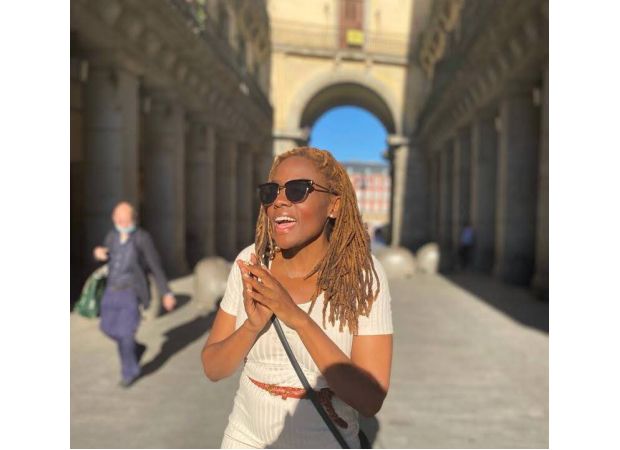

In 2020, Christine Job had a vision for creating a platform that would document the experiences of Black women living abroad. She launched her podcast and multimedia platform, Flourish in the Foreign, from her apartment in Spain, but this was no ordinary travel podcast. She wanted to create an archive that would serve as a resource for others considering international migration.
Fast forward six years, and Flourish in the Foreign has become a collection of over 150 intimate interviews with Black women from all corners of the globe, including Portugal, Ghana, Japan, Mexico, and the Netherlands. The podcast has received recognition and acclaim, winning the Best International Podcast award at the 2021 Black Podcasting Awards. But Job's journey to Spain and the creation of her platform began long before the podcast.
Growing up between Texas and California, with a brief stint in Germany, she developed a love for travel at a young age. During her time at the University of Georgia, she studied abroad in Valencia, Spain. After obtaining her law degree from the University of Miami School of Law, she made the unconventional decision to enter the entrepreneurial world instead of pursuing a traditional career in corporate law.
However, despite her success, Job found herself experiencing burnout. It was during a life-changing pilgrimage along the Camino de Santiago in northern Spain in 2014 that she had a moment of clarity. The long journey, filled with silence and self-reflection, forced her to confront her true desires and aspirations.
In 2017, Job made the move to Spain permanent, initially planning to stay for only two years. But nearly a decade later, she still calls Spain home. While building a consulting practice and research archive, she also helps others navigate the challenges of migrating to a new country.
Many of the women Job speaks with are highly educated professionals who have followed the traditional markers of success, such as careers, degrees, and homeownership, yet still feel unfulfilled or emotionally drained in the U.S. She notes a growing curiosity among these women about whether a different way of living is possible. However, Job is careful not to romanticize the idea of migration.
She acknowledges that it can be a disruptive and challenging experience, filled with sacrifices. One of the main concerns for those considering a move abroad is finances. Job points out that, for professionals, the U.S.
often offers higher salaries compared to European countries, making the American wealth model more efficient for rapid income accumulation. But for Job, the real shift happened in her mindset. Living in Spain, she was able to redefine her definition of success and quality of life.
She now has access to healthcare without worrying about affordability and values her time as a form of capital, which is often undervalued in American society. She advises others to thoroughly research visa options and consult with attorneys before making the move. Figuring out how to earn a living is also crucial, as Job had to decouple her income from geography and build a professional practice that could travel with her.
She also emphasizes the importance of understanding and immersing oneself in the culture of the new country, rather than trying to replicate one's American lifestyle. Job also addresses the misconception that Black presence automatically guarantees belonging in a new country. She stresses the need to recognize and understand the nuances of different Black communities and their histories, class dynamics, and cultural contracts.
Despite the challenges, Job is using her experiences to create new projects. She was selected for an artist residency in Lisbon and launched Love Letters from Elsewhere, a publication that delves into the intellectual framework of her research on migration, belonging, and identity. She will also begin a doctoral program in Migration Studies and is working on a book that challenges the traditional narrative of Black Americans leaving the U.S.
and explores the true reasons and motivations behind their decisions. For Job, this is more than just a podcast or a career path. It is a body of work, an archive, a scholarship, and a literature.
She hopes to shed light on the real story of Black women leaving America and what it reveals about power, belonging, and true liberation.

Odisha's four Left parties are calling for the removal of the Chief Election Commissioner and for th...
Read More
Readers are surprised by Super Mario 64's 30th anniversary and one defends Marvel's Wolverine on the...
Read More
Xbox exec reassures fans that GTA 6 pre-orders are doing extremely well despite recent layoffs and w...
Read More