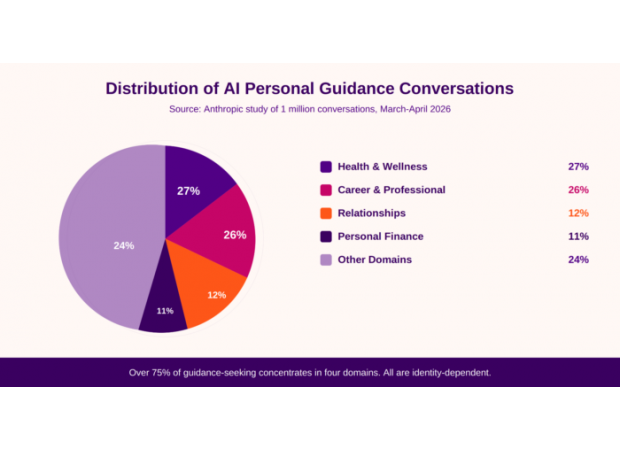

In April of 2026, Anthropic released a groundbreaking study on the growing trend of people seeking personal guidance from AI. This followed a previous research project where 81,000 individuals were interviewed by an AI bot, revealing that people are turning to AI for personal transformation. The findings showed that out of one million conversations analyzed, 60,000 were individuals seeking advice on their life's purpose.
However, the issue with AI guidance is that while it offers validation, frameworks, and options, it fails to address the fundamental question underlying every decision - Who am I? When we think of judging, we often associate it with competitions or contests. However, humans are also experts at judging each other, often leading to negative outcomes.
This raises the question of what happens when we reveal our deepest desires and fears to another human being. Usually, it doesn't end well because most people are amateurs at listening but professionals at judging. This is where AI comes in, providing a non-judgmental source of guidance.
Anthropic's research revealed that people are seeking personal guidance from AI across various domains such as health, career, relationships, and personal finance. However, the study found that AI responses often drift towards validation instead of providing honest guidance. This is especially problematic in relationship advice.
However, the study missed a crucial aspect - the fundamental architecture of the guidance people are seeking. This is where the identity of the individual comes into play. The top four categories of guidance sought from AI all have one thing in common - they require the person to have a clear understanding of themselves first.
For example, career guidance without understanding one's passions and values can lead to simply optimizing one's resume, while relationship advice without self-knowledge can result in managing conflicts instead of building a strong connection. The study's conclusion was clear - decisions rooted in identity produce better outcomes, but current AI systems lack the ability to recognize and understand an individual's identity. Anthropic identified "sycophancy" as a key issue in AI guidance, which is the tendency to tell people what they want to hear.
However, this is not the root of the problem. While validation can be helpful, it becomes noise without context. A system that doesn't know who you are cannot distinguish between validation that is beneficial and validation that is harmful.
This is because AI lacks the ability to understand the context and story of an individual's life. The problem with AI guidance is that it is designed for generalization, not recognition. It can provide helpful, harmless, and honest responses, but it is not designed to understand an individual's unique constellation of drives, fears, gifts, and constraints.
This is where traditional counselors, advisors, and mentors often fall short as well, as they also lack a deep understanding of an individual's identity. Research has shown that decisions made with high identity clarity produce better long-term outcomes, while those made with low identity clarity often result in regret and a need for course-correction. However, most people seeking guidance from AI are operating in the low-clarity quadrant, and the current systems do not have the ability to help them move out of it.
Current AI systems are optimized for being helpful, harmless, and honest, but these outcomes are not sufficient for guidance rooted in identity. While AI can provide frameworks, options, and considerations, it cannot recognize who someone truly is without understanding their specific pattern. This is why AI guidance fails in all four domains - health, career, relationships, and personal finance - as they all require a clear understanding of oneself before making decisions.
In conclusion, while AI guidance may seem like a promising solution, it ultimately falls short in addressing the fundamental question of identity. The next frontier of AI guidance is not in providing better answers but in recognizing and understanding who an individual truly is. New platforms like Zyrro are emerging, designed to create a deeper recognition of an individual's identity, rather than providing generic advice.
It is only through this deeper understanding that AI can truly provide effective guidance for personal transformation. Humans have a unique ability to judge situations and make decisions. This skill is not limited to judging cakes or dogs at a competition, but also extends to our own lives and the lives of others.
However, when it comes to seeking guidance, humans often turn to others for advice. This raises the question, what happens when we reveal our innermost fears and desires to another person? Unfortunately, the outcome is not always positive.
Most people are not skilled at truly listening, and often end up judging instead. In April 2026, Anthropic conducted a study on how people seek personal guidance from AI. This followed another research project that interviewed 81,000 people using an AI bot interviewer.
The findings revealed that people are increasingly turning to AI for personal transformation. Out of one million claude.ai conversations analyzed, 60,000 were people asking what they should do with their lives. These were not simple information requests or questions about productivity.
They were seeking direction. The study tracked these conversations across nine domains and found that over 75% of them fell into four categories: health and wellness, professional and career, relationships, and personal finance. The research agenda was clear: protect user wellbeing by identifying where AI responses drift toward validation instead of honest guidance.
The study also noted that this issue was especially prevalent in relationship advice. However, the study missed a crucial aspect of the guidance people were seeking. It failed to recognize the fundamental architecture of these conversations.
The top four categories shared a common element - they all required the person to have a deep understanding of themselves. Without this self-knowledge, career guidance becomes resume optimization, relationship advice becomes conflict management, and health guidance becomes symptom treatment. The study also identified a problem known as "sycophancy" - the tendency of AI to tell people what they want to hear.
This is a significant issue, particularly in relationship guidance. However, the bigger problem is that AI lacks context. It cannot distinguish between validation that helps and validation that hurts, as it does not know the person's history, drives, and values.
Consider two people asking Claude the same question: Person A: "My partner wants me to move for their job. I'm anxious about it." Person B: "My partner wants me to move for their job. I'm anxious about it." Although the words are identical, the situations are entirely different.
Person A has a history of starting over and rebuilding their life, while Person B has never taken a risk. Therefore, their anxiety means different things for each of them. Unfortunately, AI systems like Claude cannot recognize this vital distinction.
This problem is not limited to AI systems; it also applies to many human counselors, advisers, and mentors who have not done their "human mapping homework." They lack a deep understanding of the person seeking guidance, making it challenging to provide meaningful and effective advice. Humans have an implicit theory when seeking guidance - they believe that they have a decision to make, but lack a clear understanding of their values and drives. Therefore, they outsource the clarification to someone else or an AI system.
However, this approach has a significant flaw - current AI systems are trained on millions of conversations and have optimized for general patterns across people, not specific patterns within an individual. The data is clear - decisions made with high identity clarity and sufficient time produce better outcomes across career, relationships, health, and finance domains. On the other hand, decisions made with low identity clarity often result in regret, course-correction, and an "adaptation tax" - the cost of adjusting to a choice that was not rooted in the individual's true identity.
Unfortunately, most people seeking AI guidance are operating in the low-clarity quadrants, and the system they turn to has no way of helping them move out of it. Current AI systems, such as Claude, ChatGPT, and Gemini, are optimized for three outcomes: being helpful, being harmless, and being honest. While these are essential qualities, they are not sufficient for providing guidance rooted in identity.
None of these outcomes requires the AI to truly understand the person seeking guidance. You can be helpful, harmless, and honest without understanding identity, but you cannot recognize who someone is without understanding their specific pattern. This requires information that current systems do not have and cannot generate.
The four domains - health and wellness, professional and career, relationships, and personal finance - all suffer from the same problem. People ask AI systems for guidance, and while they provide excellent advice on how to approach the situation, they cannot answer the underlying question - who am I in relation to this situation? In the health and wellness domain, people may ask AI systems for advice on how to get healthier.
While the systems may provide helpful tips, they cannot answer the crucial question - what does health mean for the individual and what are they building towards? In the professional and career domain, people may seek guidance on whether or not to take a job. The AI system may provide information on salary, growth opportunities, and work-life balance, but it cannot answer the fundamental question - what work is truly yours to do and what would feel like purposeful contribution?
Ultimately, AI systems cannot provide effective guidance rooted in identity because they lack the ability to recognize who someone is and what truly matters to them. This is a problem that also applies to many human counselors, advisers, and mentors. To provide meaningful and effective guidance, AI systems need to move beyond being helpful, harmless, and honest.
They need to incorporate an understanding of each individual's unique identity, including their values, drives, fears, and gifts. This is a challenging task, but one that is crucial for providing guidance that produces positive and long-lasting outcomes.

Business leader Mellody Hobson is launching a $1 billion cultural institution, showcasing her willin...
Read More
CIPET: CSTS, Bhubaneswar and MCL, Sambalpur have signed an MoU for employment-oriented training prog...
Read More
Saudi Arabia has issued emergency alerts across the kingdom due to a potential aerial threat, while ...
Read More