

Recently, I came across a draft of mine that I didn't even recognize as my own. While it wasn't bad, it wasn't great either. The sentences were technically sound, the structure was solid, and the research was well-incorporated.
Yet, when I read it, it didn't sound like me at all. I realized that this was because I had relied on AI to do a lot of the heavy lifting, as I always do now. From research to structure to organizing my chaotic thoughts, AI made the process smoother and more efficient.
However, in doing so, it also took away the human element and left me with a piece that was competent but lacked any personal touch or soul. It was a polished, unhaunted draft with no scars or moments of self-discovery. Feeling unsatisfied with the piece, I deleted most of it and started over the next morning at 4:30 am.
At the time, I saw this as a personal failure as a writer. Little did I know, this was a measurable effect that researchers have now put a number on. They call it the "tool lift," where AI lifts the floor but lowers the ceiling.
In 2024, a study conducted by Anil Doshi and Oliver Hauser showed that stories written with AI assistance were rated as more creative, better written, and more enjoyable. This was especially true for less creative writers who were lifted by the tool. It seemed like a good thing, until I delved into the rest of the study.
The AI-assisted stories were more similar to one another than the human-only stories. While everyone improved their writing, they also unknowingly moved closer together. The researchers called this a social dilemma, where individuals benefited but the group produced a narrower range of ideas.
It was an unintended trade-off that nobody agreed to. This was further supported by a study done by Kibum Moon, Adam Green, and Kostadin Kushlev, who found that human essays brought more genuinely new ideas compared to GPT-4 essays. But the research didn't stop there.
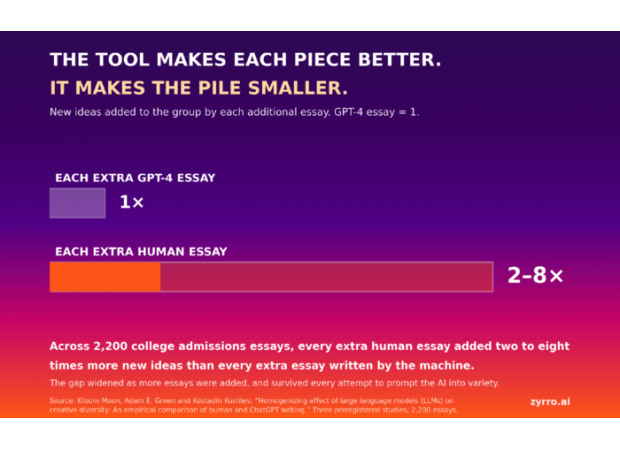
A second team found the same effect at a larger scale. They analyzed over 2,200 college admissions essays and found that the essays written with AI assistance were more varied on the surface, but the ideas were more alike. The homogenizing effect was even more prominent as the pile of essays grew.
Despite attempts to fix this, the gap remained. This phenomenon was given a name - semantic disjunction - where people sounded more different from each other than ever before, while saying the same thing. The implications of this research were unsettling, to say the least.
The old signals of effort and polish were now obsolete, as AI could provide both in a matter of seconds. The surface no longer carried information, and individuals were unable to detect a collective problem from within their own documents. It was not just limited to writing, as seen in a study where the AI group produced more ideas but felt less responsible for them.
This was due to the "cognitive debt" that accumulated from relying on AI for output rather than doing the thinking themselves. What was most concerning was that the people using AI couldn't even feel the homogenizing effect happening. They were satisfied with their work, and rightfully so.
But the problem was that nobody was asking the right question - "is this different from what everyone else is about to publish?" Instead, the focus was on the individual's performance, which only perpetuated the issue. This is a system problem, not a discipline problem, and it cannot be solved by simply telling people to try harder. A little while back, I came across a draft I had written and was taken aback by the fact that I didn't recognize the person who had written it.
It wasn't a bad draft, in fact, it was quite good. And that was the problem. The sentences were polished, the structure was solid, and the research was well-placed.
But it didn't sound like anyone I knew. You see, I had relied on AI to do the heavy lifting, as I often do. It helped me with research, structure, and organizing the chaos into a cohesive piece.
And while the end result was smooth and functional, it lacked a certain human touch. There were no scars in the writing, no moments where a real person had been wrong and had to work through it. I ended up deleting most of it and starting fresh early the next morning.
At the time, I didn't realize that this wasn't a failure on my part as a writer, but rather a measurable effect that has now been given a number by researchers. They call it the "tool that lifts the floor and lowers the ceiling." In 2024, a team of researchers conducted a controlled experiment and published their findings in Science Advances. They asked participants to write short stories, some with the help of GPT-4 AI and some without.
The results were then evaluated by others, without knowing which stories had been assisted by AI. The study revealed that the stories written with AI help were rated as more creative, better written, and more enjoyable. Interestingly, the biggest improvement was seen in the least creative writers.
The tool lifted those who needed it most, a positive outcome that I want to acknowledge before addressing the rest. And here is the rest: the AI-assisted stories ended up being more similar to one another than the stories written without AI. While everyone improved, the group as a whole produced a narrower range of writing.
This was identified as a social dilemma, where each individual benefits but the group as a whole produces a smaller variety of work. It's not a trade-off that anyone agreed to make. And then they looked at the number of ideas.
Another team sought to understand this effect on a larger scale. They analyzed 2,200 college admissions essays and found that for every additional human essay, there were two to eight times more new ideas compared to a GPT-4 assisted essay. But what's even more significant is that the gap between the number of new ideas grew wider as more essays were added.
This homogenizing effect compounded, with the machine repeating itself more and more. The researchers tried to fix it by changing prompts and parameters, but the gap still remained. But these are just studies, so the team decided to look at the real world.
In a preprint released in 2026, they examined 372,793 college admissions essays before and after the release of ChatGPT in 2022. They found that the essays written after ChatGPT's release had a wider range of vocabulary on the surface, but the underlying ideas became more alike. They called this phenomenon "semantic disjunction" - we are using more diverse language while saying the same thing.
This has a big impact on readers trying to differentiate between writers. The old signals of effort are gone, with polished prose no longer indicating someone's hard work. And almost no one notices because each individual piece looks better than what they could have produced alone.
It's impossible to detect a collective problem when you're only focused on your own writing. But this homogenizing effect doesn't just happen in writing, it happens inside our heads too. A team at MIT Media Lab found that the use of AI in writing leads to less brain connectivity and a weaker sense of ownership over the ideas produced.
And what's more, minutes after finishing, most AI users couldn't even quote a line from the essay they had written. This is what the researchers called "cognitive debt" - getting the output now but paying for it later in the thinking that we didn't do. And what's even more concerning is that the essays written with AI assistance became more similar to each other, even in a different lab measuring a different aspect.
But perhaps the most unsettling finding is that the writers using AI couldn't feel this homogenizing effect happening. They were satisfied with their work, and rightfully so. But the question that would have caught it is not "is this good?" but "is this different from what everyone else is about to publish?" And almost no one asks that question because there is no reason to.
The tool doesn't warn you, and your draft doesn't look like anyone else's. This is a system problem, not a discipline problem. Simply telling people to try harder won't solve it.
AI may be able to write, but authorship is more than just typing - it's about purpose, evaluation, a...
Read More
Readers believe the internet is against Marvel's Wolverine, and one hopes for a higher budget for Ca...
Read More
BJD leader Naveen Patnaik asked Odisha CM Mohan Charan Majhi to hold a special Assembly session to p...
Read More
Thursday letters page excited for new Resident Evil movie, reader curious about difficulty of Fire E...
Read More