

Last week, I decided to put three different AI models to the test by asking them the same question. I was curious to see how they would respond and if their answers would align. ChatGPT was the first to answer, followed by Claude who gave the same response.
Lastly, Gemini raised its hand and simply said "yes". For a moment, I thought I had stumbled upon some profound truth. But then it hit me that these models were not capable of independent thought, they were just programmed to agree with each other.
It's easy to be fooled by unanimous agreement. When three separate sources all point towards the same answer, it seems like solid evidence. However, in this case, it was not a result of critical thinking but rather a shared database of information.
These models had all been trained on the same internet sources, so it's no surprise that they arrived at the same conclusion. When everyone is studying from the same notes, agreement becomes a weak indicator of truth. I've made this mistake before, even with human beings.
If you ask five people in the same industry the same question, they will often come to a similar consensus. Not because they've independently verified it, but because they have all been exposed to the same information. It's a classic case of corporate groupthink, where fitting in and agreeing has become the norm.
People tend to say yes first and think later, just to conform. But consensus is not always a reliable measure of validity. I learned this firsthand when I posted my observations on a platform called X.
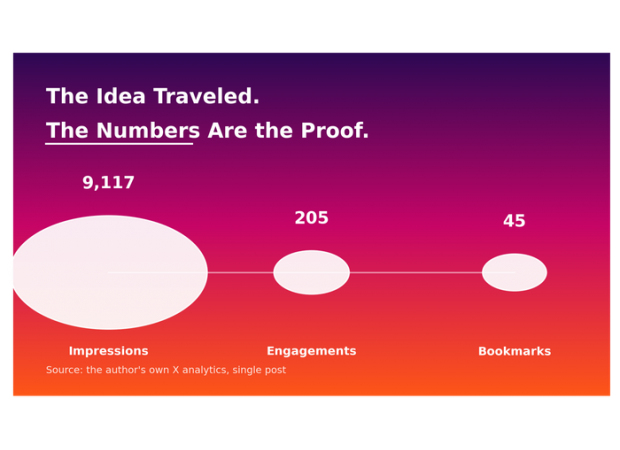
I didn't spend much time polishing my words, I just shared my thoughts. Surprisingly, there was no pushback or debate. My post received a staggering 9,117 impressions, 205 engagements, and 45 bookmarks.
But the real turning point came when I rewrote the same idea for LinkedIn. It gained traction there too, even though it was a different audience who had not seen my original post. This showed me that the strength of an idea lies in its ability to withstand being shared and reshared, in different formats and by different versions of myself.
Most content cannot survive this test because it was never meant to. It's not just my post that experienced this phenomenon. Ahrefs, an analytics company, conducted a study on 900,000 web pages published in April 2025.
They found that 74.2% of these pages had some form of AI involvement in their creation. This means that only one in four pages was entirely written by a human without any assistance from machines. If you were to scroll through your feed right now, you'd probably find that three out of four posts fail this test.
This is not the first time that a new technology has made publishing easier and diminished the value of effort. Blogs turned everyone into writers, podcasts turned everyone into broadcasters, and now AI is doing the same for written content, images, videos, and even code. However, we cannot blame AI for this shift in the publishing landscape.
The real culprit is abundance. With so much content being produced, it's no longer enough to just publish something. Publishing used to be a way to prove that you had put in the work, but now it's become a subscription-based game.
I have to admit that I am also guilty of this. I built seventeen years of my career by publishing more frequently than others in my field. And while this strategy still has some impact, it cannot compete with a competitor who can out-publish us all before lunch.
There are now two distinct types of content: content creation and thought leadership. The flood of content has forced these two to separate, whether we intended it or not. Content creation focuses on providing useful information, while thought leadership is about sharing unique insights that can change the way we perceive things.
AI excels at the former, and I use it for this purpose on a daily basis. But thought leadership requires a human touch, someone who can recognize patterns before they're confirmed and have the courage to share it under their own name, even if they might be wrong. AI is undoubtedly revolutionizing the way we create content.
It can write reports, build presentations, draft strategies, and summarize years of research in a matter of hours. The question now shifts from "can you produce the work?" to "can you determine which work is worth creating?" This is a completely different skill that involves judgment, taste, and reputation. These are qualities that AI can amplify, but it cannot replicate the unique experiences and perspectives that have shaped us.
In the end, what sets us apart is not a line on our resume, but the life we've lived and the choices we've made. Last week, I decided to conduct an interesting experiment. I asked three different AI models the same question and eagerly awaited their responses.
To my surprise, all three of them seemed to be in agreement. ChatGPT, Claude, and Gemini all gave the same answer. For a brief moment, I thought I had finally stumbled upon the truth.
However, my excitement was short-lived as I remembered that these AI models were simply programmed to provide similar responses, rather than actually thinking for themselves. It's easy to be fooled by consensus. When multiple sources are all saying the same thing, it's natural to assume that it must be true.
However, in this case, it was not three individual minds coming to the same conclusion, but rather three machines that had been fed the same information. It's not exactly reliable evidence when everyone has studied from the same notes. I've made this mistake before, but with humans instead of machines.
It's common for people in the same industry to have similar opinions and ideas, not because they have independently arrived at the same conclusion, but because they have all been exposed to the same information. It's a form of groupthink, where fitting in and agreeing with others becomes the norm, rather than independent thinking. It's important to remember that consensus is not always a strong indicator of truth.
In fact, it can often be quite misleading. I learned this firsthand when I posted a simple observation on a platform called X. I didn't expect much of a response, but to my surprise, it gained a lot of attention.
It was shared over 9,000 times, had over 200 engagements, and was bookmarked by 45 people. But then something interesting happened. I rewrote the same idea for LinkedIn, using different words and targeting a different audience.
And once again, it gained a lot of traction. This time, it was shared and discussed by people who had never even seen my original post. This experience made me realize that the true test of an idea is not in its initial publication, but in its ability to withstand being shared and discussed multiple times, in different formats, and by different versions of ourselves.
Most content cannot survive this test because it was never meant to. But in my case, my idea was strong enough to survive the journey, not because of clever distribution tactics, but because it was a genuinely thought-provoking concept. This is not an isolated incident.
Ahrefs, a popular SEO tool, recently analyzed 900,000 web pages published in April 2025 and found that 74.2% of them had some form of AI involvement in their creation. Only one in four pages was written solely by a human, without any AI assistance. This is not the first time a new tool has made publishing easier and, consequently, lowered the bar for what is considered quality content.
Blogs turned everyone into writers, podcasts turned everyone into broadcasters, and now AI is doing the same for text, images, video, and code. But let's not blame AI for this change. The real culprit is abundance.
With so much content being created and shared, the focus has shifted from producing high-quality work to simply publishing something, anything, to keep up. I have been guilty of this myself, relying on the volume of my content to make an impact rather than the actual substance. But AI cannot replicate the one thing that sets thought leadership apart from content creation: human insight.
AI can write reports, build presentations, and summarize research, but it cannot provide the unique perspective that comes from a lifetime of experiences and learning. It cannot replicate judgment, taste, or reputation. These are the intangible qualities that make a thought leader.
In a world where AI can do so much, the real challenge is not in producing the work, but in recognizing which work is worth producing. This requires a completely different skill set, one that cannot be taught or programmed. It's about having the ability to distinguish between multiple options and choosing the one that is most suitable for a specific client, moment, or level of risk.
It's about being able to identify the dangerous ideas that may seem confident, but are ultimately false. This is where judgment, taste, and reputation come into play. These are the qualities that have been shaped by the unique experiences and decisions of our individual lives.
And this is what sets us apart from AI. It can amplify these qualities, but it cannot create them. So while AI may be changing the landscape of content creation, it cannot replace the one thing that makes us truly human: our individuality.

Mumbai: Sources say Tiger Shroff shooting suspects scoped out several celebrities’ homes, includin...
Read More
Across Europe, fuel prices, poor schools, weak public services, and a housing crisis are fueling wee...
Read More
Readers are surprised by Super Mario 64's 30th anniversary and one defends Marvel's Wolverine on the...
Read More
2 officials in Bhubaneswar, Odisha were arrested for transferring Rs 9.24 crore of public money to p...
Read More