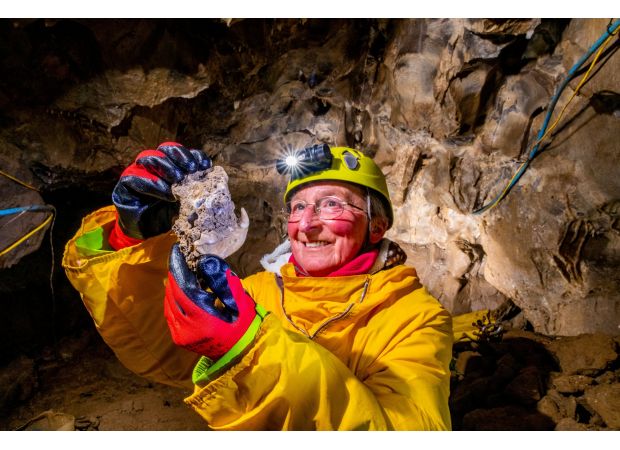

A member of the Craven Potholing Club, a group of hobby cavers, made a remarkable discovery in the Yorkshire Dales National Park. They stumbled upon the remains of a prehistoric Wolverine, estimated to be around 80-90,000 years old. Wolverines, also known as the "Arctic's ultimate animal survivor", are known for their ferocious reputation and have been living and hunting in the Arctic and subarctic regions for centuries.
However, this new discovery reveals that these fierce creatures once roamed the Yorkshire Dales as well. The discovery was made by Rowan Worsman, a dedicated member of the Craven Potholing Club, who was digging in the new C Chamber of the 300-million-year-old Stump Cross Cavern. The club has been working for over a year to open up this new section of the cave system for visitors.
It is a laborious task, with members having to dig by hand in the heart of the Yorkshire Dales National Park. Despite the challenges, Rowan's hard work paid off when she spotted something white in a bucket of rubble. Upon closer inspection, she realized that it was a part of a jaw, still containing teeth, of a Wolverine from the Ice Age.
"It is quite exciting," said Rowan, expressing her enthusiasm for the discovery. "It's hard work, you get cold, wet and dirty down there and when you find something like that you think maybe it's worth it." The find has sparked a lot of questions about how a Wolverine ended up in Stump Cross Cavern. One theory is that it entered the cave system by following the smell of decaying wild animals that had fallen into the natural pit trap.
Wolverines are known for their strength, cunning, fearlessness, and voracity, and are capable of taking down prey twice their size. Tom Thompson, who is coordinating the dig, explained that the Wolverines might have climbed into the pit, consumed the animals, but then struggled to get out. Eventually, they ended up cannibalizing each other, and when a flood occurred, their remains were preserved by stalactites.
The group has been allowed to dig at the site by Natural England, who gave them permission to remove rubble from previous digging operations. So far, the team has dug out 75 tonnes of rubble, with another 200 tonnes left to haul out. Their goal is to open the new C Chamber by 2028, which will be the first new section of the cave to open in 25 years.
Director Oliver Bowerman praised the cavers for their hard work, which will eventually lead to a 75-meter extension into a beautifully decorated cave, providing a circular route around the cavern. "The cavers are explorers, they've been digging voluntarily for a long time, and come from as far as Hull and Lancashire," said Bowerman. "Historically, we've found Wolverines, reindeer, bison, and various other Ice Age animals.
I'd put my life savings on there being a lot more down there. A Wolverine in Yorkshire is not something many people know about, and it will be a brilliant display piece for us." The specimen will now be preserved and studied by palaeontologists, in hopes of learning more about animal life during the Ice Age in the Yorkshire Dales. This exciting discovery adds to the rich history and diversity of the area, and serves as a reminder of the powerful forces of nature that have shaped our world.

Trump's ban on three news outlets from the White House has been temporarily blocked by a judge, but ...
Read More
India and UAE will work together to implement initiatives for trade in local currencies, payment sys...
Read More
Readers debate Rare's best game while one explains why they sold their Xbox Series X console....
Read More