
"The Productivity Industry: A Multi-Billion Dollar Business That Thrives on Urgency The productivity industry is a massive business, worth over $80 billion, and it has been catering to the masses with various tools and techniques to help improve their lives. From habit trackers and morning routines to Pomodoro timers and dopamine fasts, the industry has sold us on the idea that we are not doing enough, moving fast enough, or wanting it badly enough. And for a monthly subscription fee, they claim to have a solution.
But there's something that the productivity industry doesn't want you to know. The most powerful source of motivation and creativity has been within you all along, and it doesn't require any fancy apps or expensive subscriptions. It's the knowledge that one day, you will die.
This may sound like a heavy concept, but it has been proven by over 500 published studies across 40 countries. The reminder of our mortality consistently makes us more creative, purposeful, and invested in the work that truly matters to us. This is not just some philosophical idea or self-help mantra; it's a scientifically-backed finding that has been replicated time and time again, yet it remains largely ignored by the productivity industry.
In 1973, cultural anthropologist Ernest Becker published a groundbreaking book called The Denial of Death. He argued that everything humans have ever created, from art and religion to cities and love affairs, is a response to the fact that we know we are going to die. Instead of being a paralyzing thought, death awareness actually drives us and fuels our creativity.
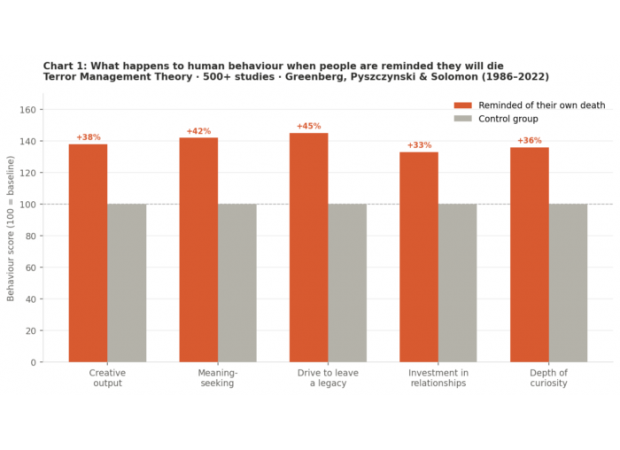
This theory was further tested and supported by three researchers, Jeff Greenberg, Tom Pyszczynski, and Sheldon Solomon, who spent four decades conducting controlled experiments and coined it as Terror Management Theory. The methodology was simple: take two groups of people and ask one to think about their own death, while the other thinks about something neutral. The results were astonishing, with the mortality-reminded group consistently showing higher levels of creative output, meaning-seeking, and drive to leave a legacy.
This effect was not limited to one specific group or culture; it was seen across different ages, languages, and continents. Looking back at history, we can see that some of the most significant periods of creative explosion coincided with times when death was close. For example, Athens' golden age of philosophy and the Italian Renaissance both followed major pandemics.
The post-World War II art boom and the Elizabethan literary explosion also happened in the aftermath of death and destruction. The evidence is clear: death awareness does not suppress creativity, it ignites it. So why does death make us more creative?
The answer lies in our brain's attention system. When we are not reminded of our mortality, we tend to focus on trivial matters and social pressures. However, when faced with the reality of death, our brain shifts its priorities.
Suddenly, what truly matters, such as meaning, connection, and contribution, becomes more urgent than superficial concerns. This is why people who have survived serious illnesses often report a newfound sense of purpose and creativity. It's not just resilience; it's a change in perspective.
The brain's attention filter is reset, and we start to prioritize what is truly important. Ultimately, the productivity industry thrives on creating a sense of urgency for tasks that may not actually matter in the grand scheme of things. But the truth is, the most significant urgency has always been within us.
We just need to embrace it and let it fuel our creativity and drive. So instead of falling into the trap of constantly chasing productivity and perfection, let yourself feel the urgency of your own mortality and see how it transforms your work and your life. The productivity industry is a massive market, worth over $80 billion.
It offers a range of products and services such as habit trackers, morning routines, timers, and challenges to boost productivity and create urgency in a seemingly unurgent life. The underlying message is always the same: you are not doing enough, moving fast enough, or wanting it badly enough. And for a monthly fee, we can fix that for you.
However, there is something that this industry does not want you to know - the most powerful source of creativity has been within you all along, and it costs nothing. That source is the knowledge of your own mortality. This has been confirmed by over 500 studies conducted in 40 different countries.
People who are reminded of their own death consistently show higher levels of creativity, purposefulness, and investment in their work. This is not just a philosophical or self-help concept; it is a well-researched finding that is often overlooked in the productivity world. The idea that the awareness of death can actually fuel creativity was first proposed by cultural anthropologist Ernest Becker in his book, The Denial of Death.
He argued that everything humans have built - art, religion, cities, love affairs, and more - is a response to the fact that we know we are going to die. Death is not something that paralyzes us; instead, it is what drives us to create and leave a lasting legacy. This theory was put to the test by researchers Jeff Greenberg, Tom Pyszczynski, and Sheldon Solomon in their Terror Management Theory.
Their experiments involved two groups of people - one was asked to think about their own death while the other group was asked to think about something neutral. The results consistently showed that those who were reminded of their mortality showed higher levels of creativity, meaning-seeking behavior, and a desire to leave a lasting legacy. These effects were not just small laboratory findings; they have been replicated across different cultures, age groups, languages, and continents.
This is not just a Western concept, but something that is ingrained in human motivation itself. Looking back at history, we can see that the most creative periods often coincided with times of heightened mortality awareness. For example, Athens' golden age of philosophy, the Italian Renaissance, and the Romantic movement all occurred during periods of war, plagues, and pandemics.
This is not a coincidence; the proximity of death ignites the deepest urgency in humans, leading to great bursts of creativity. So why does the awareness of death make us more creative? The answer lies in the brain's prioritization system.
Most of us live in a state of proximal defense, where we push thoughts of death to the back of our minds and focus on daily tasks and trivial matters. But when mortality becomes salient, the brain shifts its focus, and suddenly, the question becomes, "does this actually matter?" The trivial falls away, and the meaningful rises. This is why people who have survived serious illnesses often report a heightened sense of purpose and creativity afterwards.
In a society that values comfort and convenience, we often fall into the trap of sycophancy - seeking approval and validation from others. But when faced with the reality of our own mortality, our priorities shift, and we begin to focus on what truly matters - meaning, connection, legacy, and contribution. So perhaps the productivity industry has been selling us the wrong idea all along.
Instead of creating urgency, we should embrace the urgency that has always been within us - the reminder that our time on this earth is limited and we must make the most of it.
Readers debate Rare's best game while one explains why they sold their Xbox Series X console....
Read More
Odisha Tourism Department signs MoUs to boost homestays and adventure/heritage tourism with SBI, Dep...
Read More