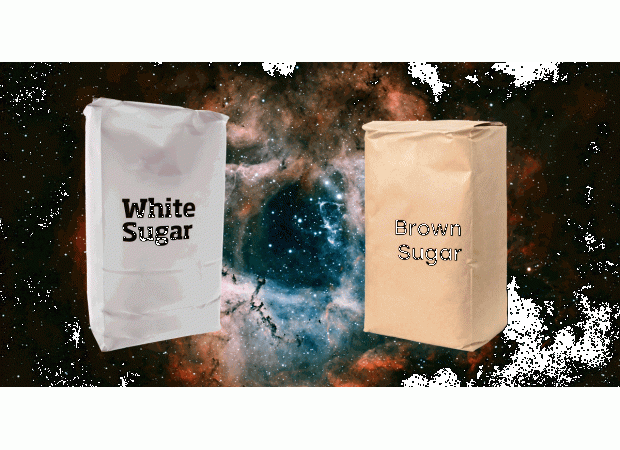

Scientists have been pondering the existence of life outside of Earth for a long time, with no concrete evidence so far. However, a recent discovery has given them a new clue - sugar. Yes, you read that right, sugar.
This tiny molecule, erythrulose, is commonly found in raspberries, melons, and even self-tanning lotions. But how did it end up floating in the vast expanse of space? Could it be the source of life on our planet?
Before we delve into this cosmic sugar mystery, let's take a closer look at what we know so far. The paper published in Nature Astronomy reveals that this type of sugar has been found in a cloud of cosmic dust called G+0.693−0.027. This thin cloud, located about 27,000 light-years away from Earth, is known as an interstellar medium.
Using powerful radio telescopes, a team of researchers from Spain's Centre for Astrobiology near Madrid was able to detect the unique frequencies produced by the molecules in this cloud. And to their surprise, they found erythrulose - a molecule made up of four carbon atoms, eight hydrogen atoms, and four oxygen atoms. But how did this sugar end up in space?
According to the team, it is likely that this sugar was formed when two other organic compounds, glycolaldehyde and ethylene, clumped together. This process is rare, but the presence of tiny "dust grains" helps these molecules come together, forming tiny islands where they can easily bond. And with the vastness of space, these chances of encounters increase.
Now, you might be wondering why scientists are so fascinated by the presence of sugar in space. Well, for starters, it has been a mystery as to where sugar came from on Earth. The main theory was that it arrived on our planet via a meteor.
And even though scientists have been trying to recreate the chemical conditions to make sugar in a lab, they have not been successful. So, the discovery of this sugar in space adds another layer of complexity to this puzzle. But what's even more intriguing is that it suggests that sugar can form without the presence of life, even before the formation of stars or planets.
This raises the possibility that life on Earth may have originated from somewhere else. Some experts estimate that up to 500,000,000,000kg of sugar may have ended up on Earth during its formation, sparking the chemical reactions needed for life to emerge. However, before we jump to any conclusions, it's essential to note that erythrulose is just one of the building blocks of life.
Other essential components include carbon, water, and nitrogen. And as Dr. David Benoit, a molecular physicist at the University of Hull, points out, a random combination of these could have eventually led to the development of primitive self-replicating systems.
So, while we may not have concrete evidence yet, this discovery brings us one step closer to understanding the origins of life on Earth. As Dr. Benoit puts it, finding complex organic molecules like sugars in space can help shed light on our own chemistry and where it came from.
And who knows, maybe one day we'll find the missing piece of this puzzle and solve the mystery of life beyond our blue marble.

One reader believes that Marvel's Wolverine is the top game of 2026, despite conflicting opinions fr...
Read More
Trump's ban on three news outlets from the White House has been temporarily blocked by a judge, but ...
Read More
Odisha Tourism Department signs MoUs to boost homestays and adventure/heritage tourism with SBI, Dep...
Read More