
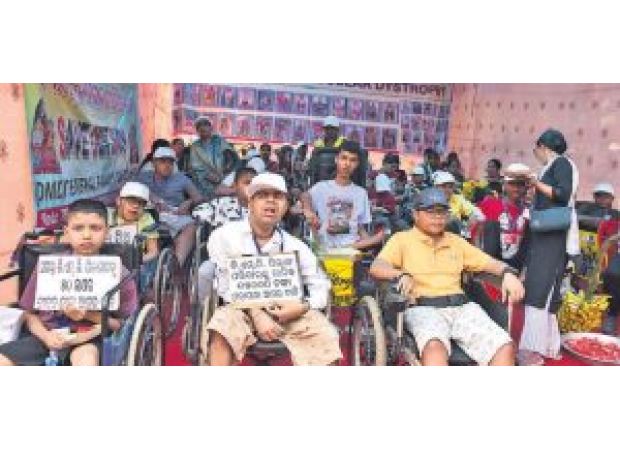

A group of concerned individuals from the Odisha Duchenne Muscular Dystrophy Association took action on Wednesday by submitting a letter to the Health & Family Welfare Minister Mukesh Mahaling. Their goal was to bring attention to the pressing issues faced by children suffering from Duchenne Muscular Dystrophy and to urge for immediate policy interventions that would help alleviate their struggles. During a demonstration at Lower PMG, families of affected children shared their heart-wrenching stories and expressed the emotional and physical toll that this condition has on both the children and their loved ones.
The constant need for care and attention has left these families exhausted, and unfortunately, many children are unable to attend school, play, or lead a normal life despite their willingness, resulting in social isolation and distress. Bishnu Charan Panigrahi, the president of the association, emphasized that access to treatment remains a major challenge. Although the High Court has intervened and directed AIIMS-Bhubaneswar to refer patients to a specialized centre in Kolkata, many families are unable to afford or manage the necessary travel and treatment outside of the state.
Despite the existence of a national policy for rare diseases, members of the association alleged that poor implementation and limited support from the Central government have left treatment inaccessible for many patients. In their plea to the state government for urgent relief, the association put forth various key demands. These include the introduction of advanced gene therapy for DMD in India, with a particular focus on Odisha, to ensure access to modern treatment.
They also requested a one-time financial assistance of Rs 1 lakh for affected children, as well as a monthly medical allowance of Rs 15,000 for ongoing care. Additionally, they asked for free genetic testing for DMD, both pre-and post-natal, and for AIIMS-Bhubaneswar to be developed into a dedicated treatment centre for muscular dystrophy. Panigrahi stressed the importance of timely intervention in managing this condition, as it rapidly deteriorates and puts an immense strain on families, both financially and emotionally.
The association urged authorities to act promptly in improving access to treatment and ensuring a dignified life for these affected children. Duchenne Muscular Dystrophy is a hereditary and progressive disorder that mainly affects young boys, causing muscle weakness and often leading to wheelchair-dependency by the age of 10-12 years. Basic daily activities such as eating, drinking, and sitting become increasingly difficult as the condition progresses.
In conclusion, the Odisha Duchenne Muscular Dystrophy Association's efforts to bring attention to the challenges faced by these children and their families are commendable. It is essential for the state government to take prompt action and implement policies that will not only improve access to treatment but also provide financial and emotional support to these families. Every child deserves a chance at a fulfilling and dignified life, and it is our responsibility to ensure that this is possible for those affected by this debilitating condition.
Police in Odisha have filed a new case against BJD leader Bikram Kumar Panda, just released from jai...
Read More
Material participation is crucial for investors and entrepreneurs to deduct losses from real estate ...
Read More
Election Commission orders AITC factions to not use party name and symbol during bypolls in West Ben...
Read More
Nabarangpur DFO suspends forester Bipin Kumar Harijan for unauthorized tree cutting and financial ir...
Read More