

In the year 2009, I found myself getting up at the ungodly hour of 4:30am, driven by a passion that no one had told me to pursue. Writing was the one thing that gave me a sense of progress, a sense of moving forward, in a year where everything else seemed to be at a standstill. And so, for five years, I diligently stuck to this habit, pouring my heart and soul into my writing.
It was through this dedication that jeffbullas.com was able to reach a staggering 100,000 monthly readers. And as time went by, that number only continued to grow, reaching an impressive 33 million readers across 190 countries. All of this was achieved through the power of one skill - content marketing.
But then, seventeen years later, I watched as that very skill slowly lost its effectiveness. It wasn't because I had forgotten how to write, but rather, because the underlying mechanisms of every platform I published on had shifted, changing the way they rewarded content. And yet, hardly anyone seemed to have noticed this pivotal moment that had taken place.
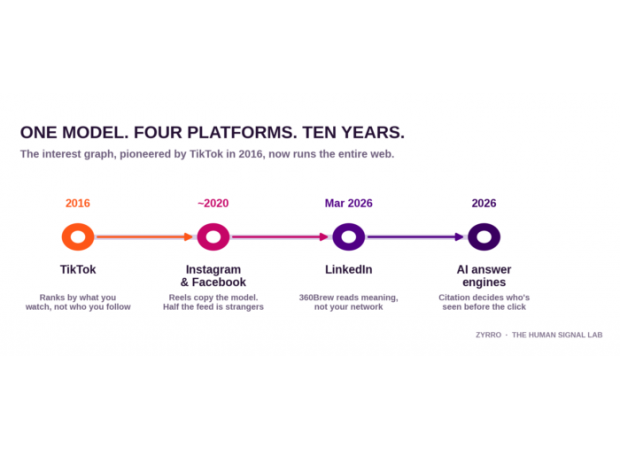
This is the story of that moment, the consequences it brought with it, and what still remains after the dust has settled. It all started with a seemingly insignificant app that most marketers had written off as a platform for teenagers to dance on. TikTok, in 2016, made a decision that would ultimately change the game of content marketing as we knew it.
They shifted their focus from ranking videos based on the accounts that users followed, to ranking them based on what they actually watched and for how long. In other words, follower count was no longer a determining factor. Instead, a brand new account with zero followers could potentially reach millions in just one day, purely based on the performance of their video with complete strangers.
This was later confirmed by Sprout Social's 2026 algorithm breakdown, which showed that this trend only became more solidified as the platform matured. At first, everyone laughed at TikTok's approach. But soon enough, everyone else started to follow suit.
Facebook and Instagram were quick to jump on the bandwagon, and by 2026, over half of the content on the average Facebook feed came from accounts that users had never even followed. In fact, according to a 2026 review of cross-platform algorithm statistics, AI now decides over 80% of the content that appears on social media platforms before users even have a chance to see it. And then, on March 12, 2026, LinkedIn joined in as well.
They introduced a new AI model called 360Brew, equipped with 150 billion parameters, designed to evaluate posts in a way that a human editor would, rather than simply matching keywords like the previous system did. Even search engines took a similar route, with Google's AI Overviews and answer engines like ChatGPT now determining which brands get cited before a single click has even been made. As reported by Conductor's 2026 benchmark study, AI referral traffic only accounts for a minuscule 1.08% of web traffic, but its impact is disproportionately large, as it dictates who gets seen before the click even happens.
Four major platforms, all operating on one underlying shift. Marketers had built their careers for twenty years on one game, only to have the rules change right under their noses, one platform at a time. And yet, most of us are still stuck playing by the old rules.
The hard numbers speak for themselves. Here's what happened to the average LinkedIn account in just twelve months, according to Richard van der Blom's Algorithm Insights Report, which was based on an analysis of over a million posts. It would be easy to assume that the quality of writing is to blame for this decline.
I've certainly felt that way myself at times this year. But the truth is much simpler, and harder to accept. Distribution on these platforms is no longer dependent on the size of your network.
It's now based on demonstrated and declared topic authority - in other words, what 360Brew infers your content is actually about, based on your headline, past posts, and consistent publishing patterns. And this inference is not a gentle one. According to one 2026 analysis, creators who stick to a specific set of topics consistently have seen their share of platform-wide reach increase significantly, from 15% to 31% since 2022.
On the other hand, creators who post about a wide range of topics have seen their share plummet from 57% to 28%. This decoupling of follower count and reach is not just limited to LinkedIn. It's a trend that has been observed across various platforms, as the interest graph takes over and dictates who gets visibility.
It's the same mechanism that has been at play on platforms like TikTok and Instagram, and even within AI answer engines. The focus is on finding a niche, picking a lane, and becoming known for a specific topic. But this rule would have silenced some of the greatest minds in history, people like Leonardo da Vinci.
He didn't just paint the Mona Lisa, he was also a pioneer in designing flying machines and studying human anatomy. His mind was constantly exploring a multitude of interests, all feeding into each other. But if he were to post about his flying machine today, right after a portrait, the algorithm would flag it as a mismatch, leading to a decrease in reach and visibility.
It's a shame, because something truly interesting, something that doesn't fit into a neatly defined category, can end up being buried by the system's limitations. And this is where the heart of the issue lies. The interest graph is focused on categories, while what truly captures our attention and sparks curiosity is the quality of a person, what makes them unique and interesting.
A machine may be able to categorize, but it will never be able to fully capture the essence of a human soul. There's no denying that the shift in algorithms has brought some positive changes, such as the decline of engagement bait and the ability for unknown creators to compete with established celebrities. But the cost of this shift is much greater than we could have ever imagined.
The old algorithm determined what we saw, while this new one determines who we are allowed to be in order to remain visible. It takes a curious human and reduces them to a niche. As Walt Whitman warned us over 160 years ago, "I am large, I contain multitudes." We are complex beings, with a multitude of interests and facets to our personalities.
But the machine has no column for this. For twenty years, content marketing relied on the assumption that building an audience and publishing consistently would lead to visibility. But now, that assumption has been shattered.
The interest graph has taken over, and it's not about the followers you already have, but rather, the strangers who share common interests with you, as determined by an AI system. Content marketing as we know it has come to an end. In 2009, I remember waking up at 4:30am and immediately feeling the urge to start writing.
It wasn't because someone told me to, but because writing was the one thing that gave me a sense of forward motion in a year where everything else seemed to be at a standstill. Little did I know, this would become a habit for the next five years and lead to the success of my website, jeffbullas.com, reaching a milestone of 100,000 monthly readers. It was a proud moment for me, especially as it continued to grow and expand reach to over 33 million readers across 190 countries.
And all of this was achieved through one skill - content marketing. Seventeen years later, I watched as that skill seemingly stopped working the way it used to. It wasn't because I had forgotten how to write, but because the underlying machinery of every platform I published on had changed what it rewarded.
And to my surprise, hardly anyone noticed the exact moment it happened. This is the story of that moment, what it cost, and what remains after it all. It all started with a seemingly insignificant app that most marketers dismissed as a platform for teenagers to dance on.
In 2016, TikTok made a decision that would ultimately revolutionize the concept of content marketing. They stopped ranking videos based on who you followed, and instead, started ranking them based on what you watched and for how long. This decision, although initially laughed at, was soon copied by other social media giants like Facebook and Instagram.
By 2026, more than half of the average Facebook feed was made up of accounts that a person had never followed. And with AI now deciding over 80% of what appears on users' screens across social platforms, it was clear that the game had changed. Even search engines followed suit, with Google's AI Overviews and answer engines like ChatGPT now determining which brands get cited before a single click even happens.
A 2026 study confirmed that AI referral traffic only accounted for 1.08% of web traffic, but its influence was outsized as it decided who got seen before the click ever happened. It was a monumental shift that affected all major platforms, and most of us in the marketing industry were still playing by the old rules. One model, pioneered by TikTok in 2016, now ran every major platform.
The numbers don't lie. In just twelve months, the average LinkedIn account saw a significant change in its reach, as reported in Richard van der Blom's Algorithm Insights Report, which was based on over a million posts. The natural instinct is to blame the writing, and I have felt that instinct myself on numerous occasions this year.
But the truth is simpler, yet harder to accept. Distribution is no longer tied to the size of your network. Instead, it is now based on your declared and demonstrated topic authority - what the AI system infers you're actually about, from your headline, your history, and the pattern of your consistent publications.
This inference is not gentle. In fact, a 2026 analysis showed that creators who stayed focused on a small, consistent set of topics saw their share of platform-wide reach roughly double since 2022. On the other hand, creators who scattered across various topics watched their share collapse from 57% to 28%.
This change also decoupled follower count from reach, meaning that an account with 8,000 focused followers could now out-distribute one with 80,000 unfocused ones. This wasn't just a LinkedIn phenomenon, but rather a result of the interest graph, which was now doing on a professional network exactly what it had already been doing on TikTok, Instagram, and all other AI answer engines. This shift may have killed off some of the noise and gimmicks, as engaging bait tactics are dying out, and unknown but brilliant creators can now outshine hollow celebrities.
However, the cost is much greater than anyone could have predicted. The old algorithm decided what you saw, but this new one decides who you're allowed to be in order to stay visible instead of being buried. It takes a curious and multifaceted human and reduces them to a single niche.
This is something that Walt Whitman warned us about over 160 years ago when he wrote, "I am large, I contain multitudes." He understood the complexity of the human mind and how it could contain a dozen different obsessions that all fed into each other. But in today's world, if you post about your various interests, the AI system will flag it as a mismatch and reduce your reach. It wants us all to fit into one lane, because a lane is easy to keep us inside.
I joined social media in 2008, starting with Facebook. My intention was to connect with and follow interesting people from around the world, not just predefined categories. I followed people because they were interesting, and that word holds more weight than any machine could ever understand.
An interest is a category, but being interesting is a quality of a person. Machines can index categories, but they cannot index the human soul. Yes, this shift has eliminated some of the noise and brought about positive changes.
But the cost is much greater than anyone could have predicted. The old assumption of content marketing - build an audience, publish consistently, and your audience will see it - is no longer valid. The interest graph has taken over, and it is built for strangers who share an interest, determined by an AI system that reads what you're actually about, not just who's already listening.
The game has changed, and it's time for us to adapt to this new reality.

A human skeleton was discovered in a scrap dealer's settlement during a cleanliness drive in New Del...
Read More
Improved education but still issues at Baman Abakash High School in Itamati panchayat, as mid-day me...
Read More
Odisha Tourism Department signs MoUs to boost homestays and adventure/heritage tourism with SBI, Dep...
Read More
Switch 2 price increase by Nintendo didn't last a month as some retailers are now selling it for les...
Read More