
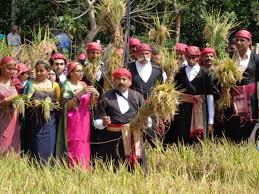

Kodagu is a small agricultural district with unique natural beauty, people's life, food and drink, clothing, tribes, traditions, flora and fauna. The Huttari festival is celebrated in Kodagu every year in the month of November or December on the eleventh day of the month of Vrischika under the full moon of the Rohini star. This festival is celebrated 90 days after the Onam of Kerala. The date and time of the Huttari festival are decided by the Takkars and Kaniyars at the Padi Iggutappa temple in Kakkabbe. First, the ears of corn are removed at the Iggutappa temple. Iggutappa means God Subramanya. The first puja and offering are performed there. This is called Devakolu, the festival of God. After offering offerings to Subramanya, the festival is celebrated in other places.
Huttari Kodagu Harvest Festival A few days before this festival, which welcomes the new rice crop, the house is cleaned and decorated with lime and paints. On the day the ears are harvested, the entire family gathers in the house. There, the traditional items are placed under a hanging lamp in the middle of the rice field and the work of building a house is done. For decoration, a rangoli of rice powder is made and decorated. A new kukke is filled with rice and half a sack of rice. It is filled with a pot of rice and milk, ghee, honey, sesame seeds, ginger, coconut, bitter gourd, and thistle are also placed. Along with the sickle, a small earthen lamp is lit in a bronze bowl filled with rice. Three betel leaves and three areca nuts are placed. Then the family eats boiled potatoes, honey, jaggery and other dishes, and the elders of the family carry the prepared gutti, hold the sickle for removing the ears and walk towards the paddy field. Then a daughter of the house carries rice in a bronze bowl and goes to the paddy field. At this time, some people wear traditional clothes, work hard and sing, and go to the paddy field. The paddy field is decorated in advance. Milk and honey are poured at the base of the ear, and the tied rope is tied to the base of the ear.
Traditionally, a round of gunshots is fired in the air. After praying to God, an odd number of ears are harvested and placed in the gutti. Firecrackers are burst and the celebratory shout of Poli Poli Deva is shouted. Everyone takes a little new ear of rice and carries a hook and goes to the paddy field, places the ear of rice and then calls out Poli...Poli Deva Poliye Ba and brings the ear of rice home. The women of the house wash the feet of the person who has cut the ear of rice, give them milk to drink and fill the house with the grain Lakshmi. The gnat comes to the middle of the fence and fills the new ear of rice tied on the mat. The ear of rice is tied to the house post planted in the field, the door of the house, the box, the pot of payasam, the pot of hotari yam soup, the bed, the vehicles and all the important things. Then the members of the house sit together and have a hotari meal with dishes like new rice payasam, ginger chutney, hotari yam, kesu gadaya soup, rice and other dishes. If there are permanent servants in the house, they get the necessary ingredients for the festival like crackers, yams, rice, coconut, tambittu powder from the owner's house and celebrate the festival at their house. They come to the owner's house with their family and have a feast.
The next day, all the people of the village gather in the kolu mandus, perform traditional songs and dances like kolata and ummatthaat, share the food brought from home, eat and celebrate.
Disclaimer: This article has been translated by xklsv.com using advanced AI-based translation tools. Please note that the use of AI for translation is still experimental and may not be 100% accurate. The original content is sourced from shakthidaily.info, and Shakthi Daily is not responsible or liable for any errors, omissions, or inaccuracies that may appear in the translated version, including spelling, grammar, or contextual misunderstandings.
If you come across any mistakes or inconsistencies in this translation, we kindly request you to report them by sending an email to [email protected]. Your feedback will help us improve the quality of our translations.
.jfif)
Government Mulls ‘Land Guarantee’ Scheme: Ponnanna ...
Read More.jfif)
Chemical Spraying Destroys Coffee and Areca Nut Saplings...
Read More
Appeal for Peaceful Law and Order During Gauri-Ganesha Festival...
Read More
