
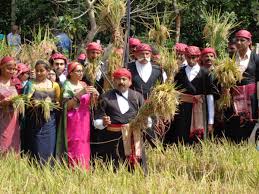

Puttari is the festival of Kodagu's unique culture, customs, and traditional agricultural life. Along with the traditional festival celebrations, the speciality of this Puttari festival is to fill the house with the goodness of grain by saying Poli... Poliye.. Ba..
This Puttari festival, which is celebrated on the full moon day of the Rohini star in the months of November and December of the year, has its own speciality. "Puttari" means "fresh" in the Kodava language, "Ari" means rice, and this Puttari festival is a festival of bringing new rice to the houses.
Every year, the day when the astrologers of Ammangeri and the relevant heads of the family deity of Kodagu, meet at the temple of Sripadi Iggutthappa, based on the Panchaga, is traditionally chosen throughout Kodagu on the day when the Puttari festival day is marked. Before the festival, the youth of the village gather in the Mand and learn the Puttari Nammeya Kolat, which is a tradition called Eid.
In every village, preparations for the festival are made in advance, and the priests associated with the village temple go from house to house and offer the gods the Tirtha Prasad, the potter the pot, the bamboo weaver the bamboo hook, and the rice, jaggery, banana, salt, oil, and Puttari Ganas and celebrate the festival.
This year, the festival will be held in Kodagu on December 4th, as the Rohini star will appear. Along with the fruit garland, the elders will taste the cooked Puttari Ganas and go to the Devanela to gather the ears of rice to bring the year's grain as a part of Puttari Nammeya. Then, while walking with the song Dudikott, a woman walks in front holding a lamp, while a man wearing a white blouse carrying a bamboo basket on his shoulder goes to the field with the traditional Valaga (instrument) and shoots a bullet in the air. At exactly 9.40, he plucks the ears of rice that have grown in the field and gives them to everyone, saying, "Polipoli....ba...igguthappanda Bhandarakett poliye ba..." Baithurappanda Bhandakatt poliye ba.. Kaverammera Bhandara Kett poliye ba.. Remembering God, he goes to the Ainmane with the song Dudikott. A woman puts rice in the basket and pours water on the feet of the person who has gone with the rice ears, washes them, gives them milk and welcomes them into the Ainmane.
From the next day, in some places in the town, On the occasion of Puttari festival, families gather in the temple to sing Puttari, and on the appointed day, all the villagers gather in their respective houses to arrange a housewarming party.
After a few days, all the villagers gather in Urmand and organize Urrome, and the elders prepare a special meal at the devanele and pray to the gods to do good. Men, women, and children gather in Urmand and sit around and enjoy the special food of the festival. Then, in Nadmand, in the presence of the relevant elders, a Kolat and Bolakat performance is performed according to various traditions.
“Bappaka Puttari Vanate Baat-Popaka Puttari Ennate Pochi, Poile.. Poile...' the men beat sticks around the Mand, saying in a folk song that the festival was missed amidst the festivities, and beat sticks, handed them over to the devanele and began the festival. The curtain will be drawn.
Disclaimer: This article has been translated by xklsv.com using advanced AI-based translation tools. Please note that the use of AI for translation is still experimental and may not be 100% accurate. The original content is sourced from shakthidaily.info, and Shakthi Daily is not responsible or liable for any errors, omissions, or inaccuracies that may appear in the translated version, including spelling, grammar, or contextual misunderstandings.
If you come across any mistakes or inconsistencies in this translation, we kindly request you to report them by sending an email to [email protected]. Your feedback will help us improve the quality of our translations.

Madikeri Dasara Committee Office Inaugurated...
Read More

If you are considering the Best UPSC Coaching in Delhi, remember that the institute is only one part...
Read More
Farmers Protest Water Release from Harangi Dam...
Read More