
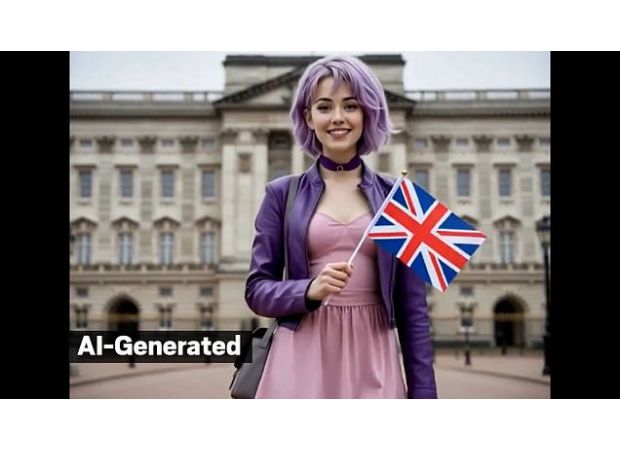

Meet Amelia, the purple-haired British schoolgirl who has unexpectedly become a symbol for the far-right movement on social media. But how did this AI-generated character end up as a mouthpiece for racism and anti-immigration messages? Amelia, with her short purple hair, purple lipstick, and edgy fashion sense, has been portrayed as a college student in viral videos and images, often holding the Union Jack flag.
She has been turned into a mascot for far-right users, with one image showing her lighting a cigarette with a burning picture of Sir Keir Starmer, similar to a trend that emerged among women protesting the Iranian regime earlier this year. But who is Amelia, and how did she become a symbol for the UK far right? Surprisingly, she was not created with this future in mind.
In fact, her first appearance was in a counter-terrorism video game funded by the UK Home Office. The game, called Pathways: Navigating the Internet and Extremism, was designed to educate teenagers about the dangers of radicalization. In the game, players make decisions as a college student and are presented with scenarios where they must choose whether to download extremist content or attend rallies that defend "English rights." However, the founder and CEO of the company that created the game, Shout Out UK, says that Amelia has been misrepresented.
He clarifies that the game does not state that questioning mass migration is inherently wrong, and that the character of Amelia was meant to represent someone who enjoys participating in political demonstrations. Despite this, Amelia has gone viral on social media, with users using AI to recreate her image in various British media, such as meetings with Harry Potter and Father Ted, and even interacting with beloved characters like Peppa Pig and Paddington. These images are often accompanied by racist language and far-right messaging.
If you haven't come across Amelia online yet, you probably will soon, as she continues to gain popularity. The first Amelia meme posted on X, a popular social media platform, was viewed over 1.4 million times. And with Elon Musk, owner of X, joining in on the trend, it's clear that Amelia has become a viral sensation.
While some may see this as harmless fun, the founder of Shout Out UK has expressed concern about the monetization of hate that has resulted from Amelia's popularity. He also shares that his company has received hate mail, which has been reported to the police. The game was originally meant to be used as a tool alongside existing classroom resources to target local radicalization risks, according to the Home Office.
Amelia's origins may not have been what anyone expected, but her rise to fame has shed light on the dangers of online radicalization and the need for education and prevention.

CIPET: CSTS, Bhubaneswar and MCL, Sambalpur have signed an MoU for employment-oriented training prog...
Read More
Switch 2 price increase by Nintendo didn't last a month as some retailers are now selling it for les...
Read More
Readers debate Rare's best game while one explains why they sold their Xbox Series X console....
Read More
Trump's ban on three news outlets from the White House has been temporarily blocked by a judge, but ...
Read More