

Machines may have the ability to provide answers, but one thing they lack is curiosity. Unlike humans, they do not have the desire to ask questions and seek out new information. This is something that sets us apart from them, a signal that has been a part of our existence for a long time.
However, in today's world, this signal is often neglected and instead, a lot of resources are wasted on things that do not satisfy our curiosity. In this piece, we will explore how to stop wasting our curiosity and start utilizing it. The first thing to understand is that machines never tire out.
They are always ready to provide us with information, no matter how long it takes. Last month, I was on a quest to find one specific number - the percentage of Netflix viewership that comes from its recommendation engine. However, after ninety minutes of searching, I found myself reading about slot machines, pigeons, and the nature of taste.
I never did find the number I was looking for. This incident made me realize that things have changed. In the past, our curiosity had a natural brake - it cost time, money, or someone else's patience.
But now, with the endless information available at our fingertips, we have removed that brake and kept the engine running. There are two types of curiosity - diversive and specific. Diversive curiosity is the restless and wide kind that is always on the lookout for something new, while specific curiosity is the one that digs deeper into a particular subject.
In the 1950s, psychologist Daniel Berlyne identified these two types, and his theory still holds true. However, with the advent of social media and feeds, our curiosity is often directed towards diversive curiosity, scrolling through endless content without ever really delving into something specific. This is because feeds are designed to keep us scanning, to keep us in the shallow kind of curiosity and never allowing us to reach the deep kind.
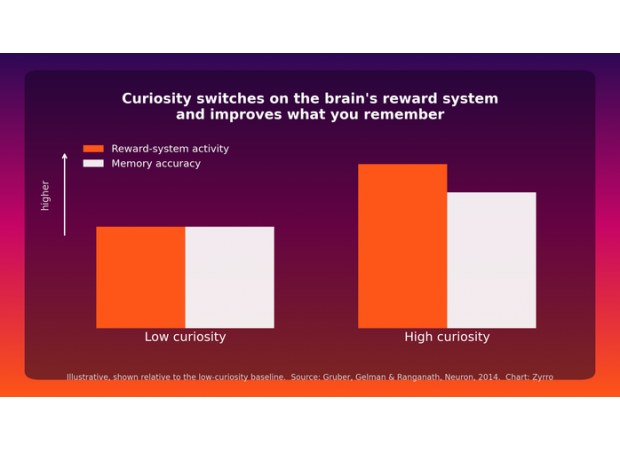
But why should we even care about our curiosity? Well, research shows that being curious activates the brain's reward system, the same wiring that responds to food and money. This means that our brain pays us for being curious, and it also puts our brain in a better state to learn new things.
So instead of trying to be more curious, the key is to give our curiosity somewhere to land. We should pay attention to which type of curiosity we are engaging in and make sure not to let scanning be the whole session. Our energy is not distributed evenly throughout the day, and it tends to pool around things that we are genuinely interested in.
This is why it is crucial to track our natural curiosity and follow where it leads us. Most advice suggests finding motivation first and then applying it, but research shows that motivation shows up after we start chasing what already pulls us. For example, I discovered this the slow way in 2009 when I started writing and publishing blog posts.
I didn't start with discipline; it was the mere act of publishing something and receiving a response from a stranger that fueled my curiosity and motivation to continue. This is where our energy pools, and we should stop hunting for motivation and instead pay attention to what already pulls us. This is especially important in the working world, where Gallup surveys show that eight out of ten people are not engaged at work.
It's not that these individuals are lazy; it's a problem of fit at a larger scale. Most of us spend our best hours in a place where our energy never gathers. This is where reading our curiosity becomes crucial.
It's not just a soft, nice-to-have habit; it's how we find work that doesn't feel like a drain. However, there is a trap in the form of feeds that keep us engaged in things that we already like, never showing us anything new. These feeds can be found on platforms like Netflix and YouTube, where the majority of our time is spent watching what the system has chosen for us.
So how do we break free from this trap? The first step is to put something in front of us that the feed never would. This could be reading a book from a different field or talking to someone who does not have the same job as us.
We need to widen our horizons and expose ourselves to new ideas and perspectives. However, this does not mean we should completely abandon focus. The key is to wander wide and then review narrow.
This was something I learned the hard way when I was in a low point in my life, and reading outside of my industry led me to discover new ideas and opportunities. In conclusion, our curiosity is a valuable signal that sets us apart from machines. However, in today's world, it is often neglected and wasted.
We need to pay attention to our curiosity, give it somewhere to land, and widen our horizons to find work that truly engages us. So let's stop scrolling through endless feeds and start reading our curiosity. Machines may be capable of answering questions, but they lack one crucial element: curiosity.
Unlike us, they do not have the urge to ask their own questions and seek out new information. It's a fundamental trait that has been ingrained in us since the beginning of time. However, our natural curiosity is currently being underutilized and even wasted, costing us time and money.
This article aims to shed light on how we can stop this wastage and start utilizing our curiosity to its full potential. One of the main reasons why machines do not experience fatigue or boredom is because they lack the natural brakes that come with old-fashioned curiosity. It used to cost us time, money, or someone else's patience to satisfy our curiosity.
But now, with the advancements in technology, we have removed these brakes and are left with a never-ending engine that keeps us constantly browsing and scrolling. But there are two types of curiosity: diversive and specific. Diversive curiosity is the restless, wide type that constantly seeks out new information.
It's the kind that is satisfied by scrolling through social media feeds. On the other hand, specific curiosity is the type that digs deeper and seeks out answers to specific questions. It's the kind that turns information into something meaningful.
The problem with our current digital world is that it caters to diversive curiosity, keeping us constantly scanning for new information. However, what we should aim for is a balance between the two types of curiosity. We must give our curiosity a specific topic or question to focus on, rather than letting it aimlessly scroll through a feed.
Interestingly, research has shown that our brain's reward system is activated when we are curious. It's the same wiring that responds to food and money. So, not only does curiosity make us want to learn, but it also puts our brain in a better state to retain information.
But our energy is not evenly spread throughout the day. It pools around what we care about. So instead of trying to find motivation to start something, we should chase what already pulls us, and motivation will naturally follow.
This is something I learned from my own experience. In 2009, I didn't start with discipline. It was a stranger's reply to one of my posts that sparked something in me and drove me to continue publishing.
It wasn't willpower that woke me up at 4:30 am every day, it was the excitement and satisfaction I felt from writing and sharing with others. Unfortunately, the majority of people are not engaged at work, which is not a reflection of laziness, but rather a mismatch between their energy and the tasks they are given. Our curiosity can guide us towards work that is fulfilling and doesn't feel like a chore.
One of the traps we fall into is relying on the digital feed that constantly shows us more of what we already like. It's a mirror that reflects back our own interests, rather than a window that shows us something new. That's where a real person comes in handy, someone who can challenge our thinking and provide a different perspective.
So, the solution is not to discipline ourselves to stay focused, but rather to wander wide and explore different topics and perspectives, then narrow down our focus afterward. This is something I experienced firsthand when my own industry had run out of answers, but by reading outside of it, I found unexpected sources of inspiration and ideas. So, the rule is not to focus first, but rather to wander wide, then review narrow.

Improved education but still issues at Baman Abakash High School in Itamati panchayat, as mid-day me...
Read More
2 officials in Bhubaneswar, Odisha were arrested for transferring Rs 9.24 crore of public money to p...
Read More
Fund backs theater instruction, productions, & performance chances for future students....
Read More
Readers are surprised by Super Mario 64's 30th anniversary and one defends Marvel's Wolverine on the...
Read More