
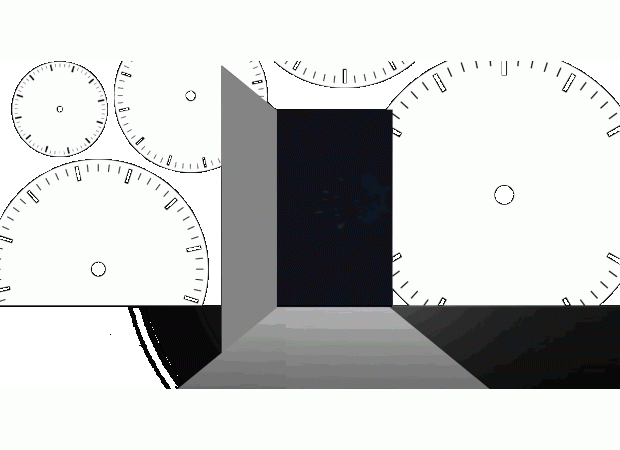

Maybe it’s best not to travel back to the past, though. Most kids dream of having superpowers. You may have wanted to fly, become invisible, or have superhuman strength.
But there’s one power that seems to top them all: time travel. According to a poll from last year, almost one in 10 Brits would choose it. As far-fetched as it sounds, Professor Jim Al-Khalili, a theoretical physicist at the University of Surrey, tells Metro that this dream could one day become reality.
Still, there would be some very big catches. So, what exactly is time? It depends on who you ask.
Most people think of time in terms of seconds, minutes, and hours. That’s clock time. Then there’s mind time, the kind you actually feel passing.
That’s where the old saying “time flies when you’re having fun” comes from. Time can also be understood as a dimension, much like length, width, and depth. Those three are spatial dimensions; add time, and you get space-time, the fabric of the universe.
“We all have this common-sense picture of time, that it’s something that goes by at the same rate everywhere in the universe,” says Jim, who will be giving lectures on the subject at the Royal Institution in London next month. Feeling confused? You’re not alone.
Jim says plenty of experts are puzzled by it too. Albert Einstein suggested that all time exists at once. It doesn’t really flow or tick away; it simply is.
“If I’m reading a book and I’m on page 150, then that is my ‘now,’ my present,” Jim says. “All the pages before page 150 are in the past, and the pages I haven’t read yet are in my future. “But if I close the book, there’s nothing special about page 150; they’re all equally real.” In certain situations, time can move at different speeds.
This is called relativity. According to relativity, the faster you travel, the slower time passes for you. The universe’s speed limit is 186,000 miles per second, which is the speed of light.
Gravity can also warp time and make it run more slowly. Imagine you’re in a rocket, Jim says, travelling just below the speed of light from one side of the galaxy to the other. Your GPS would tell you the trip should take a little over 100,000 years.
“But actually, I could do it in a day, because my time is running slower, which is what happens when you approach the speed of light,” Jim says. “That isn’t just theory; it’s something that really happens because you’re further from the centre of gravity on Earth.” So what would time travel actually look like? Jim says not to use Back to the Future or The Legend of Zelda: Ocarina of Time as your guide.
Instead, watch Interstellar. In Christopher Nolan’s thriller, the characters land on a planet near a black hole, a dense and violent region with gravity so powerful it even traps light. That extreme gravity scrambles time on the planet, so one hour there equals seven years on Earth.
“You’d return to Earth and find your friends and loved ones considerably older than they were when you left them,” Jim says. The science is sound, but since we’re nowhere near any black holes, humans can’t exactly try this for ourselves. In Interstellar, the crew gets close only because of a wormhole, a curved shortcut through space-time, supposedly created by aliens.
If humans could somehow find or create a wormhole, we’d basically have a time version of the London Underground. “So, in theory, entering one way would take you to the future and the other would take you to the past,” Jim says. “We could travel back into the past by travelling through space and forward in time but following the curvature back to where you started, before you started.” Could you meet your younger self, then?
Jim says no, and emphatically so. Going backward could create all sorts of troubling paradoxes, including the Grandfather Paradox. “If I travel back to the past and meet my younger self and were to murder my younger self, then I couldn’t grow up and travel back in time to do that,” the BBC radio host says.
Then there’s the question of where you’d end up when you return. If you went to the past and changed history, would the present still be the same one you left? Jim says you might end up in a parallel universe, one of an infinite number branching off from every possible outcome.
“But that opens up a lot more questions of potentially infinite worlds,” Jim says. “Which is why many physicists aren’t fond of the idea — it looks like what we’ve seen in the Marvel films.”


GameCentral marks the Wii’s 20th anniversary by revisiting its rise to success and top games....
Read More
Personal stories beat conventional content—my 500-hour X experiment shows how I grew from 361 to 1...
Read More
The company aims to help organizations meet needs for customer support, education, and professional ...
Read More