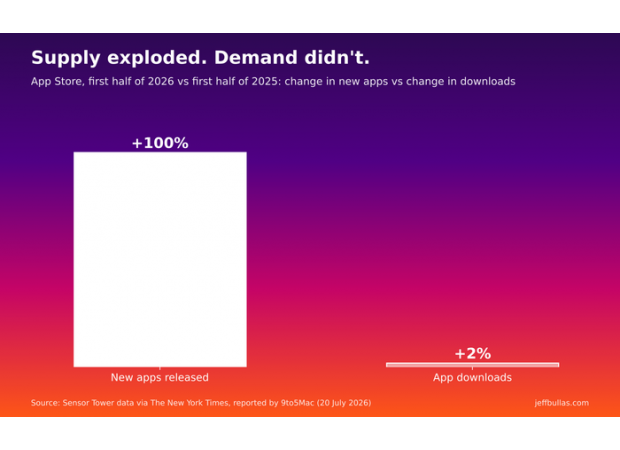

In the first half of 2026, roughly 560,000 new apps appeared on Apple’s App Store. Most of them were made with AI. That’s almost as many as launched during all of 2025.
At the same time, downloads increased by just 2%. Do the math, and that works out to around 3,000 new apps every day. If each new app were a store, a new one would be opening on your street every 30 seconds, around the clock.
Yet the number of people walking down that street hardly changed. And that’s the real challenge now. Building things has never been cheaper.
Getting anyone to notice them has never been harder. The flood For much of the past decade, the number of new apps released each year kept falling. Software was slow to build, expensive to make, and required skills most people didn’t have.
Then AI coding tools arrived. In the first quarter of 2026, new App Store releases surged by 84%, and the App Store is now on pace to pass one million new apps this year, breaking its previous record from 2016. People with ideas but no coding background can now build something over a weekend.
I think that’s fantastic. I’m one of them. I’m building an AI startup called Zyrro, and these tools have completely changed what one person can do.
Supply doubled. Demand rose 2%. But look at the chart again.
The number of apps doubled. The number of people downloading them rose by only 2%. The same pattern shows up in newsletters, podcasts, courses, and posts.
AI has massively increased the supply of almost everything. It hasn’t added a single extra hour to anyone’s day. So the bottleneck has shifted.
The hard question is no longer, “Can I build it?” It’s, “Will anyone see it?” 361 impressions I thought I had that part figured out. I’ve been publishing online since 2009. I started a blog at 52 with just a $10 investment, writing at 4:30 a.m.
before work, and it eventually reached 33 million readers. I also built a following of more than 500,000 people on X. Then, in June 2026, I returned to X to help promote Zyrro.
On 23 June, my entire account got 361 impressions. Not per post. For the whole day.
No one even visited my profile. It wasn’t the first time I’d been overlooked. In 2007, at 50, my business failed.
At 51, I applied for about 700 jobs, and the answer I kept hearing was “overqualified.” Decades of experience meant nothing to the people making the decisions. Back then, the gatekeeper was a hiring manager. In June 2026, the gatekeeper was an algorithmic feed.
Different system, same lesson. It hurt. But it also taught me the most important lesson of the last six months: the followers I’d spent 17 years building did not carry me.
I had to earn every view all over again. The rules changed while I wasn’t looking When I first started on Twitter, the feed was straightforward. You saw posts from people you followed.
More followers meant more reach. Big accounts won, and new accounts struggled to be heard. That world is gone.
X now relies mostly on its “For You” feed, which X has released as open code. It chooses posts for each user based on what they’re likely to enjoy, whether they follow the account or not. A new post is shown to a small audience first, and it only spreads if people respond and engage.
Meanwhile, the average user sees just 20 to 30 posts a day in that feed. Think about that for a moment. Tens of millions of posts are competing for about 25 spots on each person’s screen.
This is the shift from the social graph, who you know, to the interest graph, what you care about. It’s harsh for big accounts that can coast. But it’s a gift to everyone else.
Attention is now available to anyone. A 21-year-old creator named Denys proved it. With no famous name and no large audience, he went from nothing to his first X payout of $2,639.84.
His method wasn’t some clever trick. He simply replied to people every day and posted things they wanted to respond to. If a 21-year-old with no audience can do that, and a 69-year-old with half a million followers can’t coast on the old advantage, then the rules really have changed.
The new scarcity Here’s the second-order effect most people miss: when anything can be built in a weekend, the thing you build stops feeling special. Your app, your newsletter, your course—someone else can copy the features by Friday. What can’t be copied is trust.
People don’t download an app just because it exists. They download it because someone they trust said it was worth their attention. In a world flooded with AI-generated everything, a real person with a real story becomes the rare thing.
I’ve been calling this the human signal. The more content machines produce, the more people look for proof that a human is behind it. Not polish.
Not sheer volume. A voice they recognize, with scars they can see. That changes where builders should spend their time.
For years, the advice was to perfect the product and let customers come to you. Now the product is the easy part. The real work is earning attention, one honest post at a time, before you need it.
What 500 hours taught me So I treated my own X account like a lab. Since June, I’ve put in about 500 hours, roughly three hours a day. I posted, experimented with formats, used AI to analyze the numbers, kept what worked, and dropped what didn’t.
Same follower count. Different strategy. On 21 November, my account got 152,247 impressions in a single day.
On 24 November, 623 people visited my profile and 353 followed me. For the week ending 24 November, signups to the Zyrro waitlist were running at about twice the monthly average. Here’s what I learned, in brief.
Views are not the goal. One post reached 31,000 people and sent only 41 to my profile. Another reached 4,500 people and brought in 100.
What matters is how many people want to learn more about you after they read your post. Different posts do different jobs. Some are built to spread.
A simple prompt like, “You’re 55. You win $1 million tomorrow. Do you quit work?” gets thousands of people responding.
Those posts earn reach. But they rarely make anyone curious about you. Stories turn strangers into visitors.
The posts that brought people to my profile were personal confessions with real numbers. “In 2007, at 50, my business collapsed. I applied for about 700 jobs.
At 52 I started a blog.” Those posts sent 12.8 people to my profile for every 1,000 views. Everything else sent about 2. Stories convert six times better.
One post does the selling. When people land on your profile, one pinned post should tell your story and point to a single next step. Mine sent 690 people to my profile, gained 150 followers, and drove 158 waitlist clicks in one day.
Your hands matter most. My best results came from the things I couldn’t automate or schedule: replying to people and adding my own perspective to their posts. That’s where trust gets built.
Just as important was what failed. Time-travel questions, small success stories, single-stat posts, one-line opinions, and product-only pitches filled the schedule without moving anything. I cut them.
That’s the other habit: keep score. Every week, I check which posts drove people to my profile, double down on what works, and drop what doesn’t after three honest tries. I wait a full day before judging anything.
I once cut a format too soon, only to watch the post nearly double after I had already given up on it. That’s the engine. Reach posts bring in strangers.
Stories make them curious. One pinned post turns curiosity into a signup. Fighting a machine with a machine There’s one thing I haven’t told you yet: I didn’t spend those 500 hours alone.
The feed is a machine. It’s designed to keep people scrolling, not to help you get discovered. It suppresses posts with links, because links pull people away.
In the first half of 2026, roughly 560,000 new apps were added to Apple’s App Store. Most of them were made with AI. That’s almost the same number that appeared across all of 2025.
Meanwhile, downloads only increased by 2%. Do the math, and that works out to about 3,000 new apps every day. If each app were a shop, a new one would be opening on your street every 30 seconds, around the clock.
Yet the number of people walking that street hardly changed. That’s the real challenge now. Building has never been easier, but getting people to notice what you’ve built has never been harder.
The flood For most of the past decade, the number of new apps released each year was falling. Software was slow to build, costly, and required skills most people didn’t have. Then AI coding tools arrived.
New App Store releases surged 84% in the first quarter of 2026, and the App Store is now on pace to host more than a million new apps this year, beating its previous record from 2016. People with ideas but no coding background can now build something over a weekend. I think that’s a wonderful thing.
I’m one of those people. I’m building an AI startup called Zyrro, and these tools have completely changed what one person can do. Supply doubled.
Demand rose 2%. But look at the chart again. The number of apps doubled.
The number of people downloading them rose 2%. The same pattern holds for newsletters, podcasts, courses, and posts. AI has massively increased the supply of almost everything.
It hasn’t given anyone an extra hour in the day. So the bottleneck has shifted. The question is no longer, “Can I build it?” It’s now, “Will anyone see it?” 361 impressions I thought I had already solved that problem.
I’ve been publishing online since 2009. I started a blog at 52 with just a $10 investment, writing at 4:30 a.m. before work, and it eventually reached 33 million readers.
I also built an X following of more than 500,000 people. Then, in June 2026, I returned to X to promote Zyrro. On 23 June, my entire account received 361 impressions.
Not per post — for the whole day. Zero people visited my profile. It wasn’t the first time I’d been overlooked.
In 2007, at 50, my business collapsed. At 51, I applied for about 700 jobs, and the response I kept getting was the same: “overqualified.” The experience I had spent decades building meant nothing to the people making the decisions. Back then, the gatekeeper was a hiring manager.
In June 2026, it was an algorithmic feed. Different machine, same lesson. It hurt.
But it also taught me the most important thing I’ve learned in the past six months: the followers I spent 17 years building did not carry me. Every view had to be earned again. The rules changed while I wasn’t looking When I first started on Twitter, the feed was simple.
You saw the posts of people you followed. More followers meant more reach. Big accounts dominated, and new accounts struggled to be heard.
That world is gone. X now mostly runs on its “For You” feed, which X has published as open code. It recommends posts to each person based on what they’re likely to enjoy, whether they follow the account or not.
A new post is shown to a small group first, and only spreads if people reply and engage. And the average user only sees 20 to 30 posts a day in that feed. Think about that.
Tens of millions of posts are competing for about 25 spots on each person’s screen. This is the shift from the social graph — who you know — to the interest graph — what you care about. It’s ruthless for big accounts that coast.
It’s a gift for everyone else. Attention is now open to anyone. A 21-year-old creator named Denys proved it.
With no famous name and no large audience, he went from nothing to his first X payout of $2,639.84. His strategy wasn’t some trick. He replied to people every day and posted things they wanted to respond to.
If a 21-year-old with no audience can make it work, and a 69-year-old with half a million followers can’t coast on those followers anymore, then the rules really have changed. The new scarcity Here’s the second-order effect most people miss. When anything can be built in a weekend, the thing you build stops being rare.
Your app, your newsletter, your course — someone else can copy the features by Friday. What cannot be copied is trust. People don’t download an app simply because it exists.
They download it because someone they trust told them it was worth their time. In a world flooded with AI-made everything, a real person with a real story becomes the scarce thing. I’ve started calling this the human signal.
The more content machines produce, the more people look for proof that a human is behind it. Not polish. Not volume.
A voice they recognize, with scars they can see. That changes where builders need to focus their time. For years, the advice was to perfect the product and let customers come to you.
Now the product is the easy part. The real work is earning attention, one honest post at a time, before you need it. What 500 hours taught me So I treated my X account like a lab.
Since June, I’ve put in about 500 hours, roughly three hours a day. I posted, tested formats, used AI to read the numbers, kept what worked, and dropped what didn’t. Same follower count.
Different approach. On 21 November, my account got 152,247 impressions in a single day. On 24 November, 623 people visited my profile and 353 followed me.
For the week ending 24 November, signups to the Zyrro waitlist were running at about twice the monthly average. Here’s what I learned, in short. Views are not the goal.
One post reached 31,000 people and sent only 41 to my profile. Another reached 4,500 people and brought in 100. The important number is how many people want to learn more about you after reading.
Different posts serve different purposes. Some are made to spread. A simple prompt like, “You’re 55.
You win $1 million tomorrow. Do you quit work?” gets thousands of people to reply. Those posts earn reach, but they rarely make anyone curious about you.
Stories turn strangers into visitors. The posts that brought people to my profile were personal confessions backed by real numbers. “In 2007, at 50, my business collapsed.
I applied for about 700 jobs. At 52 I started a blog.” Those posts sent 12.8 people to my profile for every 1,000 views. Everything else sent about 2.
Stories convert six times better. One post should do the selling. When people land on your profile, a single pinned post should tell your story and point to one next step.
Mine brought 690 people to my profile, gained 150 followers, and drove 158 clicks to the waitlist in one day. Your own hands matter most. My best results came from the things I couldn’t automate: replying to people and adding my own perspective to other people’s posts.
That’s where trust is built. Just as valuable was what didn’t work. Time-travel questions, small success stories, one-off statistics, opinion one-liners, and product-only pitches filled the calendar but changed nothing.
I cut them. That’s the other habit: keep score. Every week, I review which posts sent people to my profile, double down on what works, and drop what doesn’t after three honest tries.
I also wait a full day before judging anything. I once cut a format too early, only to watch the post nearly double after I had already given up on it. That’s the engine.
Reach posts bring strangers in. Stories make them curious. One pinned post turns curiosity into a signup.
Fighting a machine with a machine There’s one thing I haven’t told you yet. I didn’t spend those 500 hours alone. The feed is a machine.
It’s designed to keep people scrolling, not to help you get discovered. It suppresses posts with links, because links pull people away.

Jaishankar met Mauritius FM Ramful at IORA, reviewed ties, and vowed to deepen their Enhanced Strate...
Read More
The senator-elect went to the game with his family and joined the pregame coin toss....
Read More