
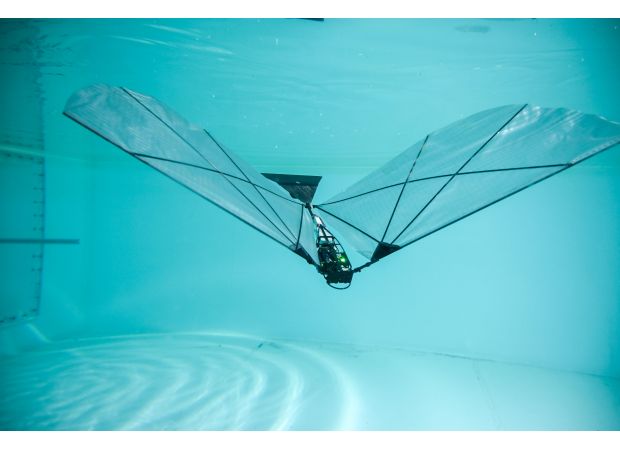

Inspired by the graceful movements of diving birds, a team of researchers from EPFL in Switzerland and MIT have created a revolutionary robot that can swim underwater and fly through the air. This ultra-lightweight robot, weighing less than 300g, mimics the abilities of diving birds like puffins, gulls, loons, and petrels. The study, recently published in the journal Science, focuses on how the robot is able to adapt to two very different environments - water and air.
By studying the movements of diving birds and replicating them in the robot, the researchers hope to not only gain a better understanding of the birds' flight mechanics but also to pave the way for the development of aerial-aquatic drones for scientific research. The robot itself is made up of a central fuselage, two flexible flapping wings, and a steerable tail. The wings are coated with hydrophobic nanoparticles, making them waterproof, and are powered by a waterproof electric motor.
The flexibility of the wings allows the robot to flap like a bird, while also providing the necessary rigidity for flying. Through experiments in a laboratory water tank and Lake Geneva, the team discovered the optimal combination of wing size, flapping frequency, and tail angle for the robot to successfully transition from swimming to flying. With wings measuring around 80cm across, the robot was able to swim at a speed of one meter per second and fly at six meters per second, all while flapping its wings at a frequency of five times per second.
The researchers also found that the robot needed to pitch upwards at a 70-degree angle to break through the water's surface and successfully take flight. Lead author Raphael Zufferey, now an assistant professor at MIT, envisions a future where this technology can be used for environmental monitoring. The robot could be launched from a boat or shore and fly close to areas of interest, such as icebergs or pods of whales, to collect data and samples at a fraction of the cost of traditional methods.
One of the most remarkable features of this robot is its ability to take off from the water without the use of feet. While birds typically need to paddle their feet to launch themselves from the water, the robot's wing design allows it to take off smoothly without this assistance. The team is currently working on improving the wing design to allow for rotation while flying.
They also plan to test the robot's performance in rough water and windy conditions before deploying it for ocean research. With this innovative technology, the possibilities for studying and understanding our oceans are endless.

Odisha's four Left parties are calling for the removal of the Chief Election Commissioner and for th...
Read More
Trump's ban on three news outlets from the White House has been temporarily blocked by a judge, but ...
Read More
Improved education but still issues at Baman Abakash High School in Itamati panchayat, as mid-day me...
Read More
India and UAE will work together to implement initiatives for trade in local currencies, payment sys...
Read More