


In the landscape of American enterprise, the ability to connect disparate systems and orchestrate complex business processes is a critical determinant of success. As organizations grow, merge, and adopt new technologies, their IT environments become increasingly heterogeneous. This is where Oracle SOA Suite has emerged as a foundational platform for thousands of U.S. companies . But what specifically drives American enterprises—from utilities and manufacturers to financial services and public sector agencies—to choose Oracle SOA Suite for their enterprise architecture? The answer lies in its proven ability to deliver scalability, reusability, integration speed, and long-term cost efficiency.
The Las Vegas Transformation: A Blueprint for Scalability
Few examples illustrate the power of Oracle SOA Suite better than the City of Las Vegas. Facing explosive population growth from 165,000 to nearly 600,000 residents, the city could no longer rely on slow, old-fashioned processes . Their Water Pollution Control Facility needed to integrate monitoring systems, lab software, maintenance applications, and financial systems—a complex web of disparate technologies.
The traditional approach of writing custom interfaces for each application had failed. After two years of struggling to build a manual interface, the city achieved the integration in just 10 weeks using Oracle BPEL Process Manager. The results were transformative: automated monitoring of water quality sensors, automatic reordering of parts when supplies ran low, and seamless integration with Oracle purchasing and accounting systems. Labor costs for calculating work expenses were reduced by automatically factoring in personnel salaries, and the workflows developed became templates for other departments .
This case demonstrates a fundamental reason U.S. companies choose Oracle SOA Suite: it replaces brittle, point-to-point connections with a flexible, reusable service architecture that scales with organizational growth.
Measurable Business Outcomes: The Numbers Tell the Story
American enterprises demand quantifiable returns on technology investments. The evidence from U.S.-based implementations is compelling.
Tucson Electric Power Company, operating in a regulated market focused on controlling costs while expanding services, implemented Oracle SOA Suite to create a single enterprisewide integration environment. The utility's IT infrastructure included hundreds of specialized application interfaces and lacked unified processes. After implementation, Tucson Electric expected to implement and integrate new applications 36 percent faster and reduce time spent on system support and maintenance by 50 percent. As Steve Rissler, manager of Information Systems, noted, freeing staff from managing customized interfaces allows them to focus on forward-looking projects that expand services and reduce expenses .
Collect America, a Denver-based provider of asset management services, needed to support rapid business expansion with a more agile infrastructure. Using Oracle SOA Suite as the foundation for their application tier, the company reduced development time for several hundred applications and services and accelerated delivery of IT projects to business users by 30 percent. Jennifer Briscoe, CTO at Collect America, emphasized that "Oracle Fusion Middleware provided a significant development savings through its out-of-the-box integration features and development tools" .
Eaton Steel Bar, a Michigan-based engineered steel bar processor, used Oracle SOA Suite to develop a service-oriented architecture that simplified EDI transactions with suppliers. Previously, processors had to call or fax to notify the company of shipments; now, integrations happen automatically, enabling the company to "easily keep inventory up to date and better understand the performance of our distributed manufacturing operation" .
The Architecture of Scalability: What Makes SOA Suite Different
Oracle SOA Suite's technical architecture provides the foundation for these business results. At its core, the suite consolidates multiple capabilities into a unified platform: messaging, service discovery, orchestration, web services management and security, business rules, an events framework, and business activity monitoring . This integration of components under a single design-time experience, single runtime infrastructure, and end-to-end monitoring greatly simplifies the building, maintenance, and monitoring of distributed SOA implementations .
The platform's adherence to standards—including Service Component Architecture (SCA), Business Process Execution Language (BPEL), and web services standards—ensures interoperability regardless of underlying operating systems or programming languages . SCA enables organizations to manage, version, and deploy components and metadata as a single unit, with all artifacts stored in a single repository . This unified approach translates into major benefits for U.S. enterprises managing complex, heterogeneous environments.
For organizations requiring high availability, Oracle SOA Suite on Oracle Cloud Infrastructure provides built-in functionality using virtual machines, load balancing through OCI load balancers, and support for scaling out to add new nodes . This cloud deployment flexibility allows enterprises to choose deployment models that match their scalability requirements.
Proven Adoption Across American Industry
The widespread adoption of Oracle SOA Suite across U.S. industries validates its value proposition. As of 2026, 1,135 verified companies use Oracle SOA Suite, with the majority based in the United States . The most common industries represented are Manufacturing, Business Services, Custom Software & IT Services, Retail, and Finance .
USinternetworking (USi) , an Annapolis-based application service provider, used Oracle SOA Suite to streamline its software infrastructure to support greater reuse and enhance regulatory compliance for Sarbanes-Oxley. By wrapping key components of applications code to expose them as web services and creating BPEL processes, USi automated user provisioning, achieved single sign-on, and reduced resources required for compliance . As Mike Rulf, vice president of advanced engineering at USi, explained, "We can take the same wrappers we are using internally and expose those Web services to extend all of the security we've built out to our customers. It adds another layer of value to our service that no one else is offering" .
Modern Integration for Hybrid Architectures
As U.S. enterprises increasingly adopt cloud-native technologies, Oracle SOA Suite continues to evolve. A 2025 presentation at Conf42 outlined comprehensive frameworks for integrating Oracle SOA Suite with Spring Boot microservices in cloud environments . Key architectural patterns include:
Performance metrics demonstrate that event-driven architectures achieve the lowest response times and highest throughput, while service bus integration provides comprehensive feature sets with marginally higher latency—offering organizations concrete data for selecting appropriate integration patterns .
Conclusion: The Strategic Choice for Scalable Architecture
U.S. companies choose Oracle SOA Suite because it delivers proven, measurable results. From Las Vegas achieving in 10 weeks what manual coding couldn't accomplish in two years, to Tucson Electric projecting 50 percent maintenance reductions, to Collect America accelerating project delivery by 30 percent—the evidence is consistent. The platform's unified architecture, adherence to standards, and continuous evolution to support hybrid cloud and microservices ensure that today's investments will scale to meet tomorrow's demands. With over 1,100 U.S. companies across manufacturing, finance, and public sector validating the platform, Oracle SOA Suite remains the definitive choice for scalable enterprise architecture.

Madikeri Dasara Begins with Traditional Karaga Deity Puja...
Read More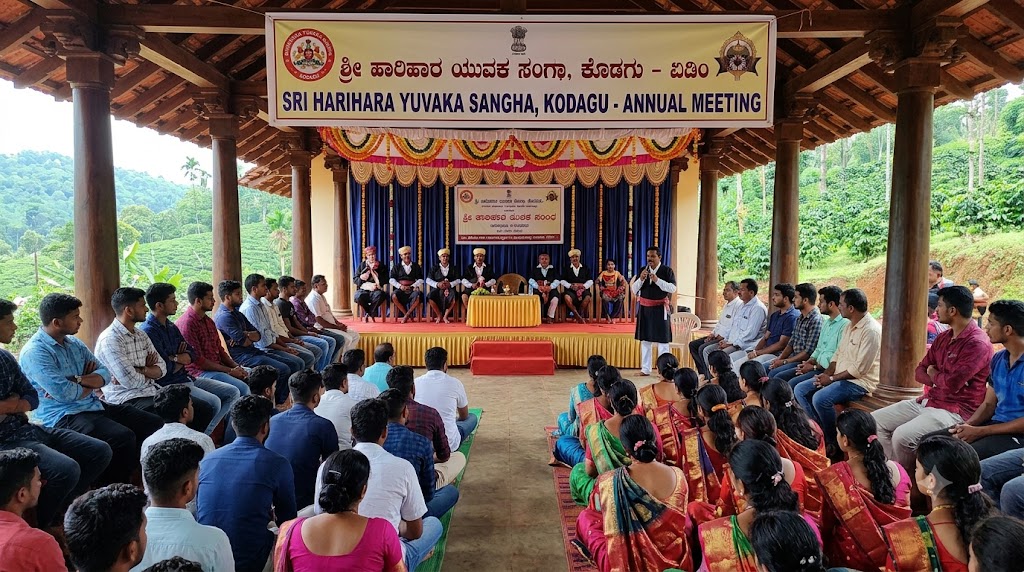
Sri Harihara Yuvaka Sangha Holds Annual General Meeting...
Read More.jfif)
Values Are as Important as Education: Shanthamallikarjuna Swamy...
Read More
Sports Events Strengthen Team Spirit and Camaraderie...
Read More