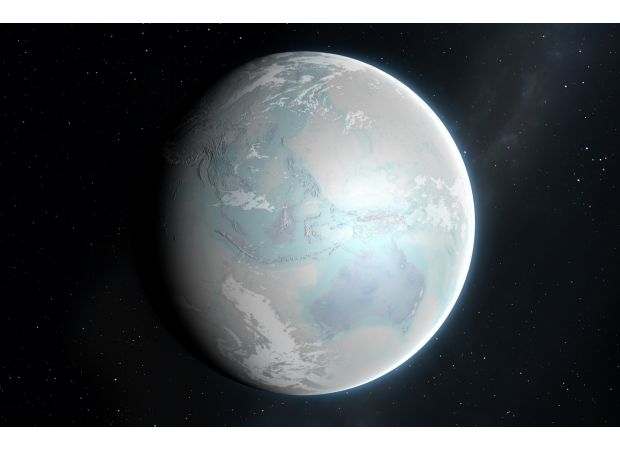

Earth was locked in snow during one of the planet’s last ice ages We all know that Earth is getting warmer. In fact, what we now call climate change used to be known as “global warming.” But 720 million years ago, the blue marble was almost like a giant snowball, swallowed by a deep ice age. Glaciations — the spread of massive glaciers and ice sheets — can trigger mass extinctions.
Now, a study published in Science suggests that humans may have delayed the planet’s next major cold spell by burning fossil fuels. That might sound like a good thing, but experts told Metro it is anything but. “Humans overpowered” the Earth, an expert says As we know, the planet is warming up.
An ice age is a long period when ice spreads much farther south than usual. During the last one, temperatures dropped so low that ice covered land from the poles to the tropics, pushing life into the oceans. This all happened before the age of mammoths and sabre-toothed tigers — which means one of your favourite children’s films isn’t entirely accurate.
What the study is actually referring to is “glaciation,” its author, Nicolás Young, tells Metro. “Over the last 2,600,000 years, Earth has cycled in and out of glaciations,” says the geochemist at Columbia’s Lamont-Doherty Earth Observatory. “The issue is that people, including scientists — and I’m also guilty of this — use ‘glaciation’ and ‘ice age’ interchangeably, even though we shouldn’t.” In simple terms, Earth should currently be in an “interglacial period” — the warmer phase that comes before a glacial period and, eventually, an ice age.
But how do we know that? Young suspected that the Barnes Ice Cap, a bowling-pin-shaped glacier in the Arctic wilderness of Baffin Island, Canada, had recently been getting bigger. If that were true, it would suggest the planet was cooling.
Today, the ice cap covers about 2,300 square miles, roughly four times the size of London. That sounds enormous, but around 20,000 years ago it was a two-mile-thick ice sheet that stretched the Arctic Circle as far south as Illinois. A great deal has changed since then, so to test whether it had grown again, scientists studied frozen moss near the edge of the ice cap and worked out when it had last been alive.
They also examined rocks to determine how long they had remained ice-free, using atomic dating and checking for radioactive traces called isotopes. What they found was that the ice cap reached its smallest size around 3,000 years ago, before starting to grow again 1,000 years later. The sheet has been shrinking since the 1960s Humans, however, have stood in the way of that regrowth.
During the Industrial Revolution, we began burning fossil fuels to power factories, smelters, and steam engines. That released greenhouse gases into the atmosphere, trapping heat that would otherwise have escaped into space. By 1960, the ice sheet started to shrink as human-caused climate change pushed up global summer temperatures.
Today, the cap is melting by as much as a metre each year. “In the last few centuries, greenhouse gases and associated temperature rises have overpowered and reversed what should still be long-term cooling,” Young says. He adds that if climate change hadn’t interfered with the planet’s thermostat, it wouldn’t mean we’d be in an ice age right now, because glaciation happens at a — pardon the pun — glacial pace.
The outer edges of the Barnes Ice Cap Global cooling would have gradually chilled the UK over about 50,000 years before eventually burying it under ice sheets. “These changes are so small initially that life would have been normal,” says Young. “Possibly in a few hundred to a thousand years down the line, the UK might have started to experience some ‘noticeable’ cooling.” Is this...
a good thing? The trimline from 1960 onwards, with the lighter half bare and the darker half full of vegetation, as glaciation abruptly halted In short: no. “Climate change ‘saving us’ should not be the take-home message here,” Young says.
“The cyclic expansion and contraction of ice sheets has been one of the most reliable patterns in the climate system over the last roughly 2.6 million years — and we have suddenly stopped that. This should give us pause.” Professor Mary Gagen, a climate expert at Swansea University who was not involved in the study, says Young’s findings are “exciting.” “It’s neither a good nor a bad thing in terms of the big-picture understanding of how the climate system works,” she says. She adds that ice ages come and go because of several factors, including orbital forcing — the way Earth’s distance from the sun changes over time.
“These changes cause small shifts in the amount of energy received on the surface of the Earth,” Professor Gagen says. “Essentially, the authors give a new view on that prediction, which is interesting; it’s a big, exciting conclusion, from evidence from one small ice cap.” The amount of planet-warming gases in the atmosphere is another important factor, says Dr John Hiemstra, a glaciologist also at Swansea University. Carbon dioxide can disrupt Earth’s orbital forcing, meaning the planet “will not enter a glacial phase simply because heat is retained in the atmosphere due to high levels of greenhouse gases.” That is what is happening now, Dr Hiemstra says, which is why he wants to see more research.
“This is how science advances,” he adds. “A little step at a time.”

The appointment honors her work on cardiovascular health disparities, especially in underserved comm...
Read More
Can you answer all 21 questions correctly?...
Read More
Odisha Congress sought Rs 20 lakh compensation for landslide victims’ families and full farm loan ...
Read More