
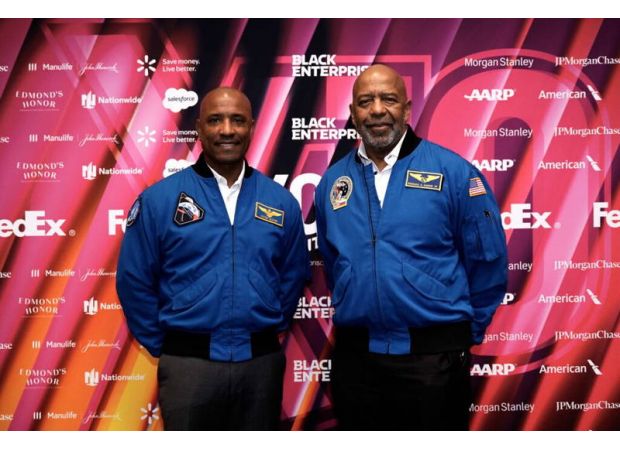

Success under pressure takes more than technical expertise. It calls for resilience, self-awareness, and a willingness to help others succeed along the way. That was the message former NASA astronauts Dr.
Bernard A. Harris Jr. and retired U.S.
Navy Capt. Victor Glover shared last week during a live fireside chat at the 2026 Black Enterprise XCEL Summit for Men. Moderated by Hakeem M.
Oluseyi, CEO of The Astro Society, the conversation highlighted how their experiences in space, medicine, military service, and mentorship offer powerful lessons in lasting excellence. Here are five important takeaways the trailblazing astronauts shared about leadership, investing in others, and helping the next generation find its place in the industries shaping the future. Source: L-R: Hakeem M.
Oluseyi, CEO, The Astro Society; Victor Glover, Emeritus NASA Astronaut, Retired U.S. Navy Captain; and Dr. Bernard A.
Harris Jr., CEO, Managing Partner, Vesalius Ventures at the 2026 Black Enterprise XCEL Summit for Men 1. Rejection Can Become Preparation Harris shared that NASA turned down his first application to the astronaut corps in 1987. Instead of giving up on the dream he had carried since childhood, he used the rejection as fuel to become stronger and more qualified.
He landed a role at Johnson Space Center and helped develop medical equipment for spaceflight before applying again. “I could have said, well, you know, I’m gonna give up on that dream,” said Harris, CEO and managing partner of Vesalius Ventures. “Or I could say, what do I need to do to make sure that the next time that they say, we gotta have you?” Speaking about the extra pressure Black professionals can face when proving themselves, he added, “Sometimes you have to show that you have the right to be there.” 2.
Mentorship Can Change Career Trajectories Glover talked about how he built leadership skills during his years in the Navy. The retired captain said he struggled with seeing so many Black and Hispanic sailors being discharged after having difficulty in their assignments. With encouragement from his wife, he began helping those sailors adjust to military life through reading groups, honest conversations, and mentorship.
He estimated that he directly impacted between 50 and 100 sailors, some of whom later became officers or completed their military careers successfully. Explaining why he chose to invest in those sailors, Glover said his wife pushed him to rethink leaving the Navy. “And she said, well, but then you won’t be able to help them.
Why don’t you go help them and help them navigate this tour and what it means to be here.” That experience, he said, taught him that real leadership means seeing people beyond their performance and helping them thrive. Source: Victor Glover, Emeritus NASA Astronaut and Retired U.S. Navy Captain, at the 2026 Black Enterprise XCEL Summit for Men 3.
Great Leaders Know When to Follow Glover also noted that strong teams need more than just a commanding leader. They need trust, accountability, and the humility to recognize when someone else is better suited to take the lead. “Great leaders make leaders,” he said.
“The key to the next level of leadership is followership.” For Glover and his crewmates, that meant letting the right person lead in the right moment, holding one another accountable, and showing grace when mistakes were made. 4. Humility and Human Health In April, Glover served as pilot for the Artemis II lunar flyby mission, becoming the first Black astronaut to travel beyond low Earth orbit and fly near the Moon, farther into deep space than any previous human.
During the panel, he described the wonder of seeing the Moon up close, including a 45-minute solar eclipse and flashes of light his crew recorded as possible lunar impact events. He said the experience changed how he views humanity’s ability to come together. “We know we can do something for us as a species when we want to,” Glover said, reflecting on the global attention the mission received.
Harris pointed to another lesson from spaceflight: the human body has to adapt to an environment it was never built for. Astronauts can lose about 1% of bone mass each month in space, which makes exercise and medical research critical. He also noted that some of the same countermeasures used in space, such as strength training and lowering sodium intake, are beneficial on Earth as well.
Source: Dr. Bernard A. Harris Jr., CEO and Managing Partner of Vesalius Ventures, at the 2026 Black Enterprise XCEL Summit for Men 5.
The Next Frontier Could Create New Business Opportunities Harris urged Black entrepreneurs to think about the business possibilities opening up through space exploration, including new technologies, infrastructure, and innovations that could build wealth. “I want you to start looking at opportunities to create businesses in space,” he told the audience. He cautioned that Black communities could be left out of those economic gains if they do not get involved in the industry’s growth.
“If we’re not careful as Black folks, we’re gonna be literally left here on Earth while other folks will be making money,” said Harris, whose career spans medicine, spaceflight, and venture capital. RELATED CONTENT: Kirk Franklin Delivers Heartfelt Words As He Accepts ‘Icon Award’ At XCEL Summit For Men
Daytona Beach HBCU's Nursing and Health Sciences College got two federal grants totaling $5.17 milli...
Read More
In June, Lisa Renee Olaso and her fiancée Cyril Christopher looked for a rental after moving from D...
Read More
Congress raises concerns over judicial independence under Modi, citing Justice Kaul’s memoir and u...
Read More
The Election Commission told the Supreme Court the SIR was conducted lawfully and its rollout was un...
Read More