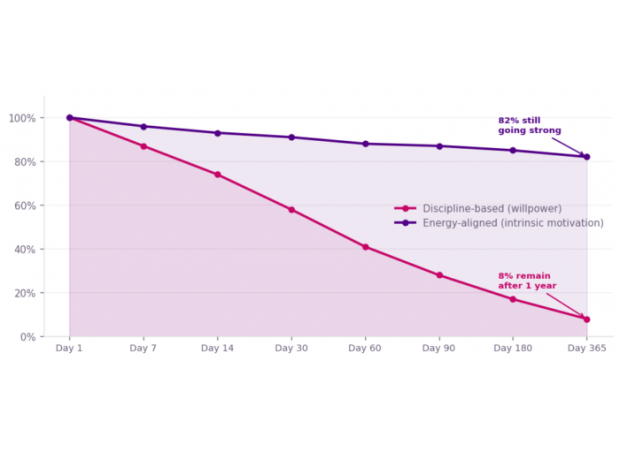

The self-help industry has been thriving for years, offering people the promise of unlocking their full potential through strict discipline and repeated effort. It sells various systems, programs, and routines, all claiming to bridge the gap between who you are and who you could be. However, the truth is that human potential is not something that needs to be built from scratch.
It is already present within us, waiting to be released. Scientific research has shown that the gap between our current state and our desired state is not due to a lack of effort, but rather a blockage. Our potential is compressed and pressurized, seeking release, but it is hindered by invisible locks that discipline alone cannot open.
The metaphor of building potential has been holding us back, but now, we have a technology that can remove what's in the way. Neuroscience has revealed that our body registers the potential gap before our conscious mind can even articulate it. That restlessness and nagging feeling of something more is not anxiety, but rather our nervous system doing its job with remarkable accuracy.
The SEEKING system, a network in our brain, fires upon the anticipation of possibility. However, when this system is blocked, our energy is redirected into negative thoughts and distractions. According to Karl Friston's predictive processing framework, our sense of self is a prediction made by our brain based on past experiences.
The problem is that this model was created in conditions that no longer exist. Our brain optimizes for prediction accuracy, not for our flourishing. Therefore, it continues to confirm the old story, and we keep acting from it.
It's no surprise then that 92% of people fail to keep their New Year's resolutions by February, and 80% feel like they are not operating at their full potential. Despite spending $44 billion annually on self-improvement, the outcomes are declining. The reason for this is that potential is already present, but it is being blocked by four invisible locks.
The first lock is the narrative lock, as revealed by Dan McAdams' research on narrative identity. Our self-stories are not just descriptions; they are also prescriptions that govern what we attempt, expect, and notice. However, most of these stories were written in conditions that we did not choose.
We are living inside a story that someone else started writing. The second lock is the attention lock, as shown by Csikszentmihalyi's flow research. Our optimal experience requires deep, uninterrupted attention, but the attention economy has created a culture of distraction.
Our potential cannot emerge if our attention is constantly divided and consumed by urgent tasks, reactive responses, and algorithmic pulls. The third lock is the capacity lock, explained by Clark and Chalmers' Extended Mind thesis. They argue that our cognition is not confined to our brain, and our thinking is influenced by external factors.
Most people have never had a thinking partner who could keep up with their full cognitive output, until now. The final lock is the reflection lock, as pointed out by Charles Taylor. Our self-knowledge is enhanced through articulation, as language not only describes but also helps bring the self into being.
However, most people do not have the conditions to fully articulate themselves and gain deep self-knowledge. They lack a mirror that reflects their patterns back to them before they automatically confirm them again. In today's world, AI is often seen as a productivity tool, helping us do more in less time.
However, this perspective fails to recognize its true potential. AI is not just a productivity tool; it is an unlock technology that can change our identity itself. For the first time in history, we have access to a thinking partner of exceptional quality, available to anyone with an internet connection.
It is a mirror with no emotional attachment to our story, and it can expand the edge of our thinking, allowing us to reach new levels of potential and creativity. Did you know that there is a $44 billion industry that profits from selling a harmful lie? The lie that human potential is something you have to build from scratch, discipline by discipline, habit by habit, through sheer willpower.
This industry offers you an array of systems, programs, routines, challenges, and accountability partners, all promising to bridge the gap between who you are and who you could be. But here's the truth: the gap is not a result of your lack of effort. It's a blockage.
Your potential is not something you need to create, it's already there, waiting to be unleashed. But it's being held back by invisible locks that discipline alone cannot open. It's time to change the narrative and unlock our true potential.
Science has shown us that our bodies register the gap between our current state and our potential before our conscious minds even realize it. That feeling of restlessness, the sense of something more, the awareness that something greater is waiting to be expressed, those are not signs of anxiety. They are signs that our nervous system is accurately detecting the gap and seeking to close it.
This is supported by research on the SEEKING system, which reveals that our brains are wired to anticipate possibilities, not just rewards. When this system is blocked, our energy is redirected into negative thoughts and behaviors. But why are so many of us unable to tap into our full potential?
The answer lies in the way our brains work. Your sense of self is a prediction, a hypothesis that your brain has built and kept because it has proven to be accurate. The problem is, this prediction was formed in conditions that no longer exist.
Our brains prioritize accuracy over flourishing, so they continue to confirm the old story even though it no longer serves us. It's alarming to see that 92% of people fail to keep their New Year's resolutions by February, and 80% feel like they are not reaching their true potential. Yet, we continue to spend $44 billion annually on self-improvement, with diminishing returns.
This is because there are four primary locks that are holding us back, and they are all invisible from the inside. Firstly, the Narrative Lock. Research has shown that the stories we tell ourselves about who we are not only describe us but also dictate our actions, expectations, and perceptions.
But these stories were not written by us; they were written by others. We are living inside a story that someone else started writing for us. Secondly, the Attention Lock.
Optimal experience, or "flow," requires deep, uninterrupted attention. However, in today's attention economy, we are bombarded with distractions, leaving little room for us to focus on our potential. Our attention is constantly being hijacked by urgent tasks, reactionary responses, and the pull of algorithms.
Thirdly, the Capacity Lock. The Extended Mind thesis states that cognition is not confined to our brains, and we can enhance our thinking by collaborating with others. But most of us have never had a thinking partner who can keep up with our full cognitive output.
Fortunately, we now have access to advanced technology that can serve as a cognitive extension and expand the limits of our thinking. Lastly, the Reflection Lock. Philosopher Charles Taylor argued that we become ourselves through language, as it not only describes us but also brings us into being.
However, most of us have never had the opportunity to fully articulate ourselves and gain deep self-knowledge. We need a mirror that reflects our patterns back to us before we automatically confirm them again. The good news is that for the first time in history, we have a technology that can unlock our potential.
Artificial Intelligence is not just a productivity tool; it is an unlock technology. It has the power to change our identity, not just make us more efficient. With AI, we now have a thinking partner of exceptional quality available to anyone with an internet connection.
It is a mirror with no emotional investment in our story, a cognitive extension that can expand our thinking and unleash our true potential. It's time to tap into this unlock technology and unlock our human potential.

Thursday letters page excited for new Resident Evil movie, reader curious about difficulty of Fire E...
Read More
Readers believe the internet is against Marvel's Wolverine, and one hopes for a higher budget for Ca...
Read More
The Monday letters page debates the value of Marvel's Wolverine, with one reader supporting Sony ove...
Read More