

Charleston, South Carolina, is a compact but lively port city known for its refined Southern food scene. Its French Quarter is a historic area that still carries a distinctly colonial feel. Along King Street, the city’s main shopping corridor, you’ll find art galleries, museums, boutiques, restaurants, hotels, and crowds of people—tourists and Charlestonians alike.
A few blocks away, on Calhoun Street, stands Mother Emanuel AME Church, the oldest African Methodist Episcopal church in the South. The street is named for John C. Calhoun, a white nationalist and pro-slavery politician.
Charleston has a deep and complicated history, and on June 17, 2015, Mother Emanuel became the site of a horrific act of terror when Dylann Roof, a domestic terrorist, carried out a white supremacist attack. He opened fire during Bible study, killing nine innocent parishioners: Cynthia Hurd, Susie Jackson, Ethel Lance, Depayne Middleton-Doctor, Tywanza Sanders, Daniel Simmons, Sharonda Coleman-Singleton, Myra Thompson, and Clementa C. Pinckney, the church’s senior pastor and a South Carolina state senator.
Five others survived: Felicia Sanders, her five-year-old granddaughter, Polly Sheppard, Jennifer Pinckney, and Malana Pinckney. Today, Rev. Eric S.C.
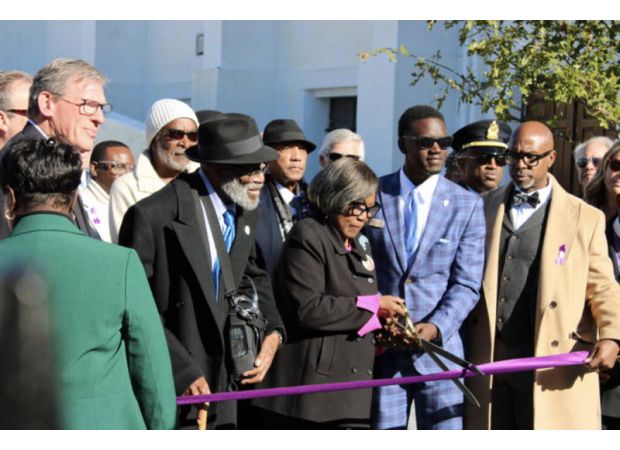
Manning serves as the church’s pastor. On Nov. 14, Mother Emanuel opened the gates to the official Emanuel Nine Memorial site, a courtyard honoring the nine victims and five survivors as a sacred place of healing.
The memorial includes the Fountain of Grace and the Cross of Hope water basin, both striking architectural features designed by Michael Arad, the architect behind “Reflecting Absence,” the National Sept. 11 Memorial. A Survivors’ Garden will also be added in phase two.
“The survivors’ garden is dedicated to the five survivors,” Deona Smith, executive director of the Mother Emanuel Memorial Foundation, told BLACK ENTERPRISE. “I always tell people the courtyard only tells half the story. We have to have a survivor’s garden to honor those people who went through that tragic event.” Smith said the Survivors’ Garden will be located behind the church and was carefully designed.
“There are six benches and five trees,” she explained. “Five of the trees and five of the benches are dedicated to each of the [five] survivors. “There were three adults and two children who survived the tragedy.
The sixth bench is dedicated to Mother Emanuel, and it honors the church and the church’s congregation as a survivor.” Constructed from about 150 tons of white marble, the memorial structures have a celestial quality. The two long curved forms create places for reflection, while also evoking angels’ arms reaching outward in a welcoming embrace. Rev.
Manning and John Darby of The Beach Company have been among the main leaders behind the project. The pastor reflected on the path from idea to completion: “You don’t just build a memorial commemorating and remembering a tragedy like this without understanding that every family matters, every congregation member matters,” Rev. Manning told BE.
“Through all that we had to learn together to form the Mother Emanuel Memorial Foundation and intentionally having not just the pastor of the church, but a community member like John Darby, because when you are seriously and intentionally trying to accomplish a task that is so large and so important, you want to make sure that there is no opportunity for any confusion, any type of challenges that come up with money.” Manning added, “We were intentional in that regard … [we] learned how to lean on each other’s strengths.” Across the street, another part of the Emanuel Nine memorial can be found in a small house donated by the City of Charleston. The space is used to house and display artwork and memorabilia donated in memory of the Emanuel Nine and the Charleston community after the tragedy. Lee Bennett and his wife oversee the archiving, processing, and curation of these items, supported by volunteer efforts.
The opening of the memorial site marks the completion of a $25 million effort that civic leaders, philanthropists, and community stakeholders have supported for more than 11 years. Contributors include the State of South Carolina, the City of Charleston, Charleston County, and nearby municipalities such as North Charleston and Mount Pleasant. Corporate and philanthropic support from the Ford Foundation, Spalding Paolozzi Foundation, The Boeing Company, Blue Cross Blue Shield, and The Beach Company helped anchor the project, along with donated labor from general contractor Balfour Beatty Construction.
Hospitality executive Michael Bennett and philanthropist Sheila Johnson also supported regional healing by creating a College of Charleston scholarship in Mother Emanuel’s name and contributing to the International African American Museum. The foundation’s work is far from over. “There will be continuous fundraising for that as well as the educational programs,” Smith said.
She hopes to raise another million dollars to support the signature Crossroads program, along with memorial programming and citywide experiences. “We will be launching a youth program where we will have a cohort for 11th and 12th graders, and they will come in, and they will sort of craft their own social justice and community project, and we will oversee it, but we’re gonna let them manage it to build their leadership skills to allow them to use their creativity and to give them voice to be able to see and voice what they want to see in their community. “Saturday is not the end.” RELATED CONTENT: Gone But Not Forgotten: Mother Emanuel AME Church Honors The Victims, Survivors
NIT Raurkela patented tech to make EV charging stations more efficient, reliable and sustainable....
Read More
He sold the pub for £975k after it deteriorated....
Read More
Hong Kong: Nvidia chips were already at the heart of the US-China AI race; a scandal involving Jense...
Read More
Williams started the program in his second year as the school resource officer to teach practical sk...
Read More