
Many people spend years of their lives searching for their purpose, never truly finding it. It's not that purpose doesn't exist, but rather that searching for it is the wrong approach. Purpose isn't something that can be constructed or created.
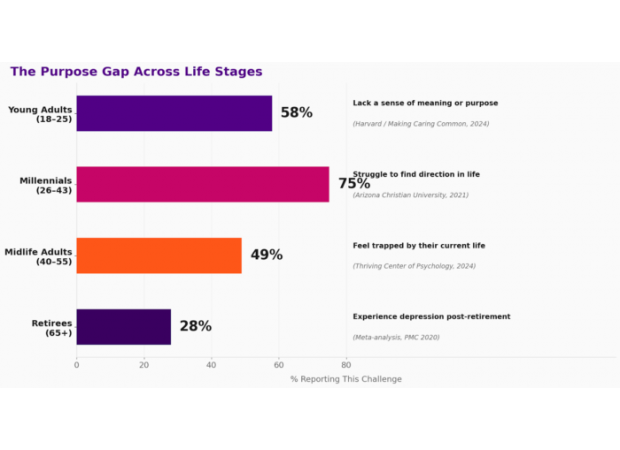
It's a pattern that already exists within our lives, present in the problems we keep encountering, the work that we get lost in, and the things that we can't help but notice. The data is clear - 75% of millennials struggle to find direction, almost half of midlife adults feel trapped, and billions of dollars in productivity are lost each year due to a lack of meaningful connection to our work. It's a widespread issue that affects billions of people and can't be ignored.
However, there is hope. With the advancement of AI technology, the equation is changing. AI may not possess wisdom, but it does have the ability to recognize patterns with perfect recall, without judgment or fatigue.
It can analyze a 5,000-word career narrative in seconds and identify recurring themes that our own biased minds may have overlooked. This post will explore why our traditional methods of searching for purpose fail, and how utilizing AI can help us unlock our true purpose. The Lost Billions There is an epidemic happening all around us, yet it often goes unnoticed.
It doesn't make headlines and there's no official diagnosis, but it may be the most widespread source of human suffering in the modern world. It's the feeling of being lost - not in a physical sense, but existentially. Feeling unanchored, without a clear sense of direction, purpose, or meaning.
This feeling can affect people at any stage of life. According to research from Harvard and other sources, 75% of people do not have a strong sense of purpose. That's billions of individuals feeling lost.
To illustrate the different experiences of feeling lost, let's look at three snapshots of different stages of life. The aspiring, confused, and lost university student. At just 18 years old, students are expected to choose a degree that will shape their future, often based on recommendations from others.
But by their second year, many students feel a sense of wrongness, as though they're on a path that doesn't belong to them. The executive with a midlife crisis. At 43 years old, this person has followed all the societal expectations - they've built a successful career, raised a family, and hit all the milestones.
Yet one day, they wake up and realize that the life they've constructed doesn't feel like their own. The end of career identity crisis. At 67 years old, this person has retired from a distinguished career, only to find that their identity, built over 40 years, has disappeared.
Without the title, the role, and the routine, they're left with a sense of emptiness and uncertainty about who they are now. Despite the different stages of life, all three individuals are facing the same experience - standing at the edge of a vast open field with no map, no compass, and no idea which direction will lead to a life that truly fits. The typical advice for all three individuals is the same - search for your purpose.
Journal, reflect, take personality tests, attend retreats. However, despite following this advice, many still feel lost. “What if the search itself is the trap?” What if purpose isn't something we need to search for, but rather something that has been present in our lives all along, hidden from our biased minds?
What if it's not a destination, but a pattern that we've been living? These are the questions we need to consider. The Scale of the Problem The purposelessness epidemic extends far beyond personal crisis.
Every year, Gallup surveys over 128,000 workers in 160 countries to measure their level of engagement - how purposeful they feel in their work. The results are consistently staggering. In 2024, only 21% of the global workforce reported feeling engaged at work.
That means four in every five workers - billions of people - are either just going through the motions or actively working against their employers. This isn't just a productivity issue, it's a lack of meaning in our work. And despite various strategies and initiatives to address this problem, there has been no significant improvement in decades.
Why This Is a Health Crisis, Not Just a Career Problem The impact of purpose on our mental health is not just an aspirational concept - it's a clinical reality. Research from Harvard's Graduate School of Education found that young adults without a sense of purpose experience anxiety and depression at more than twice the rate of those with a clear sense of direction. This is backed up by a meta-analysis of 16 studies, which found that having a sense of purpose can reduce stress and lead to a longer lifespan.
“Purpose isn't a luxury, it's one of the most powerful protective factors for mental health.” The Dip Nobody Talks About The purpose crisis affects different stages of life in varying degrees. Economists have identified the "happiness U-curve" - a pattern seen in over 132 countries. Life satisfaction is highest in our twenties, then declines through our thirties and forties before reaching its lowest point around age 47.
This phenomenon is not unique to Western culture - it has been observed in studies of great apes as well. Some researchers believe that this dip in life satisfaction is due to the accumulation of unlived life - the growing distance between who we are and who we feel we could have been. The good news is that the curve goes back up, and for those who can read the signs, the second half of life can be the most fulfilling.
But we must know what to look for. Why the Search Keeps Failing: The Psychology Behind the Trap We have been taught to approach purpose like an architectural project - envision our ideal future self, then work our way backward to create a plan to get there. This assumes that there is a single "I" making these decisions.
However, psychologists like Carl Jung and Dan McAdams have shown that this is not the case. We are not one unified person, but rather a complex constellation of different selves, including the persona we present to the world, our shadow self, and deeper archetypes guiding our choices from beneath our conscious awareness. Strong and stable purpose is not discovered in one grand revelation, but rather recognized through small, seemingly unrelated experiences that light up something within us.
“The self is not a unified subject, but an ecology - complex, sometimes contradictory, and always richer than any single story we tell about ourselves.” Summary: Many people spend years searching for their purpose in life, but often come up empty-handed. This is not because purpose does not exist, but because the traditional methods of searching for it are flawed. Purpose cannot be constructed or created, but is instead a pattern that already exists within one's life.
It can be seen in the recurring problems, the work that brings joy and fulfillment, and the things that catch one's attention while others pass by. Statistics show that a large percentage of people struggle with finding direction and feeling trapped, leading to a loss of trillions in productivity worldwide. However, with the advancement of AI technology, there is a new way to uncover one's purpose.
AI, with its ability to recognize patterns and recall information without bias or fatigue, can quickly analyze a person's career narrative and reveal recurring themes that may have been overlooked or ignored. The problem of feeling lost is widespread and affects people of all ages. From the confused and overwhelmed university student to the mid-life executive experiencing a crisis, and even the retired individual struggling with their new identity.
The common advice to search for one's purpose through self-reflection, personality tests, or retreats often proves ineffective for many. This is because the search itself may be the trap, and purpose is not a destination to be reached, but a pattern that has been present all along. The scale of this purposelessness epidemic is staggering, with only a small percentage of the global workforce reporting genuine engagement in their work.
The economic cost of this disengagement is immense, but the impact on mental health is also significant. Studies show that those without a sense of purpose are more likely to experience anxiety and depression, and purpose has been linked to lower stress levels and better overall health. The purpose crisis affects different stages of life, with the lowest point often occurring in mid-life.
This has been attributed to the gradual accumulation of unlived life and the growing distance between who one is and who they feel they could have been. However, there is hope for a more fulfilling second half of life for those who can recognize the signs and patterns. The reason why the search for purpose often fails is due to the flawed psychology behind it.
The traditional approach assumes a unified self making conscious decisions, but research has shown that the self is much more complex and can be influenced by various factors. True purpose is not discovered in a single revelation, but rather recognized through a series of experiences and patterns that resonate with one's deepest desires and values. It is not a singular destination but rather an ongoing journey of self-discovery.

Experts believe a rebrand is needed, even though the idea can be modified....
Read More
NIA officials sent to 7 Assembly seats in West Bengal to prevent bomb threats during ongoing polling...
Read More