
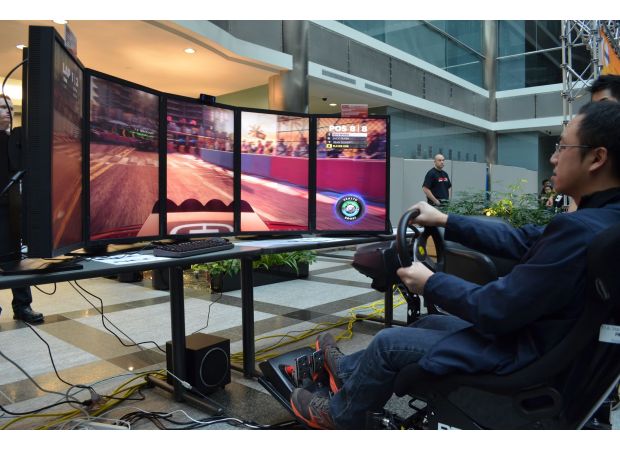

Multiple monitors have a lot of uses. Although local multiplayer has become less common in recent years, one reader has a very detailed vision for how it could become more appealing again. In the future, I can imagine a modern version of local multiplayer gaming where one powerful console or PC powers several separate displays.
That would give each player a full-screen experience while still keeping everyone together in the same room. What makes this idea especially interesting is that the technology to make it happen already exists in large part. What’s really missing is broad support from game developers and platform makers.
The dream setup Picture one high-end gaming PC or console connected to multiple monitors or televisions. Each player would have their own complete, unobstructed view, their own controller, keyboard, or mouse, and their own HUD, inventory, map, and menus. They wouldn’t be able to see another player’s perspective unless they physically looked over at their screen.
And because everyone would be sharing the same machine and simulation, latency between players would be almost nonexistent. That last point is particularly exciting for competitive games. What would make it different from traditional split-screen is simple: screen space would go from shared to full screen per player, screen cheating would become much harder, field of view would no longer be compromised, and competitive fairness would improve through better privacy.
Local co-op could be just as strong as ever, and hardware requirements would shift from one display to multiple displays. Performance demands would also increase, since the system would need to handle multiple viewpoints and possibly higher resolutions. One important distinction is that separate displays wouldn’t automatically stop screen cheating if players can still see one another’s monitors.
But placing the screens back-to-back, using dividers, or seating players in different parts of a room could solve that. The biggest technical obstacle isn’t really the displays. Modern graphics hardware can already drive multiple monitors.
The real challenge is getting games to support multiple independent players, cameras, input streams, and display outputs within a single running instance. For example, imagine a competitive multiplayer shooter. The CPU would run one shared arena simulation, the GPU would render several different camera angles, each view would go to its own display, each controller would control only its assigned character, and the game would keep each player’s private information separate.
That would be more demanding than rendering just one perspective, since it would require more computing power. Still, some parts of the simulation, physics, world data, and rendering could be shared. There are also some interesting precedents.
The Nintendo DS and Wii U experimented with asymmetric displays in different ways, while PC software like Nucleus Co-op has shown that multiple game instances can be run for local multiplayer, even if that isn’t the same as native multi-output support. I can think of three especially compelling uses for this idea. First, multiple people in one room could play a tactical shooter, racing game, or arena fighter with independent displays and no network connection required.
Second, it could create more immersive cooperative adventures, where players explore different parts of an open world on their own, talk to each other, and regroup for missions without being limited by split-screen or a shared camera. Third, it could work brilliantly for local racing and simulation games, with multiple drivers on separate screens, perhaps even using individual steering wheels, all powered by one high-performance machine. In a way, it could bring back something modern gaming has partly lost: the social experience of being physically together, while keeping the competitive fairness and visual freedom of online multiplayer.
You’d essentially get the feel of a LAN party without needing a separate PC or console for every player. There’s also a possible business angle here. Imagine a future console built specifically for multi-display multiplayer gaming, with developers able to target a standard hardware setup.
By reader Sheel The Wii U did have some great local multiplayer games. The reader’s features do not necessarily represent the views of GameCentral or Metro. You can submit your own 500- to 600-word reader feature at any time, and if it’s used, it will be published in the next appropriate weekend slot.
Just contact us by email or use our Submit Stuff page, and you won’t need to send an email. ArrowMORE: How GTA 6 made money on its advertising and why Rockstar hate discs - Reader’s Feature ArrowMORE: I’m shocked by how little has changed about Zelda: Ocarina Of Time remake – Reader’s Feature ArrowMORE: GTA 6 is worth all the hype and will be worth the wait - Reader’s Feature Add Metro as a Preferred Source on Google

Cockroach Janta Party announced zonal in-charges and coordination committees across 10 states and re...
Read More
The only known handwritten final draft of Martin Luther King Jr.’s “I Have a Dream” speech may...
Read More
He sold the pub for £975k after it deteriorated....
Read More
Amul and Mother Dairy raised milk prices by Rs2-4 per litre from Thursday due to higher input and fu...
Read More