

I had just landed my first job as a teacher and was sent to a city that seemed almost too perfect. It was clean, orderly, and boasted good restaurants and a beautiful bay. The people were well-behaved and had impeccable manners that even the British would be proud of.
However, despite all its surface charm, there was something missing. I knew I had been to cities like this before, but I couldn't quite put my finger on what made this one different. As a child, I had visited another city that captured my heart.
It had everything I wanted - a huge amusement park right next to the harbor, white sandy beaches, and ferries that took you to the most picturesque bays. The sand was so white that it squeaked under your feet, and the weather was always warm and inviting. This city also had iconic landmarks like an Opera house and a big bridge with an arch that people affectionately called "the coat hanger." It had an undeniable charm and charisma that drew me in.
I couldn't shake off the feeling that the city I was currently in lacked that special something. Charisma, we call it. It's that intangible quality that sets one city apart from the rest.
And it turns out, it's not just cities that possess this trait. In the online world, charisma has become one of the most valuable assets a person can have. Many believe that charisma is a natural gift, something you're born with.
But I have come to learn that it's a skill that can be learned and honed. Dale Carnegie, a renowned public speaker and author, spent his life proving that charisma is not magic, but a skill that can be trained. And contrary to popular belief, it's not about being the loudest voice in the room or putting on a slick performance for the camera.
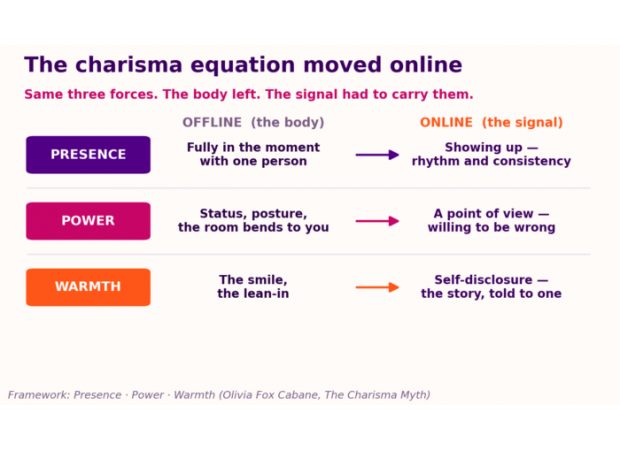
It's about exuding a quiet, steady signal that tells people there is a real person on the other side worth paying attention to. Modern research has also identified three key forces that contribute to charisma - presence, power, and warmth. However, there's a catch that no one likes to talk about.
Carnegie's famous rules for charisma were designed for in-person interactions. They rely heavily on body language and first impressions, which can be formed in a tenth of a second. But in the online world, the room is gone, and with it, half of Carnegie's rules.
You can't make eye contact, remember names, or read body language through a screen. So how do you exude charisma in a virtual setting? The three forces of charisma don't disappear; they simply manifest in a different way.
Presence becomes a rhythm - showing up consistently and building a connection with your audience. Power becomes a point of view - taking a stand and being unafraid to voice your opinions. Warmth becomes self-disclosure - sharing your story and connecting with others on a personal level.
These are the qualities that make a person charismatic in the online world. And the value of charisma cannot be underestimated. In a world where trust in institutions is declining, people now put their trust in individuals who they can relate to.
The creator economy is booming, and the most successful creators are the ones who have mastered the art of charisma. They have built a loyal following who trusts them and is willing to listen to their recommendations. It's not about being the most talented or the luckiest; it's about having a strong enough signal to stand out from the crowd.
But there's a looming threat to charisma - the sameness machine. The algorithms and AI that dominate the online world reward predictability and conformity. They churn out content that follows templates and best practices, resulting in a sea of identical posts that lack any real human connection.
Charisma, on the other hand, is all about being different and magnetic. It's the one thing that a template cannot replicate. And there's proof that authenticity and emotion cannot be replicated by machines.
Virtual influencers and AI-generated faces may look perfect, but they lack the human element that makes charisma so powerful. The machine can copy the format, but it can't replicate the human signal. That's where the true power of charisma lies - in its ability to connect with people on a deep, personal level.
In conclusion, I realized that the city I wanted to be in was not the one that did everything right, but the one that had that special something - charisma. And in the online world, it's not about being perfect or following a formula, but about being yourself and connecting with others on a human level. Charisma is not just a gift; it's a skill that can be learned and used to make a real impact in the world.
So let's embrace our charisma and use it to build meaningful connections in our increasingly digital world. I was once sent to a city for my first job as a teacher. It was a pristine place, with everything in its perfect place.
The streets were clean, the restaurants were top-notch, and the bay was absolutely breathtaking. The people were well-mannered, with a level of civility that even the British would be proud of. However, despite all its beauty and order, there was something missing about this city.
We've all been to places like that, where everything is just right but there's still something lacking. But there was another city that I longed for instead. I had visited it as a child and it left a lasting impression on me.
It had a big amusement park next to the harbor, which had been reconstructed one ride at a time. The ferries would take you to stunning beaches and bays, with white sand that squeaked under your feet. The weather was warm and inviting, almost like a comforting hug, and it never really experienced harsh winters.
This city also boasted an Opera house and a grand bridge with a unique arch that was famously nicknamed "the coat hanger" and recognized by people all over the world. This city had an X-factor, a special charm that set it apart from all the others. I couldn't resist its charisma and eventually arranged for a transfer to this city, where I have stayed ever since.
It was the perfect example of the saying, "one city did everything right, but the other had that special something you can't put on a checklist." And that special something has a name - charisma. In today's world, it has become one of the most valuable assets a person can possess. Many people believe that charisma is a natural gift, either you're born with it or you're not.
But the truth is, charisma is not a magical quality, it is a skill that can be learned and honed. Dale Carnegie spent his life proving this, and his famous rules for charisma, such as smiling, using someone's name, and reading the room, still hold true. However, there is a catch that no one talks about - Carnegie was teaching in a room, where body language and first impressions play a significant role.
But in the online world, where the room is gone, half of these rules no longer apply. Charisma should be impossible to achieve online, and yet, there are some people who are able to connect with millions of strangers through a screen. They are not breaking the rules of charisma, they are simply using a different set of guidelines.
So, the question arises - what carries the charisma when the body disappears? The answer is that the three forces of charisma - presence, power, and warmth - do not die, they simply adapt to the virtual world. For instance, presence becomes a rhythm, with creators showing up consistently and building a following.
Power is no longer about posture, but about having a unique point of view and being unafraid to share it. And warmth is no longer just a smile, but the act of self-disclosure, of sharing personal stories and connecting with others on a human level. In a world where we are separated by screens and distance, we must find new ways to exude charisma and make others feel like a friend.
In today's world, trust no longer resides in institutions, but in individuals. People now trust a person who they can relate to more than they trust a brand or a logo. This has led to the rise of the creator economy, where trust in a person translates into financial success.
However, the middle ground is thin, with only a small percentage of creators earning a full living from their work. The key to standing out and achieving success lies in having a strong and memorable signal of trust. But there is a force that is trying to kill this X-factor - a system that rewards predictability and conformity.
With the rise of algorithms and AI, we are bombarded with content that is generic and lacks individuality. However, charisma is the opposite of being identical, it is about embracing our differences and making them attractive. And there is proof that even the most perfect AI-generated faces cannot match the authenticity and emotional connection of a real human being.
In a world where we are constantly bombarded with the same content, the human signal of charisma stands out and has the power to move people to action. It is a force that cannot be replicated by machines and has no limits. So, while attention may be cheap and trust may be rare, charisma will always be the key to standing out and making a lasting impact.
As someone who discovered the power of social media, I know that it has the ability to reach people all over the world and give a voice to those who are willing to use it. But we must be careful not to fall into the trap of becoming just another cog in the sameness machine. We must embrace our uniqueness and let our charisma shine through, for that is what will make us truly memorable and successful in this digital world.

One reader believes that Marvel's Wolverine is the top game of 2026, despite conflicting opinions fr...
Read More
CIPET: CSTS, Bhubaneswar and MCL, Sambalpur have signed an MoU for employment-oriented training prog...
Read More
2 officials in Bhubaneswar, Odisha were arrested for transferring Rs 9.24 crore of public money to p...
Read More
Odisha Tourism Department signs MoUs to boost homestays and adventure/heritage tourism with SBI, Dep...
Read More