
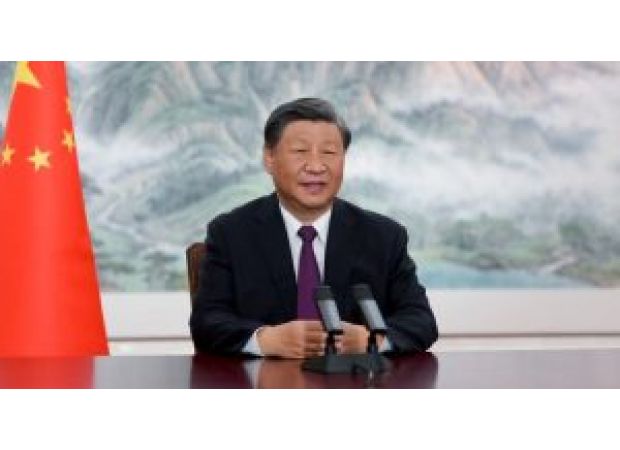

Chinese President Xi Jinping is embarking on a trip to Pyongyang on Monday, marking his first visit to North Korea in seven years. The purpose of this trip is likely to reaffirm China's strong influence over North Korea and solidify their relationship through economic and political benefits. During his two-day stay, Xi will meet with North Korean leader Kim Jong Un.
This will be their first summit since their meeting in Beijing last September, where they attended a military parade alongside Russian President Vladimir Putin and other foreign leaders. While no specific agenda has been revealed, experts predict that this meeting will have significant implications on the bilateral relationship and beyond. As both countries face separate confrontations with the United States, this summit will serve as an opportunity for them to fully restore their traditional alliance.
"A Chinese leader does not visit North Korea simply because it is due. Xi's trip will have real consequences for China-DPRK relations," explained Leif-Eric Easley, a professor at Ewha University in Seoul, using the abbreviation for North Korea's full name. Xi's visit to North Korea comes after his back-to-back summits with US President Donald Trump and Putin in Beijing last month.
He is also expected to meet with Trump again on his planned visit to the US in September. This trip to North Korea will allow Xi to demonstrate China's influence over the Korean Peninsula and assert their leadership role in Northeast Asia amidst strategic competition with the US, according to Kwak Gil Sup, the head of One Korea Centre, a website specializing in North Korea affairs. China has long been North Korea's economic lifeline and main diplomatic backer.
Despite international pressure, China has been believed to have provided clandestine aid to help their neighbor stay afloat. This year marks the 65th anniversary of their mutual defense treaty, highlighting the longevity of their relationship. However, there have been questions about the strength of their ties in recent years, as North Korea has prioritized cooperation with Russia, particularly in supplying troops and weapons to support Russia's war against Ukraine.
In return, North Korea has received economic and military assistance from Russia. Restoring their exclusive influence over North Korea would give Xi leverage in his dealings with Trump, who has expressed a desire to restart diplomacy with Kim. "Implementing UN Security Council resolutions and enforcing sanctions do not seem to be priorities for China," said Easley.
In an article published in North Korea's main Rodong Sinmun newspaper on Monday, Xi emphasized the importance of strategic cooperation between China and North Korea, as well as their shared opposition to "hegemonism and coercive politics." Kim Jong Un is in need of China's support for his push for a nuclear state. Xi is expected to offer economic aid packages, such as shipments of rice and fertilizers, a resumption of Chinese group tourism to North Korea, and joint economic projects. "North Korea cannot rely solely on Russia.
It needs to align with China," said Kwak. In a Monday editorial, North Korea's Rodong Sinmun newspaper referred to Xi as "the most honored state guest," underscoring the warmth and friendship between the two countries. During the summit, Xi may choose to refrain from pressing Kim on the issue of denuclearization of North Korea and instead vaguely mention the importance of peace and stability on the Korean Peninsula.
This would be crucial for Kim, who is desperate for international recognition as a nuclear weapons state and the lifting of UN sanctions. "Chinese officials have taken the stance of not publicly discussing denuclearization on the Korean Peninsula while still viewing it as a long-term goal. Kim appears to want Xi to accept North Korea as a nuclear neighbor," explained Easley.
Last week, Kim unveiled a new plant to produce nuclear materials and pledged to increase the country's nuclear arsenal at an exponential rate. He also observed sea trials of a new naval destroyer and urged for the speed-up of efforts to build a nuclear-armed navy. On Sunday, Kim's sister, Kim Yo Jong, echoed her brother's sentiment, denouncing the US's push for denuclearization as "an escapist and anachronistic dream." Since the collapse of his high-stakes diplomacy with Trump in 2019, Kim has rejected offers for talks from the US and South Korea, instead focusing on expanding and modernizing his nuclear weapons.
Experts believe that Kim may eventually seek arms reduction talks with the US to gain concessions in exchange for partially surrendering his nuclear weapons. However, for now, he remains determined to hold onto his nuclear arsenal and continue his efforts to gain international recognition as a nuclear state.

New film "Hanuman Ansh" about spiritual leader Neem Karoli Baba earns Rs 200 crore at box office. Di...
Read More
Trump opposes calls to regulate AI, saying it could harm US in the race against other countries....
Read More
Bhubaneswar, Kataka, and Brahmapur are celebrating Ganesh Puja with enthusiasm. Follow Orissa POST f...
Read More
AI may be able to write, but authorship is more than just typing - it's about purpose, evaluation, a...
Read More