
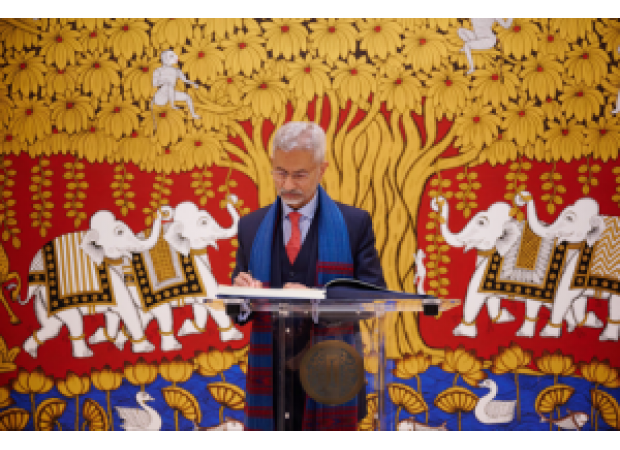

Recently, the External Affairs Minister of India, S. Jaishankar, paid a visit to the Swami Vivekananda Cultural Centre in Paris. In a post on social media platform X, he expressed his excitement about witnessing the impressive expressions of India's cultural and spiritual heritage at the centre.
He also expressed his hope that the recently renovated facility will serve as a hub for the deepening interest in Indian art and culture in Paris. The centre boasts vibrant exhibits of Indian art, including beautiful tree-of-life murals featuring elephants and peacocks, as well as intricate miniature paintings that symbolize India's rich spiritual heritage. Managed by the Indian Council for Cultural Relations, the centre serves as a diplomatic tool to strengthen Indo-French ties.
This aligns with the commitments made by Prime Minister Modi during his talks with French President Emmanuel Macron in February to expand cultural hubs in Europe. EAM Jaishankar arrived in France on March 27 to attend the G7 Foreign Ministers' Meeting. During the meeting, he emphasized the importance of the India-Middle East-Europe Economic Corridor in promoting global connectivity, especially in the midst of ongoing geopolitical tensions.
He also noted that the conflicts in West Asia only reinforce the need for resilient trade routes and secure supply chains. Addressing the session, EAM Jaishankar highlighted India's expanding trade agreements with major global partners, including the Free Trade Agreement with the European Union, the European Free Trade Association, and the United Kingdom. These agreements have added significant value to the India-Middle East-Europe Economic Corridor.
The External Affairs Minister also appreciated the growing enthusiasm among international partners to realize the connectivity initiative. He also stressed the urgency of reforms within the United Nations Security Council and highlighted the challenges faced by the Global South. In a post on social media platform X, EAM Jaishankar shared his views about the India-Middle East-Europe Economic Corridor during the second session of the G7 Foreign Ministers' Meeting with invited partners.
He also pointed out that the uncertainties arising from the conflicts in West Asia only make a stronger case for more resilient trade corridors and supply chains. At the same time, he acknowledged that India's free trade agreements with the European Union, EFTA members, and the UK have enhanced the utility of the India-Middle East-Europe Economic Corridor. In conclusion, the visit to the Swami Vivekananda Cultural Centre in Paris and the discussions at the G7 Foreign Ministers' Meeting have highlighted the importance of promoting cultural ties and global connectivity.
As India continues to strengthen its trade agreements and partnerships, it is also working towards bringing about much-needed reforms in the international community.
A human skeleton was discovered in a scrap dealer's settlement during a cleanliness drive in New Del...
Read More
Fund backs theater instruction, productions, & performance chances for future students....
Read More
Readers express outrage at Xbox layoffs and share their thoughts on Fire Emblem: Fortune’s Weave....
Read More
Iran's President Pezeshkian will speak at the UN General Assembly, marking a historic moment as the ...
Read More