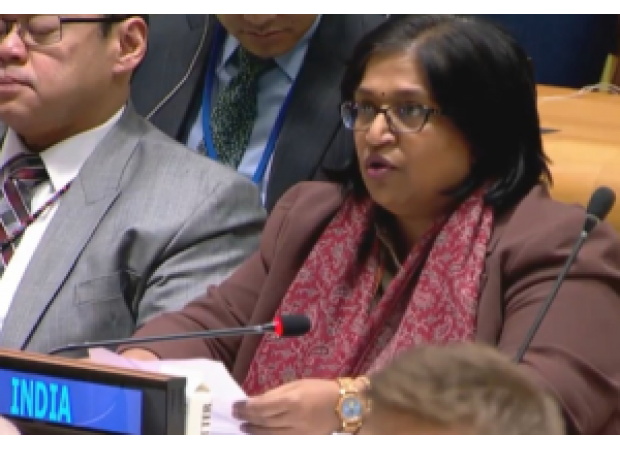

At the United Nations meeting, India made it clear that they do not support the idea of a third category of membership in the Security Council. This proposal would give longer terms and allow for re-election, but it would also eliminate the need for expanding permanent membership. India's Deputy Permanent Representative, Yojna Patel, spoke out against this plan, stating that it would only delay the much-needed reforms and keep the UN in a state of crisis for years to come.
Patel called this suggestion a "red herring", meant to distract from the real issue of implementing necessary reforms. She also expressed concern that this could lead to a subpar outcome that would delay real change for decades, ultimately damaging the legitimacy and relevance of the UN. This idea for a third category, known as Fixed Regional Seats, was proposed by a small group called Uniting for Consensus (UfC), led by Italy and including Pakistan.
UfC opposes expanding permanent membership and has consistently hindered progress in negotiations. In contrast, the Group of 4 (G4), which includes India, Japan, Germany, and Brazil, advocates for expanding the permanent membership and supports each other's bids for permanent seats. Japan's Permanent Representative, Yamazaki Kazuyuki, who spoke on behalf of the G4, emphasized that the proposed third category would not be any different from the current non-permanent seats.
He also pointed out that since there is no guarantee of continuity for this category, it cannot serve as a substitute for permanent seats. The G4 firmly believes that expanding both the permanent and non-permanent categories is essential for meaningful reform and has the backing of the majority of UN members. The L.69, a group of 42 developing countries, also opposes the third category proposal.
Speaking on behalf of the L.69, Saint Lucia's Permanent Representative, Menissa Rambally, stated that any intermediate or hybrid proposal that replaces the expansion of the two categories would not be a true reform of the Council. She added that the Global South did not wait 80 years for a mere appearance of reform. Patel rejected another suggestion to grant the Fixed Regional Seat-holders veto power, stating that it is impossible to determine which country would exercise this power and how.
She viewed this as a deliberate attempt to complicate an already difficult discussion and further solidify opposition to expanding the permanent category. Patel stressed that expanding both the permanent and non-permanent categories is crucial for achieving meaningful reforms and is supported by the majority of UN members. She also dismissed concerns that this would complicate the Council's working methods, stating that these can be reviewed and reformed to accommodate a larger presence of member states.
Finally, Patel highlighted the issue of under-representation of the Asia-Pacific, Africa, and Latin America-Caribbean group in the permanent category. She emphasized that this is a central factor in any Council reform and must be addressed. With the aim of achieving necessary reforms, India stands firm in their rejection of the third category proposal and continues to advocate for expanding permanent membership.
CIPET: CSTS, Bhubaneswar and MCL, Sambalpur have signed an MoU for employment-oriented training prog...
Read More
Readers debate Rare's best game while one explains why they sold their Xbox Series X console....
Read More
Readers are surprised by Super Mario 64's 30th anniversary and one defends Marvel's Wolverine on the...
Read More