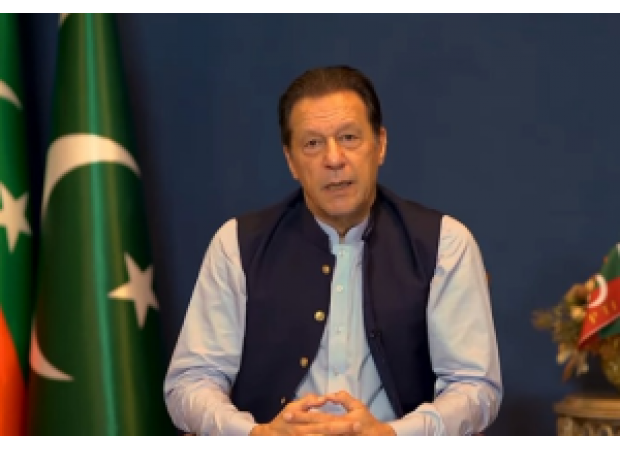

A recently leaked diplomatic cable has shed light on the role of the United States in the removal of former Pakistani Prime Minister Imran Khan from office. According to a report from The Drop Site News, the classified cable was sent by Pakistan's envoy to the US, Asad Majeed Khan, to the Foreign Secretary in Islamabad. It detailed a meeting between Khan and US Assistant Secretary of State for South and Central Asia, Donald Lu, on March 7, 2022.
During the meeting, Lu expressed the US's frustration with Khan's decision to visit Russia on February 24, 2022, the same day as the attack on Ukraine. Lu believed that this visit had "created a dent" in the bilateral relationship between the US and Pakistan. However, he also suggested that if a no-confidence motion against Khan were to succeed, the US would be willing to forgive and forget.
Lu's words were carefully chosen, as he stated that the dent in the relationship would "go away very quickly" if the political situation changed. It was clear that the US had a vested interest in seeing Khan removed from office. The Pakistani envoy also noted that Lu warned of tough times ahead if the no-confidence motion did not succeed.
Lu's concerns were not limited to the US's relationship with Pakistan. He also mentioned the potential reaction from Europe, indicating that they would likely have a similar stance. The report also suggests that the US was disappointed with Khan for not allowing their forces to use Pakistani bases against Afghanistan.
As a result of the no-confidence motion, Khan was ousted from his position on April 10, 2022. The leaked cable was shared by The Drop Site on social media, causing a stir and sparking a debate. Khan's political party, the Pakistan Tehreek-i-Insaf, used the cable to their advantage, claiming that it proved their allegations of a conspiracy against their government.
The controversy surrounding the leaked cable first came to light when Khan himself addressed it during a public rally in March 2022. He produced a paper from his pocket and waved it to the crowd, claiming it was evidence of the alleged conspiracy against his government. Interestingly, the report from The Drop Site News also sheds light on the events that followed Khan's ouster.
It states that the US's relationship with Pakistan improved after his removal, but was once again tested when the country's Army chief at the time, Qamar Javed Bajwa, refused to grant the US access to key nuclear sites. This prompted then-US President Joe Biden to refer to Pakistan as "one of the most dangerous nations in the world." Bajwa eventually stepped down and was succeeded by Asim Munir. However, in 2025, after three tumultuous years at the helm of the military-led government, Munir promoted himself to the rank of Field Marshal.
He also created a new office for himself as Chief of Defence Forces and abolished the role of Joint Chiefs of Staff Committee through a constitutional amendment. These actions effectively placed Munir in charge of Pakistan's nuclear weapons. This was the first time in history that the checks and balances surrounding Pakistan's nuclear command were unified under one person - the country's pro-US army chief.
The report also suggests that the IMF's bailouts to Pakistan were tied to the country's involvement in the Ukraine conflict, and that Pakistan signed a defence pact with Saudi Arabia, a move that Khan's government had resisted. After his ouster, Khan used the leaked cable as proof of an international conspiracy against him. This led to a case being launched against him for violating the country's secret laws.
In July 2023, Prime Minister Shehbaz Sharif's coalition government ordered an investigation under the Official Secrets Act, and in August 2023, Khan was arrested in connection with the leak. In January 2024, a special court in Islamabad convicted Khan and his former foreign minister, Shah Mehmood Qureshi, in the case, and sentenced them to 10 years in prison each. However, the verdict was later overturned by the Islamabad High Court in June 2024, citing lack of evidence.
The leaked cable had far-reaching consequences, not only for Khan and his government but also for the US-Pakistan relationship. It also highlighted the power dynamics within the Pakistani government, with the Army chief ultimately holding control over the country's nuclear weapons.

2 officials in Bhubaneswar, Odisha were arrested for transferring Rs 9.24 crore of public money to p...
Read More
Fund backs theater instruction, productions, & performance chances for future students....
Read More
Xbox exec reassures fans that GTA 6 pre-orders are doing extremely well despite recent layoffs and w...
Read More