December 15th 2025.
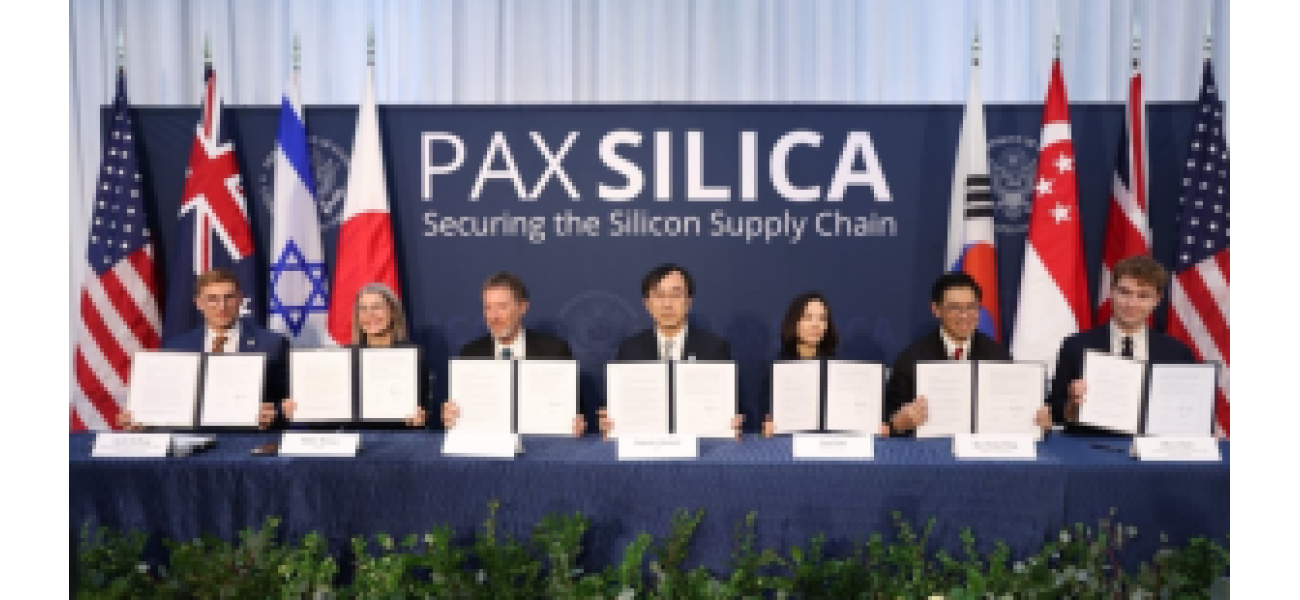
On December 11th, the United States made a major announcement about their new strategic initiative called "Pax Silica." This initiative aims to create a secure and trusted supply chain that covers critical minerals, emerging technologies, advanced manufacturing, and semiconductors. The members of this grouping include the US, Japan, South Korea, Singapore, The Netherlands, the United Kingdom, Israel, the United Arab Emirates, and Australia. However, the exclusion of India from this alliance has sparked questions and raised eyebrows in New Delhi, causing many to wonder about the future of India-US economic and strategic ties. This omission comes at a time when India and the US have been unable to reach a trade agreement despite multiple rounds of high-level political engagement and technical negotiations, leaving Indian exporters facing a harsh 50% tariff imposed by the Trump administration.
The US has positioned Pax Silica as its flagship initiative for artificial intelligence and supply-chain security, seen as a way to counter China's dominance in these fields. This alliance is designed to reduce dependence on China, which currently controls nearly 70% of global rare-earth mining and plays a significant role in several critical technology supply chains. Essentially, it seeks to secure the entire technology ecosystem that supports modern AI, from access to rare minerals and energy inputs to semiconductor fabrication, AI infrastructure, logistics, and advanced manufacturing.
The name "Pax Silica" holds symbolic meaning, with "Pax" representing order and stability, while "Silica" directly refers to silicon chips and computing power. Together, the initiative symbolizes an effort to influence who controls the key inputs and strategic choke points of the AI-driven global economy. Pax Silica's stated goals include identifying vulnerabilities and opportunities across AI supply chains, promoting joint ventures and co-investment arrangements, and protecting sensitive technologies and critical infrastructure from access by "countries of concern." However, if pursued aggressively, these objectives could potentially isolate countries outside the alliance, such as India, from critical technology flows and investment.
The US's decision to leave India out of the alliance has sparked a political debate and triggered a deeper strategic conversation about Washington's intentions. Many are questioning whether this is simply a matter of timing, a result of unresolved trade frictions, or a more pointed signal about how the US is redrawing the global technology map. The answer may lie in recent developments, such as increasing pressure on India to open up its market, particularly in agriculture, to American companies. There is also a growing concern among the US and its allies about India's ability to keep key technological advancements secure and safe.
In a surprising move, Mexico announced tariffs of up to 50% on imports from India, China, and other countries, affecting a wide range of products from textiles and footwear to automobiles and auto components. This decision is striking because Mexico is not among India's top 20 trading partners, leading many to question if there are broader geopolitical motives at play rather than just trade-based considerations. It is speculated that Mexico may be acting at the behest of the US, similar to how the US imposed a 25% punitive tariff on India for purchasing Russian crude oil. In this case, the Russian oil was merely a guise, and the real intent was to punish India.
Just days before this announcement, President Trump threatened to impose new tariffs on Indian basmati rice following allegations from an American agricultural delegation that India was "dumping" rice in their market. These emerging developments highlight the need for India to engage in renewed diplomatic efforts, as global supply chains fragment and technology alliances become more rigid. India must carefully navigate trade negotiations, protect its market access, and strengthen its position in critical technology ecosystems to safeguard its long-term economic and strategic interests. However, this may prove to be challenging as India's foreign policy decisions have left them virtually friendless on the global stage.
[This article has been trending online recently and has been generated with AI. Your feed is customized.]
[Generative AI is experimental.]