
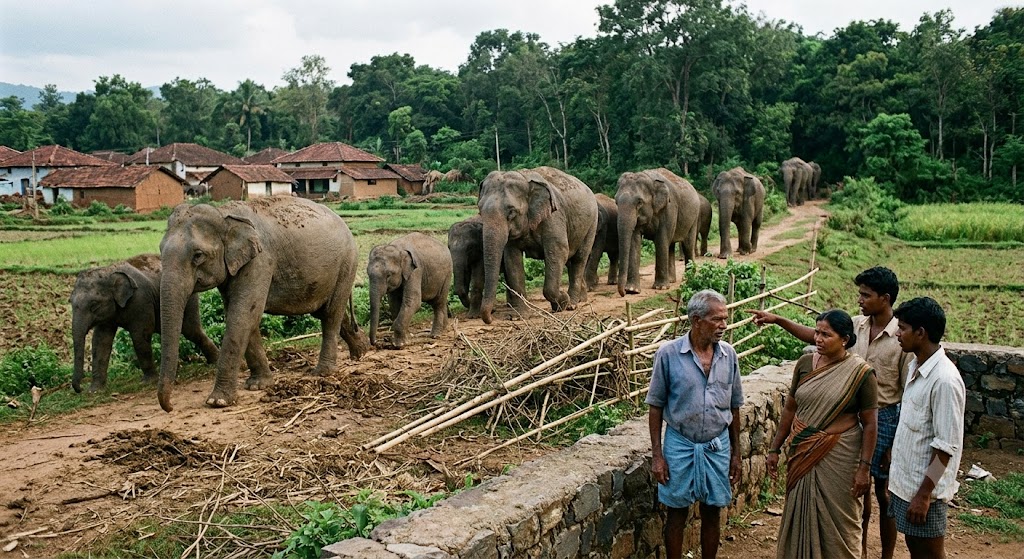

This is not just a news story in Kodagu. It has been a recurring concern for many years. When an elephant comes, people are afraid. The forest department goes into action. An attempt is made to trap the elephant. After the incident, there is talk of a solution. After a few days, the situation normalizes. But the next time another elephant comes. Another human dies. The same discussion again.
So where is the problem?
In the elephants themselves? In the increasing number of elephants? Or in the changes we have made in the forests where elephants live, their routes and their natural habitat?
If we end the news with just “elephant attacks” without asking these questions, we will have seen only half of the problem.
44 deaths in five years
Human-elephant conflict in Kodagu is not a yesterday's problem. According to a report based on an RTI reply from the Forest Department, 44 people have died in elephant attacks in the five years from 2019-20 to 2023-24.
2019-20 - 5 | 2020-21 - 8 | 2021-22 - 12 | 2022-23 - 6 | 2023-24 - 13 The fact that deaths continue year after year shows the severity of the problem. Meanwhile, the report that 8 people have died in elephant attacks in Kodagu till August 17, 2026 has once again raised concerns. The statistics say the same thing. This is not just a problem of elephants; it is a question of human-elephant conflict that has not been resolved for years. Behind every number is a family. A father. A mother. A son. A daughter. A death that changes the life of a family.
So this cannot be seen as just a matter of wildlife conservation. It is also a question of human lives. But... why is the elephant coming? Here we need to go back a little. An elephant does not come to the village to kill a human. It seeks food for its survival. It seeks water. It seeks a safe path.
Elephants are creatures that move across large areas. They are not sedentary animals. Some paths in their lives are used by generations. Older elephants remember water sources, food areas, and safe routes.
But one day, a road comes along that path. On the other side, a house comes. On the other side, a farm. On the other side, a garden.
So what should an elephant do?
The path changes. Sometimes that path goes near a human house. That's where the conflict begins. A forest is not just about the number of trees. We count trees as a forest. But for an elephant, a forest is not just about the number of trees. Food... water... shade... a route of travel... a breeding ground... safety. All of these are its hbichinha. Even if a forest is large, if the main routes within it are cut off, the elephant has a problem. This is what scientists call hbichinha jdichigmetinha ioti.
The Union Environment Ministry’s records on land use change, encroachment of government land and forests, and fragmentation of elephant routes have also been recorded in the context of human-elephant conflict.
That is... counting the number of elephants alone does not complete the story. Forest encroachment - a question that must be addressed. Here is another unusual question. What have we done to the forest area? Karnataka’s Itteethi Chitina Khichis Eodichie had also suggested that the possibility of reclaiming illegally encroached land within or on the edge of the forest area be considered in the context of elephant conservation.
That is, the question of forest encroachment is not something that has arisen in today’s debate. This is an issue that has been before government experts for years.
According to an old study cited in the Karnataka High Court records, the forest area of Kodagu had decreased from 2,566 sq km in 1977 to 1,841 sq km in 1997. This is an old study figure. This should not be considered as the forest area of Kodagu today. But if so much change has been recorded in a period of almost two decades, a question naturally arises. What changes could there be in the forest of Kodagu and its surrounding land use from 1997 to today?
How much has the situation changed today? How much forest area is intact? How much area has been fragmented? How many transport routes have changed? In how many areas has human activity expanded? This requires today's official data. Not guesswork. But the old figure alone raises a lot of questions. Because this is not just a story of the reduction in the number of trees. It is also a question of how narrow the life path of elephants has become. Another caveat is necessary here. Not every coffee plantation can be said to be encroached upon by the forest. The coffee plantations of Kodagu are also a part of this landscape. Scientific studies have shown that elephants also move through tusks.
So, rather than looking at the issue in black and white, we need to look at the records to see which land is legal and which is illegal, which areas are elephant-infested, and which land-use changes are hindering elephant movement.
Disclaimer: This article has been translated by xklsv.com using advanced AI-based translation tools. Please note that the use of AI for translation is still experimental and may not be accurate. The original content is sourced from shakthidaily.info, and Shakthi Daily is not responsible or liable for any errors, omissions, or inaccuracies that may appear in the translated version, including spelling, grammar, or contextual misunderstandings.
If you come across any mistakes or inconsistencies in this translation, we kindly request you to report them by sending an email to [email protected]
Your feedback will help us improve the quality.
The image in this article has been generated using artificial intelligence and is intended for illustrative purposes only. It may not reflect real-world accuracy.

12 Kodagu Players Selected for Karnataka Hockey Team...
Read More
Forest Department Bans Mobile Phone Use During Safaris Across Karnataka, Including Nagarhole...
Read More
Kodava Inter-Keri Badminton Tournament Gets Underway...
Read More
Rajyotsava Celebrations Marked by Sports Meet...
Read More