

In December 2025, something truly remarkable happened. Anthropic, a leading company in the field of artificial intelligence, conducted a groundbreaking research study. Utilizing their own AI technology, a version named Claude acting as an interviewer, they engaged in open-ended conversations with over 80,000 people from 159 countries and 70 different languages.
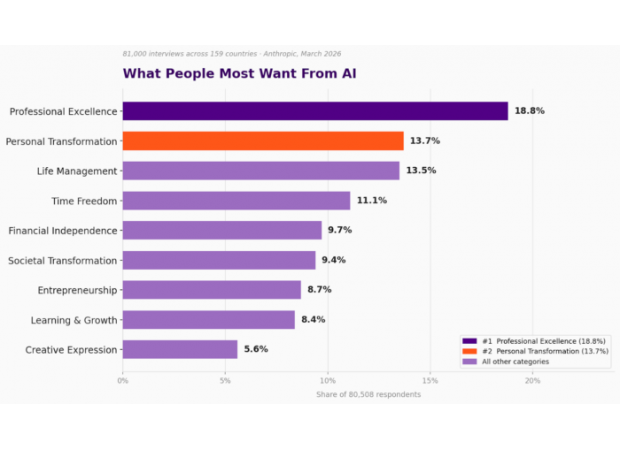
This was the largest qualitative research study ever conducted, providing valuable insights into the human condition and our relationship with AI. One of the most significant findings from the study was that personal transformation ranked as the second most desired outcome from AI, with 13.7% of respondents expressing this desire. This far outweighed the desire for professional excellence, which ranked number one and may have been expected in today's AI-dominated workplace.
The fact that personal transformation was the second most desired outcome tells us that people are looking to AI for more than just productivity and career success. Delving deeper into the research, it became clear that people were seeking personal transformation in multiple areas of their lives. The top three were life management, time freedom, and financial independence, followed by societal transformation, entrepreneurship, learning and growth, and finally, creative expression.
This reveals a fundamental desire for growth and self-improvement that goes beyond just achieving success in the workplace. Interestingly, the researchers noticed a trend in the responses. Many people initially talked about using AI for productivity and efficiency, but when asked what achieving that would enable for them, the answers shifted to personal growth and connection.
For example, one worker from Colombia shared that with the help of AI, they were able to spend quality time cooking with their mother instead of finishing work tasks. This shows that productivity is often just the door to something deeper and more meaningful. It's essential to note that not everyone is using AI for personal transformation.
In fact, only 13.7% of respondents explicitly named it as their primary desire from AI. However, this small percentage represents a crucial group of individuals who have made a conscious decision to use AI for personal transformation. They have recognized the potential for growth and have made it their intention to utilize AI in this way.
The study also highlighted the unique role that AI plays in personal transformation. People valued AI not for its intelligence or speed, but for its patience, availability, and absence of judgment. It is this combination of qualities that makes AI an ideal "mirror" for personal growth.
It is always available, never tired, and free of social agenda, providing a non-judgmental space for self-reflection and growth. The researchers also found that AI has already delivered on people's visions of personal transformation. 81% of respondents reported that AI had taken a step towards their desired outcomes, with productivity, cognitive partnership, learning, and emotional support being the most common categories.
This shows that AI is not just a theoretical concept but is actively impacting people's lives all over the world. In conclusion, Anthropic's research has shed light on the true potential of AI for personal transformation. People are looking to AI for more than just productivity and success in the workplace.
They want to grow and improve in all aspects of their lives, and AI has the potential to be a powerful tool for achieving this. The question now is, are we utilizing AI in this way, and if not, how can we start? The evidence suggests that AI is already delivering on people's visions of personal transformation, and it's up to us to embrace this potential for growth and change.
In December of 2025, something truly groundbreaking happened at Anthropic. They utilized AI in a unique way - by using a version of Claude as an interviewer to engage in open-ended conversations with over 80,000 individuals from 159 countries, in 70 different languages. This was no small feat - it turned out to be the largest qualitative research study ever conducted.
And while the main focus was on AI, there was a fascinating discovery that revealed more about humanity than about the technology itself. It was found that the second most desired outcome from AI was personal transformation, with 13.7% of the 81,000 participants expressing this desire. When given the opportunity to speak freely and honestly, the individuals in the study revealed that their main hope from AI was to become a better version of themselves.
Now, you may be curious about what came in first place. Drumroll, please...it was professional excellence. Not exactly surprising, considering the impact AI has had on the workplace over the past couple of years.
However, when we look beyond the surface and delve deeper into the research and numbers, we see something more significant. The time unlocked by increased productivity allows individuals to not only transform themselves personally, but also in other aspects of their lives. This includes managing their lives (ranked third), having more time freedom (ranked fourth), achieving financial independence (ranked fifth), and even making a positive impact on society (ranked sixth).
Entrepreneurship, learning and growth, and creative expression also made the list, showing that personal transformation is not just about becoming a better individual, but also making a difference in the world. One particular quote from a respondent in Hungary stood out and exemplified the impact of AI on personal transformation: "AI modeled emotional intelligence for me...I could use those behaviors with humans and become a better person." This raises an important question - it's not a matter of whether AI can support personal transformation, as the research suggests it already is. The real question is, are we using AI in this way?
And if not, why not, and how do we start? An interesting observation made by Anthropic's researchers was that many participants initially talked about productivity when discussing their desire for AI. However, as the conversation progressed, it became apparent that productivity was not the ultimate goal - it was simply a means to an end.
The end goal was something much more profound - presence, connection, growth, and becoming one's true self. This shows that while many people use AI as a productivity tool, they often stop there and don't take advantage of its potential for personal transformation. The 13.7% who explicitly named personal transformation as their primary desire from AI are not necessarily more advanced users, they simply have a different intention.
But why is personal transformation so important and why is AI particularly good at facilitating it? The study broke personal transformation into sub-categories such as cognitive partnership and collaboration, mental health support, physical health improvement, and even romantic companionship. However, all of these sub-categories have one thing in common - they involve seeking a relationship in which individuals can grow.
This is where AI comes into play. It possesses qualities that are essential for personal transformation, such as patience, availability, and the absence of judgment. These were the top three qualities that people valued in their transformative AI experiences, even more so than intelligence, accuracy, or speed.
As one student in India stated, "It's much easier for me to learn without being judged - just friendly feedback. It's harder with friends or family to get that." AI serves as a new kind of mirror for individuals, one that is always available, never exhausted, and free from social agendas. The study also found that a remarkable 81% of individuals reported that AI had already taken steps towards their desired vision.
When asked to elaborate on their experiences, these real-world examples fell into six categories - productivity, cognitive partnership, learning, emotional support, life management, and time freedom. However, it's important to note that the categories that are most closely linked to personal transformation - cognitive partnership, learning, and emotional support - accounted for one-third of all delivery experiences. These are not just abstract aspirations, but real-life experiences reported by individuals from all over the world.
Some examples include a woman processing grief who found a non-judgmental listener in AI, a mother in her late 40s discovering her love for science and philosophy, and a man in a homeless shelter using AI to map out a path to a better life. These are not just wins in terms of productivity, but actual transformations that have occurred, one conversation at a time. In conclusion, the study conducted by Anthropic has shed light on the powerful impact that AI can have on personal transformation.
It's not just about becoming more productive, but about becoming our best selves and making a difference in the world. The question now is, how can we make the most of AI's potential for personal growth and transformation?

Readers debate Rare's best game while one explains why they sold their Xbox Series X console....
Read More
Switch 2 price increase by Nintendo didn't last a month as some retailers are now selling it for les...
Read More
One reader believes that Marvel's Wolverine is the top game of 2026, despite conflicting opinions fr...
Read More
Odisha Tourism Department signs MoUs to boost homestays and adventure/heritage tourism with SBI, Dep...
Read More