
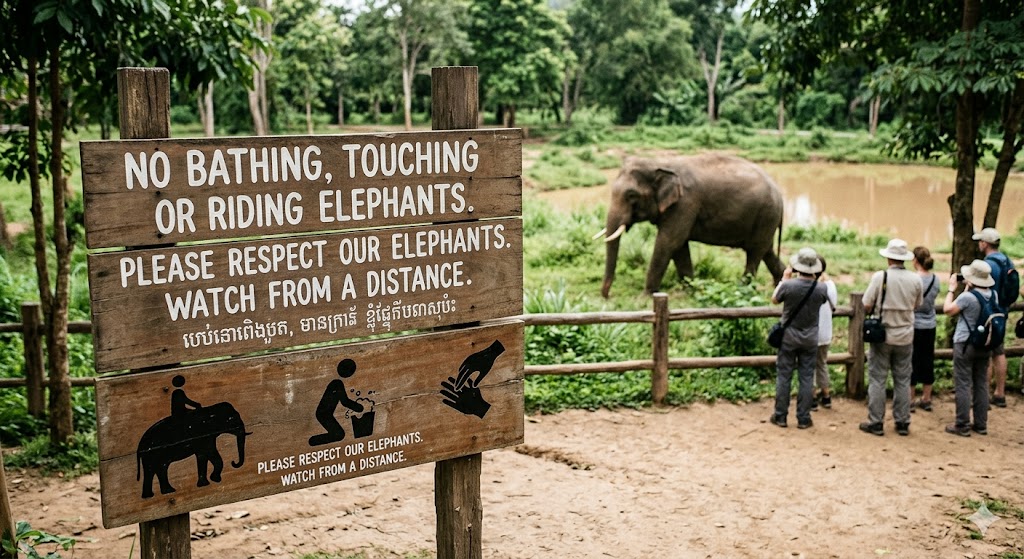

Bengaluru, June 17: The state forest department has released the first-ever Karnataka elephant camp safety etiquette guidelines applicable to elephant camps, captive elephant taming centres and public elephant viewing facilities in the state.
According to the newly formulated rules, tourists will have to stand at least 30 feet away from elephants to view elephants at elephant camps. Tourists will no longer be allowed to bathe, touch or feed elephants. They will have to stand in the designated green zone - the viewing gallery - to view elephants. All activities of elephants and visitors will be monitored and recorded through CCTVs. Not more than 10 elephants will be allowed for public viewing at a single elephant camp.
Taking the matter seriously after a woman tourist from Tamil Nadu died after being mauled by elephants at Dubare elephant camp on May 19, the state government has imposed a temporary ban on elephant camps. Environmentalists have also urged the government to allow tourists to view elephants only after formulating safety protocols. Following this, the forest department has now issued a standard operating procedure for tourist entry and viewing at elephant camps. Responding to this, Principal Chief Conservator of Forests (Wildlife) Kumar Pushkar said, “The circular of these new rules was signed on June 11. The elephant camps in various districts of the state have been given 15 days to comply with them. Then senior officials will inspect and certify the camps. Tourist viewing will be allowed later. He said that viewing will not be allowed until permission is obtained from senior officials of the state. He said that the number of elephants, number of viewers and the time allowed for visitors to view the elephants will also be decided based on the capacity of the space available for tourists in the elephant camp. Pushkar said that not more than 50-75 visitors will be allowed at one point in the green zone. Except for the 10-minute briefing time and 10-minute buffer time, the viewing time should be restricted to 20-30 minutes. Of the total 10 elephant camps in the state, Dubare, Harangi, Tourists are allowed in Mattigodu, Sakrebail and Pansoli in Dandeli. The forest department has kept 114 elephants in 10 camps in the state, he said, adding that no other state in the country has seen such a large number of elephants.
It has been stated that aggressive, injured, sick, tired, stressed, newly captured, recently fought with other elephants or mothers who have given birth (up to about six months) should not be allowed to view the public. The rules state that elephants should not be allowed to push or jostle each other during public viewing or handling, and that sufficient space should be provided from one elephant to another. All elephant camps should have three zones.
KApu Zone: Elephant operation area, where elephants are bathed, fed, treated, and veterinary care is provided. Only mahouts, veterinarians and staff can enter this area. This area should be barricaded.
Yellow Zone: This is for personnel movement and emergency The path is controlled for works.
Green Zone: This is a viewing area for visitors with guides to view the elephants. Visitors are not allowed to touch, feed or bathe the elephants. Tourists are prohibited from crossing the barricades.
Elephant camps are monitored by Sub-Zonal Forest Officers and non-compliance with the above rules may lead to closure of the camp. Visitors and time slots will be allocated and displayed based on the footpath and camp capacity. An online booking and spot-entry ticketing system will be introduced for this. Children, senior citizens, differently-abled and pregnant women should visit under the supervision of family members. Records of elephant behaviour and daily routines should be maintained, the guidelines said. Once this system is in place, the state elephant camps will be opened for public viewing one by one.
Disclaimer: This article has been translated by xklsv.com using advanced AI-based translation tools. Please note that the use of AI for translation is still experimental and may not be 100% accurate. The original content is sourced from shakthidaily.info, and Shakthi Daily is not responsible or liable for any errors, omissions, or inaccuracies that may appear in the translated version, including spelling, grammar, or contextual misunderstandings.
If you come across any mistakes or inconsistencies in this translation, we kindly request you to report them by sending an email to [email protected]
Your feedback will help us improve the quality.
The image in this article has been generated using artificial intelligence and is intended for illustrative purposes only. It may not reflect real-world accuracy.

**Book Reading Celebration: A Unique and Meaningful Experience** ...
Read More
.png)
Kamagra Jelly Australia: Uses, Dosage, Side Effects & Benefits Explained...
Read More.jfif)
**Harangi Reservoir Water Storage Reaches 5.4 TMC** ...
Read More